Video lesson: Four big rules for Chinese grammar (语法 yǔfǎ)
视频课:汉语语法四大规则
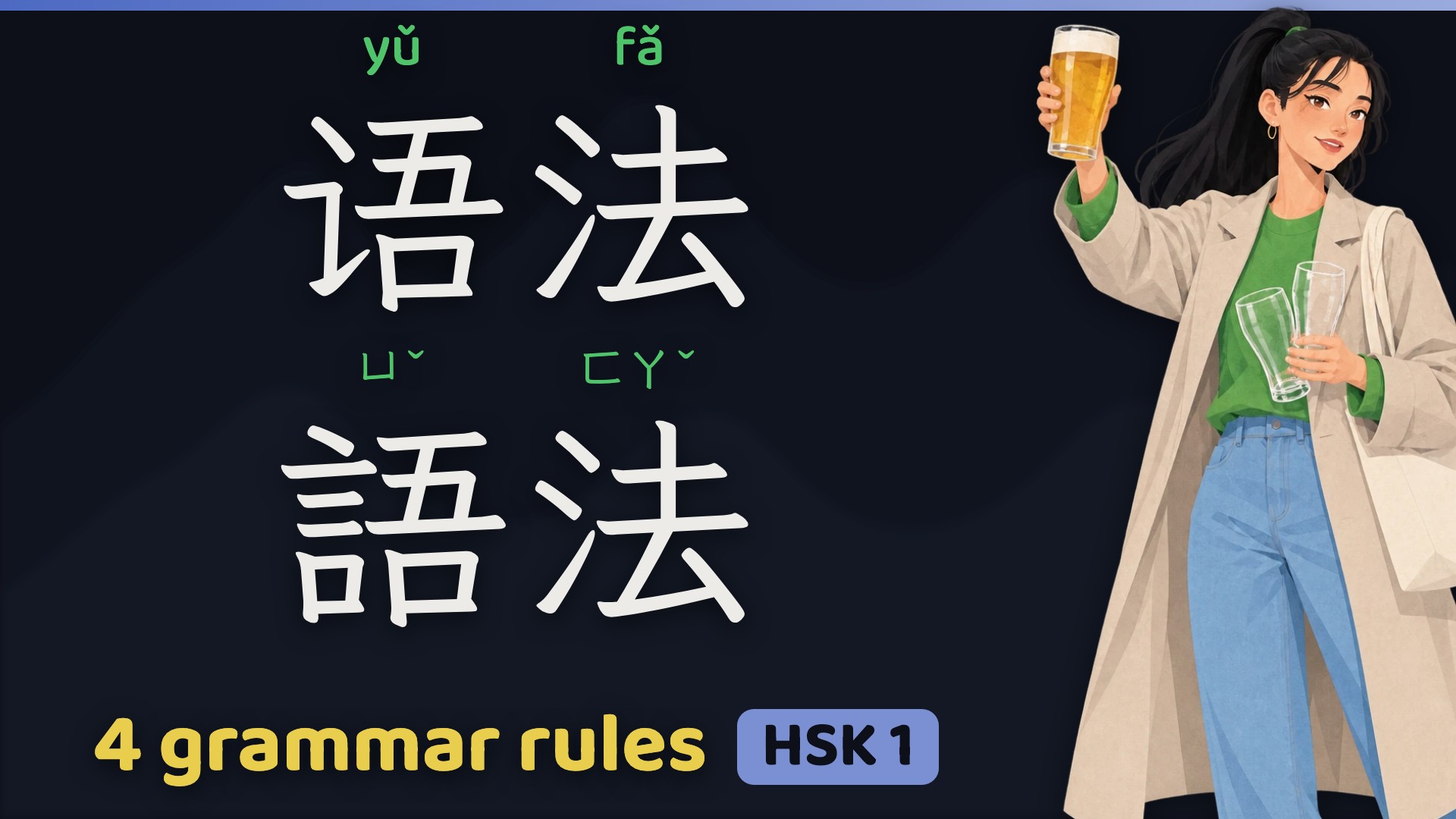
Four patterns that are true for a great many sentences in Mandarin Chinese, each with example sentences built up a word at a time: modifiers usually go before what they modify, verbs and adjectives keep the same form, the topic can go first, and Chinese verbs have no tense endings.
The grammar guide: Chinese grammar rules: 5 general rules for Chinese grammar
Chapters
- 0:00 语法 (yǔfǎ)
- 1:25 Rule 1 · modifiers usually go first
- 5:23 Rule 2 · verbs and adjectives keep the same form
- 10:50 Rule 3 · the topic can go first
- 14:18 Rule 4 · Chinese verbs have no tense endings
- 17:16 Recap
Example sentences
卧虎藏龙
Vocabulary list 词单
- Vocabulary list: Video lesson: Four big rules for Chinese grammar (语法 yǔfǎ) 语法:的、了、地 59 words and 18 example sentences
Transcript
-
0:05
Hello again! Today's lesson is a bit different. Instead of one word, we're looking at four big rules that are true for lots of Chinese sentences. And to start us off, here's the Chinese word for grammar.
-
0:19
语法。 Once you understand these four rules, it opens up a lot more sentences.
-
0:24
And if you're just starting out, don't worry about following every sentence in detail. Today is a flavour of some big patterns in Chinese grammar, so you'll start to notice them everywhere. Now, let's look at the two characters while they're being written. The first means language. The second means a method, or a rule. Put them together, and you get the rules of a language: grammar.
-
0:49
And you can see the first character looks different in traditional Chinese. On the left is the speech radical. Traditional Chinese writes it in full, and simplified Chinese shortens it to just two strokes.
-
1:01
So nine strokes in simplified, and fourteen in traditional. And the second character is the same in both.
-
1:09
That's right. It has the water radical on the left, and on the right, the verb for 'go'. That's a nice way to remember its shape, though it doesn't explain the meaning. We'll meet that verb again in rule two.
-
1:21
Okay, let's get going. What's rule one?
-
1:26
Rule one: modifiers usually go first. A modifier adds detail. It tells you what something is like, or how someone does something. And in Chinese, it usually comes before the word it describes. Here's the first one, about a friend who's careful with money. 他不喜欢贵的东西。
-
1:48
'He doesn't like expensive things.' Very sensible. Let's take it word by word. You say each word, and I'll give you the English.
-
1:58
他。
-
1:59
He.
-
2:00
不。
-
2:01
Not.
-
2:02
喜欢。
-
2:04
Like.
-
2:05
贵。
-
2:06
Expensive.
-
2:08
“的”。
-
2:08
A little linking word.
-
2:11
东西。
-
2:12
Things.
-
2:13
All together once more. 他不喜欢贵的东西。
-
2:17
So 'expensive' comes before 'things', the same order as in English. Now let's try one where English does it the other way round.
-
2:27
Sure. This next one starts plain. 我哥哥在开车。
-
2:33
'My older brother is driving.' Just him, behind the wheel.
-
2:38
Now let's say how he's driving. 我哥哥在慢慢地开车。
-
2:45
'My older brother is driving slowly.' Probably because he's borrowed my car. Let's go word by word, then.
-
2:55
我。
-
2:56
My.
-
2:57
哥哥。
-
2:58
Older brother.
-
3:00
在。
-
3:00
It's happening right now.
-
3:02
慢慢。
-
3:04
Slowly.
-
3:05
“地”。
-
3:06
Another linking word.
-
3:08
开车。
-
3:10
Drive.
-
3:11
And the whole sentence once more. 我哥哥在慢慢地开车。
-
3:16
So in English, 'slowly' comes after 'driving'. In Chinese, it comes first, right in front of the verb. And I noticed those little linking words.
-
3:27
Yes, two of them. Listen. 贵的。慢慢地。 They sound the same, but they're written differently. In these two sentences, the first links a description to a noun, and the second links one to a verb.
-
3:40
Same sound, different characters. Sneaky. And I think there are some patterns that put a description after the verb, too?
-
3:48
There are, but they're for another lesson. This next one is about a friend who enjoys a night out. Plain, it's: 她能喝啤酒。
-
3:59
'She can drink beer.'
-
4:01
And now say how much. 她能喝很多啤酒。
-
4:07
'She can drink a lot of beer.' Impressive. Shall we go word by word?
-
4:14
她。
-
4:15
She.
-
4:16
能。
-
4:17
Can.
-
4:18
喝。
-
4:19
Drink.
-
4:21
很多。
-
4:22
A lot of.
-
4:23
啤酒。
-
4:25
Beer.
-
4:26
And all together. 她能喝很多啤酒。
-
4:30
So again, 'a lot of' comes before the beer. Before we move on, I hear there's a film connection.
-
4:36
There is! The Chinese title of Crouching Tiger, Hidden Dragon is: 卧虎藏龙。
-
4:46
'Crouching Tiger, Hidden Dragon.' I love that film, especially the fight in the bamboo forest. Let's take it character by character.
-
4:58
卧。
-
4:59
Crouching.
-
5:00
虎。
-
5:01
Tiger.
-
5:03
藏。
-
5:04
Hidden.
-
5:05
龙。
-
5:06
Dragon.
-
5:07
Once more. 卧虎藏龙。
-
5:10
So 'crouching' comes before 'tiger', and 'hidden' before 'dragon'. Modifiers first, including in film titles. Right, on to rule two.
-
5:22
Rule two: verbs and adjectives keep the same form. Let's start with verbs, with a sentence about me, going to work. 我去上班。
-
5:36
'I go to work.' Now word by word, please.
-
5:41
我。
-
5:42
I.
-
5:43
去。
-
5:44
Go.
-
5:45
上班。
-
5:46
To work, as in going to your job.
-
5:49
Now for him. 他去上班。
-
5:55
'He goes to work.' In English, 'go' changed to 'goes'. Did anything change in Chinese?
-
6:01
Only the first word, from 'I' to 'he'. The verb is exactly the same. Listen to both. 我去上班。他去上班。
-
6:12
'I go to work.' 'He goes to work.' The same verb both times. English adds an ending, and Chinese doesn't.
-
6:22
And for a group of people. 他们去上班。
-
6:27
'They go to work.' And the verb still hasn't changed!
-
6:30
Still the same. Now listen to the first word. 他,他们。我,我们。
-
6:39
So 'he' becomes 'they', and 'I' becomes 'we'. That extra character on the end makes it a group of people. But the verb after it doesn't change at all.
-
6:51
Let's hear all three once more. 我去上班。他去上班。他们去上班。
-
6:59
'I go', 'he goes', 'they go'. English changes, Chinese doesn't. If you've ever had to memorise French verb tables, that's very good news.
-
7:10
Adjectives keep the same form too. Let's start with a car. 这是一辆车。
-
7:16
'This is a car.'
-
7:18
Now add the colour. 这是一辆红色的车。
-
7:24
'This is a red car.' Very nice. Let's go word by word.
-
7:31
这。
-
7:31
This.
-
7:33
是。
-
7:34
Is.
-
7:35
一。
-
7:36
One.
-
7:37
辆。
-
7:37
The measure word for vehicles.
-
7:40
红色。
-
7:41
Red.
-
7:42
“的”。
-
7:43
The linking word.
-
7:45
车。
-
7:46
Car.
-
7:47
All together. 这是一辆红色的车。
-
7:50
Chinese puts a measure word between a number and a noun. And there's rule one again: 'red' comes before 'car'. Now let's try a different colour, on a different thing.
-
8:01
This next one is a shirt. 这是一件蓝色的衬衫。
-
8:09
'This is a blue shirt.' Shall we go word by word?
-
8:15
这。
-
8:16
This.
-
8:17
是。
-
8:18
Is.
-
8:20
一。
-
8:20
One.
-
8:21
件。
-
8:22
The measure word for clothes.
-
8:25
蓝色。
-
8:26
Blue.
-
8:27
“的”。
-
8:28
The linking word.
-
8:30
衬衫。
-
8:31
Shirt.
-
8:32
Once more. 这是一件蓝色的衬衫。
-
8:36
The same pattern as the car: the colour, the linking word, then the thing. And now for my favourite: cats.
-
8:44
This next one is one cat. 这是一只橘色的猫。
-
8:53
'This is an orange cat.' Orange cats are famous online for sharing one brain cell between them.
-
9:03
And in China, people say this about them. 十只橘猫九只胖。
-
9:11
'Out of ten orange cats, nine are fat.' That seems fair. Shall we do the cat one word by word?
-
9:20
这。
-
9:21
This.
-
9:22
是。
-
9:23
Is.
-
9:25
一。
-
9:25
One.
-
9:26
“只”。
-
9:27
The measure word for animals.
-
9:30
橘色。
-
9:31
Orange.
-
9:32
“的”。
-
9:33
The linking word.
-
9:35
猫。
-
9:35
Cat. It even sounds a bit like one.
-
9:39
All together. 这是一只橘色的猫。
-
9:42
Now, what if there's more than one cat?
-
9:46
Good question. This next one has a few. 我看到了一些橘色的猫。
-
9:56
'I saw some orange cats.' Let's go word by word, then.
-
10:01
我。
-
10:03
I.
-
10:04
看到了。
-
10:05
Saw. The little word on the end shows it completed.
-
10:10
一些。
-
10:11
Some.
-
10:13
橘色。
-
10:14
Orange.
-
10:15
“的”。
-
10:16
The linking word.
-
10:18
猫。
-
10:19
Cats.
-
10:20
Once more. 我看到了一些橘色的猫。
-
10:24
More than one cat, but 'orange' stays the same, and so does the word for cat. In French, 'blue' would have four written forms, depending on whether the thing is masculine or feminine, and whether there's one or more. And in Chinese?
-
10:42
Just one form, every time. For the car, the shirt, and all those cats.
-
10:48
What's rule three?
-
10:51
Rule three: the topic can go first. The topic is the thing you want to talk about. You start with it, and then say something about it. Here's a sentence that starts with 'I'. 我不太喜欢红酒。
-
11:05
'I don't really like red wine.'
-
11:08
Now imagine we're comparing drinks. We can move the wine to the front. 红酒,我不太喜欢。
-
11:17
'Red wine, I don't really like.' We say that in English too, when we're comparing drinks. White wine's fine, but red wine, I don't really like.
-
11:26
In Chinese, it's very common.
-
11:28
Let's take it word by word.
-
11:32
红酒。
-
11:34
Red wine.
-
11:35
我。
-
11:36
I.
-
11:37
不太。
-
11:38
Not really.
-
11:40
喜欢。
-
11:41
Like.
-
11:42
All together. 红酒,我不太喜欢。
-
11:46
So red wine is the topic, and the rest says what I think of it. Yoda would feel right at home. Can you do the same with places?
-
11:55
You can. This next one is about a place. 法国,我没去过。
-
12:06
'France, I haven't been to.' Shall we go word by word?
-
12:13
法国。
-
12:14
France.
-
12:15
我。
-
12:16
I.
-
12:17
没。
-
12:18
Haven't.
-
12:19
去过。
-
12:20
Been to.
-
12:22
Once more. 法国,我没去过。
-
12:26
So France is the topic, and the rest is about it. Hang on, though. The first character of France looks like the second character of grammar.
-
12:38
Good spot! It's the same character. Listen. 语法。法国。
-
12:43
Grammar, and France. And they share that character.
-
12:48
In 'grammar', it means a method, or rules, like we saw at the start. But in 'France', it doesn't mean anything at all. It's only there for its sound, because it sounds a bit like the start of 'France'.
-
13:00
So in grammar it's a meaning, and in France it's just a sound. And French grammar has nothing to do with it.
-
13:07
Exactly. Here's another everyday example. There's a pen on the table. You point to it, and ask a friend: 这支笔,你用吗? And your friend says: 不用,你用吧。
-
13:21
'Are you going to use this pen?' 'No, I'm not. You use it.' Very polite. Let's do the question word by word.
-
13:31
这。
-
13:32
This.
-
13:33
支。
-
13:34
The measure word for pens.
-
13:36
笔。
-
13:37
Pen.
-
13:39
你。
-
13:40
You.
-
13:41
用。
-
13:42
Use.
-
13:43
吗。
-
13:44
And that makes it a question.
-
13:46
And the answer.
-
13:49
不。
-
13:50
Not.
-
13:51
用。
-
13:52
Use. So, 'I'm not using it'.
-
13:55
你。
-
13:56
You.
-
13:57
用。
-
13:58
Use.
-
13:59
吧。
-
14:00
And that makes it a friendly suggestion.
-
14:03
That's it. So 'this pen' is the topic, and the question is about it. Grammar books call this pattern topic and comment. First the topic, then what you say about it.
-
14:15
And the last one, rule four?
-
14:17
Rule four builds on rule two. Chinese verbs have no tense endings. A verb looks the same whether you're talking about the past, the present or the future. Time words, or the conversation around a sentence, tell you when. Suppose we're talking about travel plans. 我去北京。
-
14:39
'I'm going to Beijing.' But on its own, it doesn't say when.
-
14:44
So let's add tomorrow. 我明天去北京。
-
14:49
'I'm going to Beijing tomorrow.' Shall we go word by word?
-
14:55
我。
-
14:56
I.
-
14:57
明天。
-
14:59
Tomorrow.
-
15:00
去。
-
15:00
Go.
-
15:01
北京。
-
15:03
Beijing.
-
15:04
All together. 我明天去北京。
-
15:07
The word for tomorrow says when, and the verb stays the same. That's rule two again. And what if the trip was yesterday?
-
15:17
Then it's this. 我昨天去了北京。
-
15:23
'I went to Beijing yesterday.' In English, 'go' changed to 'went'. Let's go word by word.
-
15:32
我。
-
15:33
I.
-
15:34
昨天。
-
15:35
Yesterday.
-
15:36
去。
-
15:37
Go, the same as before.
-
15:39
“了”。
-
15:40
And this one's new.
-
15:41
北京。
-
15:43
Beijing.
-
15:44
Once more. 我昨天去了北京。
-
15:47
So is that new little word the past tense?
-
15:51
No, it isn't. That's a very common mix-up. In this sentence, it marks the trip as completed in the time we're talking about. The word for yesterday is what tells you when.
-
16:02
So it isn't a past-tense ending. Can it turn up with the future, then?
-
16:09
It can. This next one is about tomorrow. It's longer, so just listen for tomorrow, and for that same little word after the verb. 我明天下了课就去找你。
-
16:22
'Tomorrow, once my class is over, I'll come and find you.' Let's go word by word, then.
-
16:30
我。
-
16:31
I.
-
16:32
明天。
-
16:33
Tomorrow.
-
16:35
下。
-
16:36
Finish.
-
16:37
“了”。
-
16:38
Done.
-
16:39
课。
-
16:40
Class.
-
16:41
就。
-
16:42
Then.
-
16:43
去。
-
16:44
Go.
-
16:45
找。
-
16:46
Find.
-
16:47
你。
-
16:48
You.
-
16:49
All together. 我明天下了课就去找你。
-
16:53
So the class will have finished before the visit, even though it's all tomorrow. You don't need to remember all of that one yet. The point is that the little word can turn up with tomorrow, too. The verbs stay the same, whether you're talking about the past, the present or the future.
-
17:09
And one last thought. Once you know a pattern, you can use it with other words to make new sentences.
-
17:15
Let's go through our four rules once more. One: modifiers usually go first.
-
17:23
Two: verbs and adjectives keep the same form.
-
17:26
Three: the topic can go first.
-
17:29
And four: Chinese verbs have no tense endings. 明白了吗?
-
17:35
'Got it?' I think so! If you'd like to save these sentences and practise them later, you can make a free account at Chinese Boost dot com.
-
17:45
那我们下次见!
-
17:46
Bye for now!
Sign up for a free Chinese Boost account
Save the words and sentences you find here to your own list, and hear them read aloud. You can export the list to your flashcards whenever you like.
Other articles about 的
- The 是…的 (shì…de) construction vs 了 (le) in Chinese grammar A1
- The 是…的 (shì…de) construction in Chinese grammar A1
- 的 (de) after adjectives: when to use it, when to drop it A1