Video lesson: 得 for how well, and for can or can't (de) in Mandarin Chinese grammar, part 3 of 3
视频课:“的”“地”“得”(三)
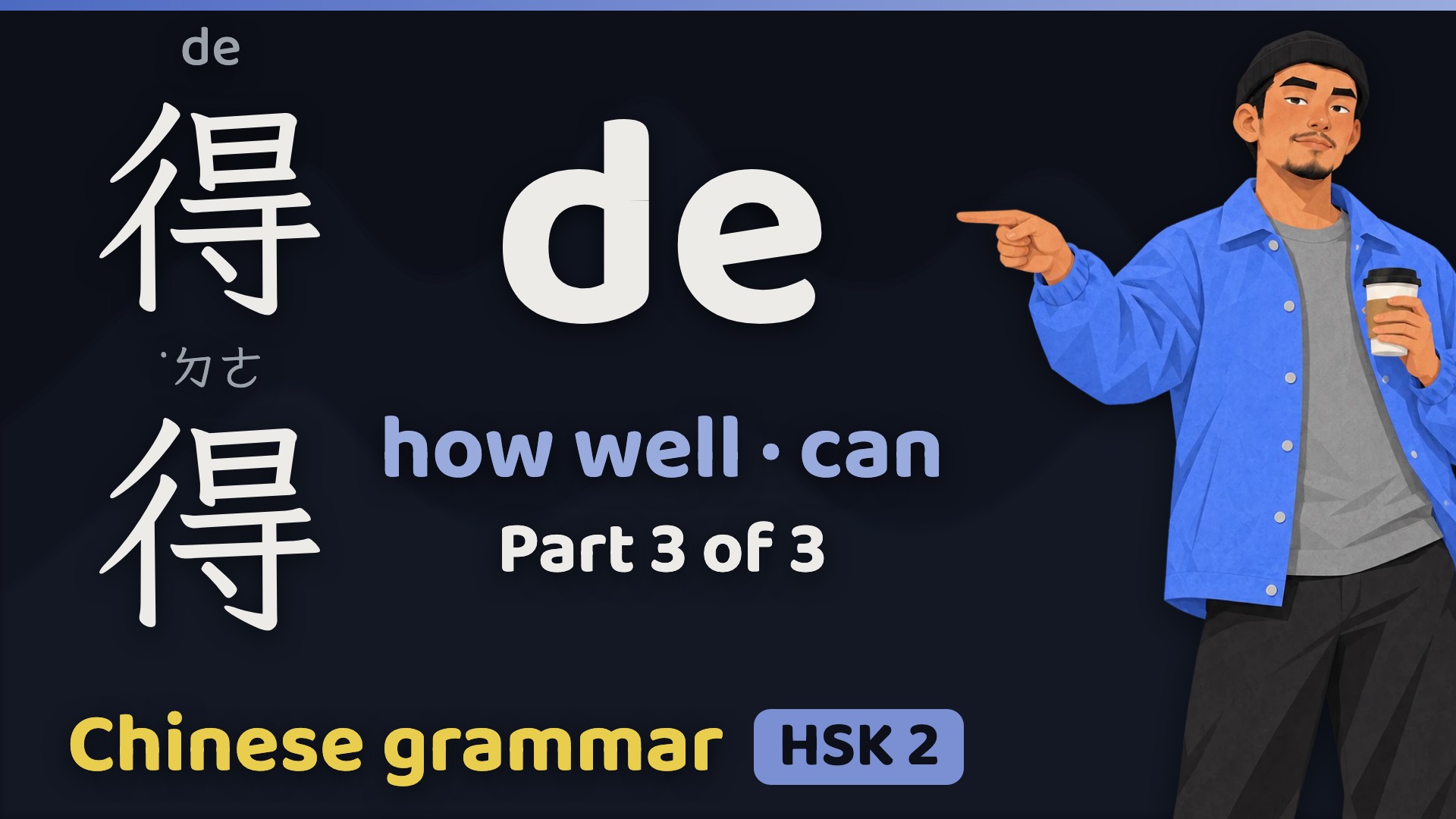
的, 地 and 得 are all said de in Mandarin Chinese, and each does a different job. This third part is about 得 with example sentences built up a word at a time: after a verb for how well something is done, and between a verb and its result for whether it can be done.
The grammar guide: Chinese grammar de particles summary: 的, 地 and 得
Chapters
- 0:00 得 (de)
- 1:04 Job 4 · 得 for how well
- 4:07 Job 5 · 得 for can or can't
- 7:47 Recap
- 8:16 Job 5 · 得 for can or can't
Example sentences
Vocabulary list 词单
- Vocabulary list: Video lesson: 得 for how well, and for can or can't (de) in Mandarin Chinese grammar, part 3 of 3 语法:的、得、地 23 words and 6 example sentences
Exercises 练习
- Exercises: Chinese grammar de particles summary: 的, 地 and 得 语法:的、得、地 练习 2 drills over 12 characters, and 1 grammar exercise over 4 items
Transcript
-
0:05
Last time, a describing word went before the verb. Today it goes after the verb, and that needs the last of our three characters.
-
0:14
That's right. Here are all three again. “的”。“地”。“得”。 The first goes before a noun, and the second before a verb. Today's comes after a verb.
-
0:23
That's the one named after a part called double person. How do we write it?
-
0:27
It has eleven strokes, and it's written the same way in simplified and traditional Chinese. On the left is the part called double person, which is also its radical. So people call it this. 双人“得”。
-
0:39
So that's why it's called double person. Does its sound change with its meaning, like the second character's?
-
0:46
It does. We'll save those other sounds for another day. Today it sounds just like the other two, and it comes straight after a verb to tell you more about the action. Grammar books call that a complement.
-
0:57
We've covered three jobs so far. This character has two more. What's job four?
-
1:05
Job four: how well something is done, or how it went. Here's the first sentence, about a friend's speech at a wedding. 你说得非常好。
-
1:18
'You spoke really well.' What everyone making a speech wants to hear afterwards. Let's go word by word.
-
1:27
你。
-
1:27
You.
-
1:28
说。
-
1:29
Speak.
-
1:30
“得”。
-
1:31
This joins speaking to how it went.
-
1:33
非常。
-
1:35
Really.
-
1:35
好。
-
1:36
Good.
-
1:37
All together. 你说得非常好。
-
1:40
So we start with speak, add the linking word, then say how well. Grammar books call this a degree complement.
-
1:48
That's right. This next sentence is about a friend at an athletics event. Before we say how fast, he's just running. 他跑。
-
1:59
'He runs.' No sign yet of how fast.
-
2:02
Now let's say how. 他跑得很快。
-
2:07
'He runs really fast.' And he's off! Let's go word by word.
-
2:13
他。
-
2:14
He.
-
2:15
跑。
-
2:16
Run.
-
2:17
“得”。
-
2:18
This links run to how fast.
-
2:20
很。
-
2:21
Very.
-
2:22
快。
-
2:22
Fast.
-
2:23
Once more. 他跑得很快。
-
2:26
'He runs really fast.' Hang on. We used 土也“地” for how an action is done. How is 双人“得” different?
-
2:37
双人“得” is more common than 土也“地”. It also has a wider range of uses.
-
2:43
土也“地” marks an adverbial before the verb. It only describes the manner, or how you perform the action.
-
2:50
双人“得” introduces a complement after the verb. That can describe how you perform the action, or how well.
-
2:57
So 双人“得” lets us comment on the action. We might describe its speed, or judge how well someone does it.
-
3:05
Listen to both. 他很快地吃饭。他吃得很快。
-
3:11
'He's eating quickly', and 'he eats fast'. Both describe fast eating.
-
3:17
The first presents quickly as the manner of eating. The second comments on how fast he eats.
-
3:23
双人“得” can also link an action to its result. In job five, we'll see how it says whether that result is possible.
-
3:32
That's right.
-
3:33
Now, quiz time! Which of these is correct for 'He runs really fast'? Have a think.
-
3:52
It's this sentence. 他跑得很快。 Our word comes straight after the verb, then how fast.
-
4:00
The other answer puts it before the verb, where it doesn't go. Right, what's job five?
-
4:08
Job five: can or can't. Put it between a verb and its result, and it says the result can happen. Grammar books call that a potential complement.
-
4:17
Wait, I thought a potential compliment was when someone might say I look nice today!
-
4:24
That's compliment with an I. This is complement with an E, the part that completes the verb. The most useful sentence is about understanding. 我听得懂。
-
4:39
'I can understand.' Here, that means I can understand what I hear. Listening is the action, and understanding is the result. Let's go word by word.
-
4:52
我。
-
4:53
I.
-
4:54
听。
-
4:55
Listen.
-
4:55
“得”。
-
4:56
This one marks potential or result. Here, it says the result can happen.
-
5:02
懂。
-
5:03
Understand.
-
5:04
Once more. 我听得懂。
-
5:07
And if I don't understand?
-
5:10
Then swap it for the word for not. 我听不懂。
-
5:16
'I don't understand.' Swapping the middle word turns can into can't, so it has the sense of 'I can't understand'. Let's go word by word.
-
5:29
我。
-
5:30
I.
-
5:31
听。
-
5:31
Listen.
-
5:32
不。
-
5:33
Not, so it's can't.
-
5:36
懂。
-
5:36
Understand.
-
5:37
Once more. 我听不懂。 Change the verb to do, and you can say whether you'll manage something. 我做不到。我做得到。
-
5:49
'I can't do it', and 'I can do it'. Here, the result is managing it.
-
5:54
Here's a meme for fun, but you don't need to memorise it. It comes from Empresses in the Palace, a palace drama that's hugely popular in China, and this line is a very well-known meme. The empress is given an order she can't carry out, and she cries: 臣妾做不到啊!
-
6:15
'Your humble servant just can't do it!' People in China post this line whenever they're asked to do too much. Let's go word by word.
-
6:27
臣妾。
-
6:28
Your humble servant. Literally, it means your concubine, so it's how she speaks of herself to the emperor.
-
6:36
做。
-
6:37
Do.
-
6:38
不。
-
6:39
Not, so it's can't.
-
6:41
到。
-
6:42
Manage. So, can't manage it.
-
6:45
啊。
-
6:46
This adds emotion to her cry.
-
6:49
Once more. 臣妾做不到啊!
-
6:53
Probably best to leave your humble servant out of the work email.
-
6:57
Agreed.
-
6:58
Time for one more quiz. Which of these means 'I don't understand'? Have a think.
-
7:16
It's this sentence. 我听不懂。 The word for not in the middle makes it can't.
-
7:22
And the other sentence means I can understand. Now let's hear a phrase with each of the three characters.
-
7:29
All three together. 我的书。慢慢地说。说得很好。
-
7:36
My book, say it slowly, and spoke very well. The first goes before a noun, the second before a verb, and the third after one.
-
7:46
Let's go through all five jobs once more. One: 白勺“的” marks the possessive.
-
7:53
Two: it links an adjective to a noun.
-
7:56
Three: 土也“地” links an adverb to a verb.
-
8:00
Four: 双人“得”, after a verb, says how well.
-
8:03
And five: between a verb and its result, it says can. Swap it for the word for not, and you get can't.
-
8:11
That's all three. And do we have time for one more meme?
-
8:16
Let's finish with a film. No need to have seen it. In Rush Hour, a detective shouts at his new partner, played by Jackie Chan. In Chinese, you could say: 你听得懂从我嘴里出来的话吗?
-
8:32
'Do you understand the words that are coming out of my mouth?' The joke is that his partner understands every word. It's a long sentence, so let's go word by word.
-
8:44
你。
-
8:45
You.
-
8:46
听得懂。
-
8:47
Can understand. That's job five.
-
8:50
从。
-
8:51
From.
-
8:52
我。
-
8:53
My.
-
8:54
嘴里。
-
8:55
Mouth.
-
8:56
出来。
-
8:57
Coming out.
-
8:58
“的”。
-
8:59
This links the description to the noun, words. That's job two again.
-
9:04
话。
-
9:04
Words.
-
9:05
吗。
-
9:06
And that makes it a question.
-
9:09
All together. 你听得懂从我嘴里出来的话吗?
-
9:12
No need to remember the whole line. Keep the part that means can understand. You can practise these sentences at Chinese Boost dot com, and replay the recordings as often as you like.
-
9:27
下次见!
-
9:29
'See you next time!' Take care!
Sign up for a free Chinese Boost account
Save the words and sentences you find here to your own list, and hear them read aloud. You can export the list to your flashcards whenever you like.
Other articles about 的
- Video lesson: 地 with adverbs (de) in Mandarin Chinese grammar, part 2 of 3 A1
- Video lesson: 的 for the possessive, and with adjectives (de) in Mandarin Chinese grammar, part 1 of 3 A1
- Video lesson: Four big rules for Chinese grammar (语法 yǔfǎ) A1