Video lesson: 的 for the possessive, and with adjectives (de) in Mandarin Chinese grammar, part 1 of 3
视频课:“的”“地”“得”(一)
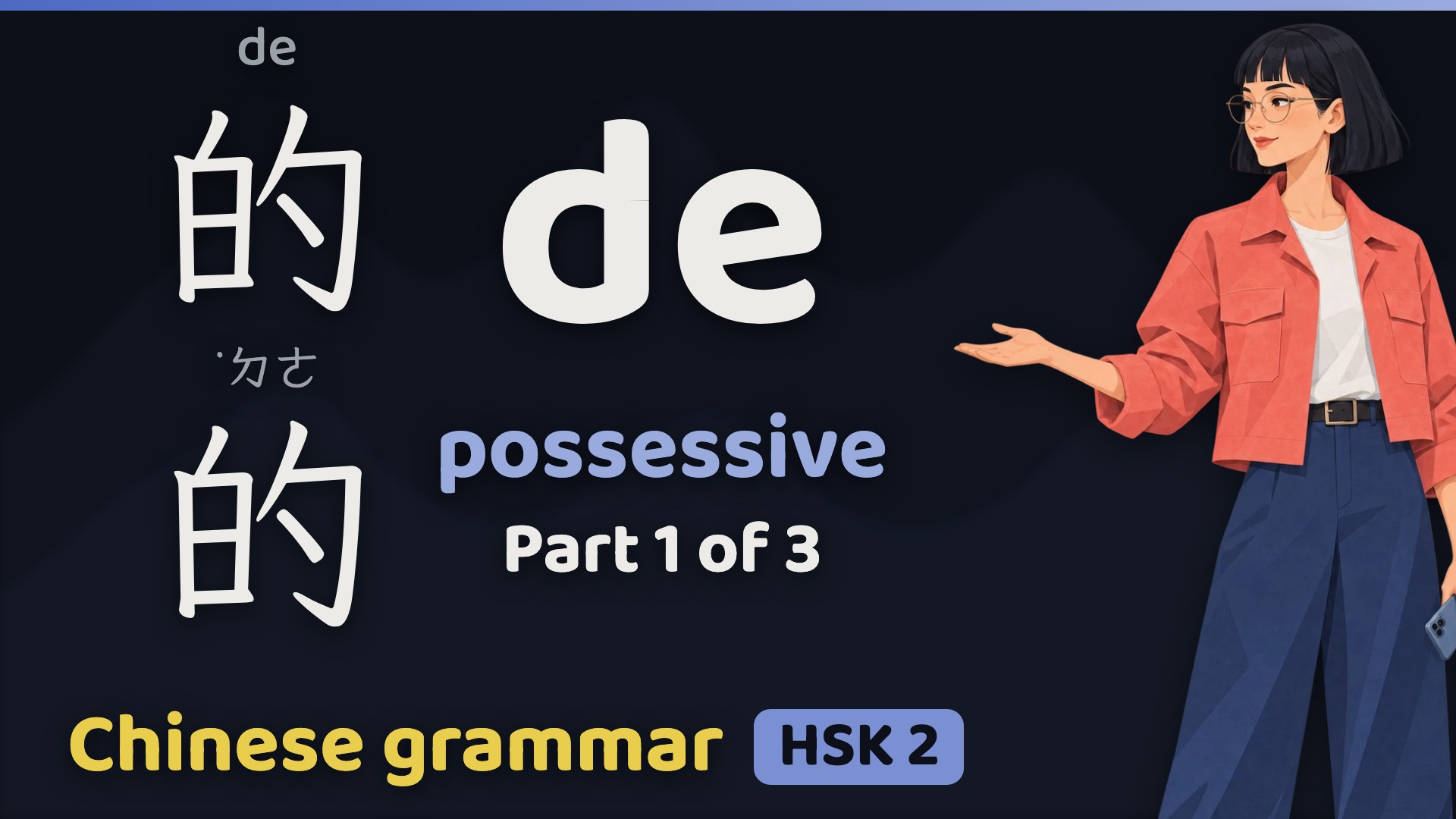
的, 地 and 得 are all said de in Mandarin Chinese, and each does a different job. This first part is about 的, the most common character in written Chinese, with example sentences built up a word at a time: 的 as the possessive, and 的 linking an adjective to its noun.
The grammar guide: Chinese grammar de particles summary: 的, 地 and 得
Chapters
Example sentences
Vocabulary list 词单
- Vocabulary list: Video lesson: 的 for the possessive, and with adjectives (de) in Mandarin Chinese grammar, part 1 of 3 语法:的、得、地 26 words and 6 example sentences
Exercises 练习
- Exercises: Chinese grammar de particles summary: 的, 地 and 得 语法:的、得、地 练习 2 drills over 12 characters
Transcript
-
0:05
Hi there! Let's start with a puzzle. Here are three different Chinese characters, and they all sound exactly the same. Listen.
-
0:13
“的”。“地”。“得”。 Three characters, one sound. And each one has its own job in a sentence.
-
0:20
The first marks the possessive, like my or your. It also links adjectives to nouns. We'll focus on that one today. Parts two and three cover the other two, with adverbs and after verbs.
-
0:35
It's the most common character in written Chinese. It has eight strokes, and it's written the same way in simplified and traditional Chinese. It's usually filed under the radical for white, which is on its left.
-
0:48
So if all three sound the same, how do people say which one they mean?
-
0:53
They describe it by its parts. This one has the character for white on the left, and the character for spoon on the right. So people call it this. 白勺“的”。
-
1:06
So this one's named after its two parts, white and spoon. What about the other two?
-
1:12
The second has the character for earth, and the character for also. 土也“地”。 And the third has a part on the left that looks like two people. 双人“得”。
-
1:23
Earth and also for the second, and double person for the third. A bit like spelling out a word so someone knows which one you mean. Do Chinese speakers ever mix them up?
-
1:33
All the time! It's a lot like there, their and they're in English. Mixing them up is wrong, but plenty of native speakers still do it, especially online. Some classrooms even teach a rhyme for it. Here's how it starts. 左边白,右边勺,名词跟在后面跑。
-
1:53
'White on the left, spoon on the right, and the noun runs along behind.' You don't need to learn that rhyme. The thing to remember is that a noun comes after this one. And if you're just starting out, you don't need to remember every sentence today either. Listen for what this word does. Where do we start?
-
2:13
Job one: the possessive. It works a lot like apostrophe s in English. Here's the first one, about a book. Before we say whose it is, it's just a book. 这是书。
-
2:26
'This is a book.' We haven't said whose it is yet.
-
2:30
Now let's say whose it is. 这是你的书。
-
2:35
'This is your book.' The possessive word goes between the words for you and book. Let's go word by word.
-
2:45
这。
-
2:46
This.
-
2:47
是。
-
2:48
Is.
-
2:49
你。
-
2:50
You.
-
2:50
“的”。
-
2:51
The possessive. With the word for you, it makes your.
-
2:56
书。
-
2:57
Book.
-
2:58
All together once more. 这是你的书。
-
3:01
So you, plus this word, gives your. What about my, or his?
-
3:07
Same pattern. 我的书。你的书。他的书。
-
3:14
'My book, your book, his book.' Each uses the same pattern. Start with the word for I, you or he, then add the possessive.
-
3:26
That's right. This next one you might know from The Lord of the Rings. It's what Gollum says about the Ring. 我的宝贝。
-
3:37
'My precious!' You don't need to know the films. We're only mentioning Gollum as a fun aside. Couples use these words too, like 'my darling'. Hopefully with less worry about who gets the Ring. Let's take it word by word.
-
3:54
我。
-
3:55
I.
-
3:56
“的”。
-
3:56
The possessive, so it's my.
-
3:59
宝贝。
-
4:00
Treasure, or precious.
-
4:02
Once more. 我的宝贝。
-
4:05
What if we already know which thing we're talking about? Can we leave out the noun?
-
4:11
Yes, and then it means mine, or yours. This next one is about a coat, at the end of a party. 这是我的。
-
4:22
'This is mine.' So with no noun after it, it's like mine, yours or his. Let's go word by word.
-
4:32
这。
-
4:33
This.
-
4:34
是。
-
4:35
Is.
-
4:36
我。
-
4:37
I.
-
4:37
“的”。
-
4:38
The possessive. With the word for I and no noun after it, that gives us mine.
-
4:45
Once more. 这是我的。
-
4:48
Is it always there for the possessive?
-
4:50
Not always. With family and close friends, it's often left out. With family, listen to both. 我的妈妈。我妈妈。
-
5:02
Both mean my mom. The shorter one is common when you're talking about family. Now, quiz time! Which of these means 'This is mine'? Have a think.
-
5:26
It's this one. 这是我的。 The other one means this is me.
-
5:30
Handy for photos, less so for getting your coat back. Right, what's job two?
-
5:36
Job two: it links an adjective to a noun. Here's the first one, about dogs. Before we say what kind, it's any dog at all. 我害怕狗。
-
5:51
That one means 'I'm afraid of dogs.' All of them?
-
5:55
Not all of them. Let's say which ones. 我害怕很大的狗。
-
6:01
'I'm afraid of big dogs.' Small ones are fine, then. Let's go word by word.
-
6:08
我。
-
6:09
I.
-
6:10
害怕。
-
6:11
Afraid of.
-
6:12
很。
-
6:13
Very.
-
6:14
大。
-
6:15
Big.
-
6:15
“的”。
-
6:16
This links the adjective to the noun.
-
6:19
狗。
-
6:20
Dogs.
-
6:21
All together. 我害怕很大的狗。
-
6:25
So very big comes first, then the linking word, then dogs. The adjective describes the noun. Do you always need the linking word with an adjective?
-
6:36
Not with a short one on its own. Listen. 大狗。很大的狗。
-
6:42
'Big dog' and 'very big dog'. The Chinese adjective for big has one syllable, and can go straight before the noun. Adding the word for very brings in the linking word too.
-
6:54
That's right. This next one is about a friend who loves animals. 他喜欢可爱的动物。
-
7:04
'He likes cute animals.' That could explain all the cat videos on his phone. Let's go word by word.
-
7:13
他。
-
7:14
He.
-
7:15
喜欢。
-
7:16
Likes.
-
7:17
可爱。
-
7:18
Cute.
-
7:19
“的”。
-
7:20
Linking cute to animals.
-
7:22
动物。
-
7:23
Animals.
-
7:24
Once more. 他喜欢可爱的动物。
-
7:28
The Chinese word for cute has two syllables, so here it takes the linking word. By the way, Japanese writes its word kawaii with these same two characters. Time for one more quiz. Which of these means 'cute animals'? Have a think.
-
7:57
It's this one. 可爱的动物。 The adjective first, then our word, then the noun.
-
8:03
And the other one means the animals' cuteness. Not quite the same thing.
-
8:10
Listen to both jobs together. 你的书。可爱的动物。 Either way, it comes just before the noun.
-
8:17
'Your book' and 'cute animals'. In both, the noun comes after the linking word, just as the rhyme says. Let's go through the two jobs once more. One: the possessive, like your book.
-
8:34
Two: it links an adjective to a noun, like cute animals.
-
8:39
And we often leave it out with family, or with a one-syllable adjective on its own, as in big dog.
-
8:47
In part two, it's the second character, the one that goes with adverbs.
-
8:51
The one with earth and also in its name. Until then, you can save this lesson's sentences and practise them at Chinese Boost dot com.
-
9:01
下回见!
-
9:02
'See you next time!' Bye!
Sign up for a free Chinese Boost account
Save the words and sentences you find here to your own list, and hear them read aloud. You can export the list to your flashcards whenever you like.
Other articles about 的
- Video lesson: Four big rules for Chinese grammar (语法 yǔfǎ) A1
- The 是…的 (shì…de) construction vs 了 (le) in Chinese grammar A1
- The 是…的 (shì…de) construction in Chinese grammar A1