Video lesson: 了 for a completed action, and 了 read liǎo (le) in Mandarin Chinese grammar
视频课:“了”的用法(二)
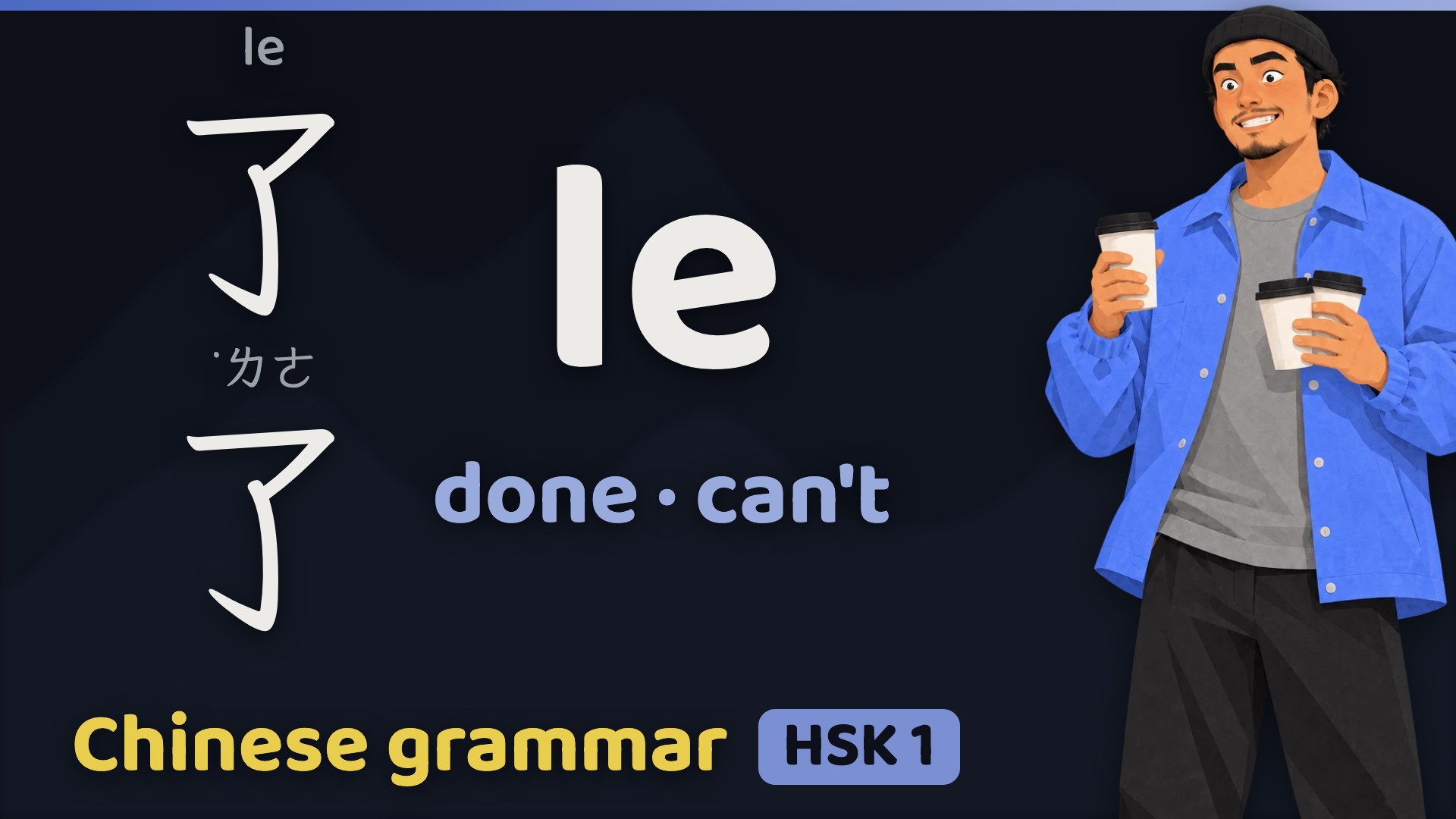
了 (le) is one of the most common words in Mandarin Chinese, and it does several different jobs. This second part goes through the other two with example sentences built up a word at a time: a completed action after a verb, and 得了 and 不了, where it is read liǎo and means can or can't.
The grammar guide: Chinese le grammar summary (了)
Chapters
- 0:00 了 (le)
- 0:37 Job 3 · a completed action, after the verb
- 4:32 Job 4 · can or can't, read liǎo
- 7:56 Recap
Example sentences
Vocabulary list 词单
- Vocabulary list: Video lesson: 了 for a completed action, and 了 read liǎo (le) in Mandarin Chinese grammar 语法:了 25 words and 8 example sentences
Writing drills 写字练习
- Vocabulary list: Video lesson: 了 for a completed action, and 了 read liǎo (le) in Mandarin Chinese grammar 语法:了 6 drills over 31 characters
Grammar exercises 语法练习
- Video lesson: 了 for a completed action, and 了 read liǎo (le) in Mandarin Chinese grammar 语法:了 1 grammar exercise over 12 items
Transcript
-
0:05
Hi, welcome back! This is part two of our lesson on one word you'll hear in nearly every conversation in Chinese. Here it is again.
-
0:13
“了”。 In part one, we saw it in set patterns, like too big, and at the end of a sentence for a change, like he's a teacher now.
-
0:24
Today it's the other two jobs. And there's the character again, with its two strokes. It's written the same way in simplified and traditional Chinese. So, what's job three?
-
0:36
Job three: a completed action. Here, it goes right after the verb, and says the action is done. Here's the first one, about a friend who loves coffee. 我今天喝了三杯咖啡。
-
0:58
'I've had three cups of coffee today.' That explains a lot. Let's go word by word.
-
1:05
我。
-
1:06
I.
-
1:06
今天。
-
1:07
Today.
-
1:09
喝。
-
1:09
Drink.
-
1:10
“了”。
-
1:11
Done.
-
1:12
三。
-
1:12
Three.
-
1:13
杯。
-
1:14
Cups.
-
1:15
咖啡。
-
1:16
Coffee.
-
1:17
All together. 我今天喝了三杯咖啡。
-
1:21
So this time it comes straight after the verb for drink. In job two, it went at the very end.
-
1:27
That's right. Listen to both. 他是老师了。我今天喝了三杯咖啡。
-
1:36
In the teacher sentence, it marks a change. In the coffee sentence, it marks a completed action. So is the one after the verb the past tense?
-
1:46
No, and that's a very common mix-up. It says the action is complete, but not when. It works for the future too. This next one is a plan. 我喝了咖啡就去上班。
-
2:03
'Once I've had my coffee, I'll go to work.' And that hasn't happened yet. Can we take it word by word?
-
2:11
我。
-
2:12
I.
-
2:12
喝。
-
2:13
Drink.
-
2:14
“了”。
-
2:15
Done.
-
2:16
咖啡。
-
2:17
Coffee.
-
2:18
就。
-
2:19
Then.
-
2:20
去。
-
2:20
Go.
-
2:21
上班。
-
2:22
To work.
-
2:24
Once more. 我喝了咖啡就去上班。
-
2:27
So I'll finish my coffee, then go to work. It can turn up in a plan for the future too. What happens if we use it twice, after the verb and at the end?
-
2:37
That happens a lot. Together, they say how much is done so far. This next one is about a very hungry friend. 他已经吃了八碗面条了!
-
2:53
'He's already eaten eight bowls of noodles!' And he might not be finished. Let's go word by word.
-
3:01
他。
-
3:02
He.
-
3:03
已经。
-
3:04
Already.
-
3:05
吃。
-
3:06
Eat.
-
3:07
“了”。
-
3:08
Done.
-
3:08
八。
-
3:09
Eight.
-
3:10
碗。
-
3:11
Bowls.
-
3:12
面条。
-
3:13
Noodles.
-
3:15
“了”。
-
3:15
And so far. That's how things stand now.
-
3:18
All together. 他已经吃了八碗面条了!
-
3:23
The first one marks those eight bowls as eaten. The last one brings us up to now. What if the verb is the last word, though?
-
3:30
Then they join into one. When a friend gets to the restaurant, they'll text you to say they've arrived. 我到了。
-
3:41
'I'm here.' The arrival is complete, and the situation has changed. Let's go word by word.
-
3:49
我。
-
3:49
I.
-
3:50
到。
-
3:51
Arrive.
-
3:52
“了”。
-
3:53
Done, and now.
-
3:54
Once more. 我到了。
-
3:57
So one word does both jobs here. Now, quiz time! Which of these is about something still to come? Have a think.
-
4:17
It's this one. 我喝了咖啡就去上班。 The coffee is done before work, but the whole plan is still to come.
-
4:26
So our word means done, not past. Right, what's job four?
-
4:33
Job four sounds different. It's the same character, but it's said another way. Listen. 我受不了。
-
4:45
'I can't stand it.' That last part sounds different from the word we've heard so far. Shall we go word by word?
-
4:53
我。
-
4:54
I.
-
4:55
受不了。
-
4:57
Can't stand it.
-
5:00
Here, it's said like the start of the word for understand. Listen. 了解。受不了。
-
5:08
Understand, and can't stand it. Funny coincidence, too: this character is in both Chinese words, and 'stand' is in both English ones. That's all it is, though, a coincidence. So it's the same character, but a different sound, and a different job.
-
5:26
That's right. After a verb, it says whether you can do something. This next one is at a big dinner. 这么多菜,你吃得了吗?
-
5:42
'There's so much food. Can you eat it all?' Let's go word by word.
-
5:48
这么。
-
5:49
So.
-
5:50
多。
-
5:51
Much.
-
5:52
菜。
-
5:53
Food.
-
5:54
你。
-
5:55
You.
-
5:56
吃得了。
-
5:58
Can eat it all.
-
5:59
吗。
-
5:59
And that makes it a question.
-
6:01
All together. 这么多菜,你吃得了吗?
-
6:06
I think I know the answer.
-
6:07
And the answer. 我吃不了。
-
6:14
'I can't eat it all.' Very honest. Let's go word by word.
-
6:20
我。
-
6:21
I.
-
6:22
吃不了。
-
6:24
Can't eat it all.
-
6:25
Once more. 我吃不了。
-
6:28
So the word for not makes it can't.
-
6:32
That's right. It's can, or can't, depending on the word in the middle. 吃得了。吃不了。
-
6:42
Can eat it all, and can't eat it all. Can job four team up with the others?
-
6:48
It can team up with job two. Put a change on the end, and you get this. 我受不了了!
-
6:57
'I can't stand it anymore!' Adding that last word tells us something has changed. Let's take it word by word.
-
7:06
我。
-
7:07
I.
-
7:08
受不了。
-
7:10
Can't stand it.
-
7:11
“了”。
-
7:12
Anymore.
-
7:13
Once more. 我受不了了! And listen to both. 我受不了。我受不了了!
-
7:21
'I can't stand it.' 'I can't stand it anymore!' The same character twice, with a different sound each time. Time for one more quiz. Which of these means 'I can't eat it all'?
-
7:47
It's this one. 我吃不了。 The word for not in the middle makes it cannot.
-
7:55
Let's go through the four jobs once more. One: set patterns, like 'too big'.
-
8:03
Two: at the end of a sentence, a change.
-
8:06
Three: after the verb, a completed action.
-
8:10
And four: said differently, can or can't. 明白了吗?
-
8:15
'Got it?' And there it is again, asking whether you understand now. You can save the sentences from this lesson and practise them later at Chinese Boost dot com.
-
8:24
那我们下次见!
-
8:25
'See you next time!' Bye for now!
Sign up for a free Chinese Boost account
Save the words and sentences you find here to your own list, and hear them read aloud. You can export the list to your flashcards whenever you like.
Other articles about 了
- Video lesson: 了 in set patterns, and 了 for a change (le) in Mandarin Chinese grammar A1
- Video lesson: Four big rules for Chinese grammar (语法 yǔfǎ) A1
- The 是…的 (shì…de) construction vs 了 (le) in Chinese grammar A1