Video lesson: Three ways to use 才 (cái) in Mandarin Chinese grammar
视频课:“才”的三种用法
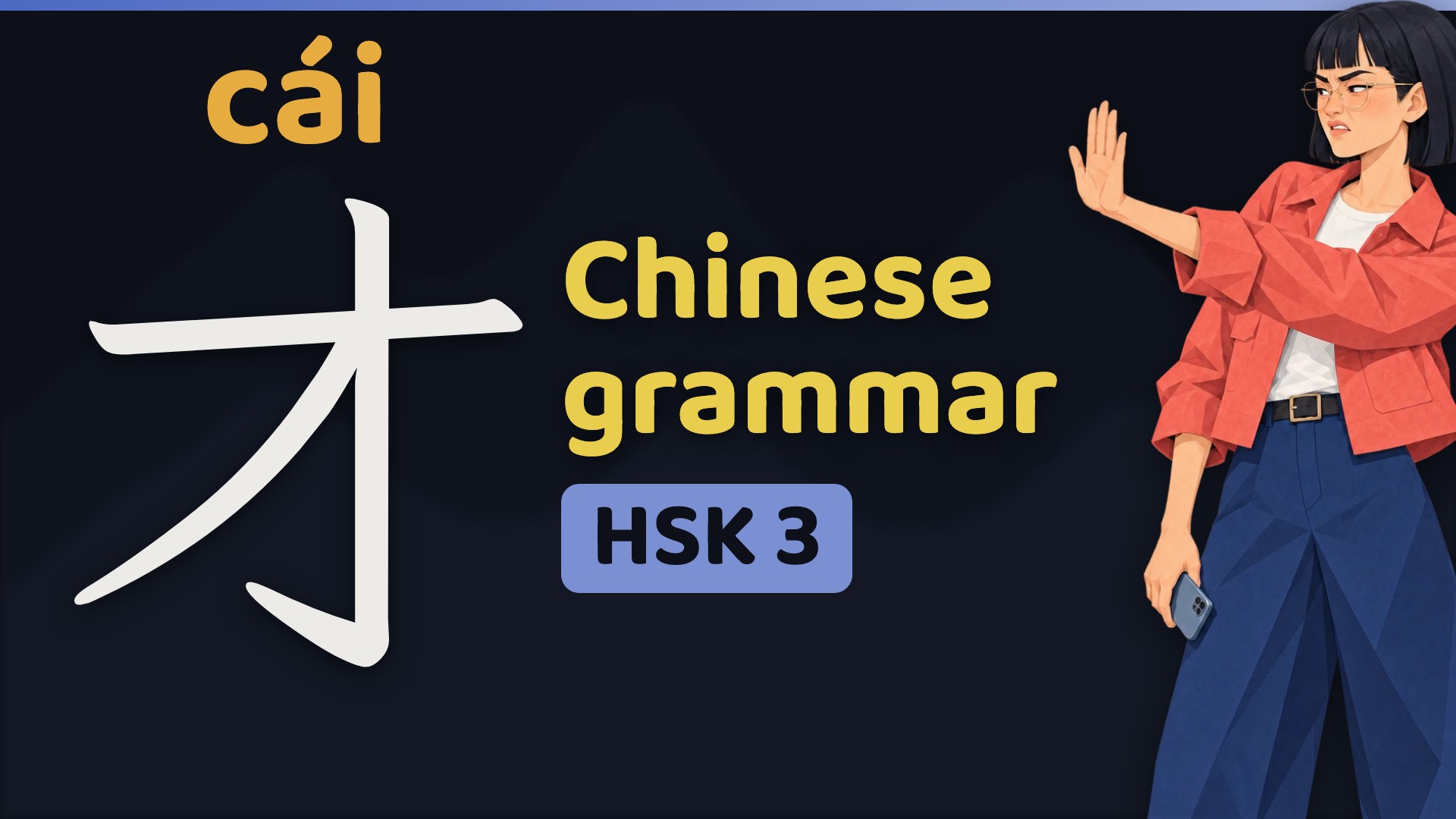
才 (cái) is one of the commonest words in Chinese, and one of the most confusing, because it does three quite different jobs. This lesson goes through each of them with example sentences: 才 meaning "only", 才 meaning "not until" or "just now", and 才…呢 meaning "no way".
The grammar guide: Three uses of 才 (cái) in Chinese grammar: only, just now / not until, emphasis
Chapters
- 0:00 才 (cái)
- 0:51 才 · only
- 2:49 才 · not until
- 4:55 才 · the real thing
- 6:16 才 · just now
- 6:45 才 · no way
- 7:52 Recap
Example sentences
Vocabulary list 词单
- Vocabulary list: Video lesson: Three ways to use 才 (cái) in Mandarin Chinese grammar 语法:才 57 words and 17 example sentences
Transcript
-
0:05
Hey, welcome back! Today we're looking at a tiny word that does a surprising amount of work: 才.
-
0:10
对,才。You'll hear it all the time, and it can be confusing at first, because it does three quite different jobs.
-
0:19
Three jobs for one little word. Before we get into them, have a look at 才 itself. It only has three strokes, so it's quicker to write than most.
-
0:27
And it looks the same in simplified and traditional Chinese, so there's only one form to learn.
-
0:34
It's usually filed under the hand radical, and here's a clue to why. It looks almost exactly like the narrow form of hand. The only difference is the last stroke, which sweeps down to the left instead of flicking up.
-
0:45
That's a nice way to remember it.
-
0:47
Okay, let's take the jobs one at a time. What's the first?
-
0:50
The first one means 'only'. It says an amount is small, smaller than someone expected. One friend asks: 你怎么有那么多? And the other says: 我才有两个!
-
1:07
'How come you've got so many?' 'I've only got two!' One thinks two is a lot, and the other pushes back.
-
1:13
Let's take that answer apart. A plain answer would be: 我有两个。
-
1:20
'I've got two.' Just a fact, nothing more.
-
1:23
But add one word, and you get: 我才有两个!
-
1:29
'I've only got two!' That one word is what pushes back. No, it's only two.
-
1:35
Exactly. And notice where it goes: after the person, and right before the verb. You'll often hear it with a number. Without it: 他来过一次。 With it: 他才来过一次。
-
1:55
'He's been here once' becomes 'He's only been here once.'
-
1:59
It can also go straight in front of a time or a number, with no verb at all. Just the time first: 现在早上七点。
-
2:09
'It's seven in the morning.' Just a time, nothing more.
-
2:13
And with it: 现在才早上七点,太早了。
-
2:21
'It's only seven in the morning, it's too early.' I feel that one at the weekend.
-
2:25
And one more. 我们一共才有两百块钱,完全不够。
-
2:36
'Altogether we've only got two hundred kuai. It's nowhere near enough.' So in all of these, there's a feeling that we've only got so far. There might be more later, but right now, it's only this much.
-
2:46
That's right.
-
2:47
Okay, what's the second job?
-
2:49
The second one means 'not until'. Something happens later than you'd expect. Picture someone waiting for a friend who's late: 我们十点上课,可是她十一点才来。
-
3:04
'Class starts at ten, but she didn't come until eleven.' So she was an hour late. Can we hear that one again?
-
3:09
Sure. 我们十点上课,可是她十一点才来。
-
3:22
And the order is: the time comes first, then 才, then the verb.
-
3:27
Here's another one. Without it, you'd say: 他明天走。
-
3:34
'He's leaving tomorrow.' No feeling either way, just the plan.
-
3:38
Now add it in: 他明天才走。
-
3:43
'He's not leaving until tomorrow.' So now it sounds later than you'd hoped.
-
3:47
This next one you might hear from a friend who's been waiting for you. 你怎么现在才来?
-
3:59
'How come you've only just got here?' I've heard that one a few times.
-
4:04
And this next one is from your parents. As a promise: 你做完作业可以出去。
-
4:10
'You can go out when you've finished your homework.' Sounds fair enough.
-
4:14
And as a condition: 你做完作业才可以出去。
-
4:21
'You can't go out until you've finished your homework.' Classic. No homework, no going out. Same pattern, with a condition in place of the time.
-
4:32
And one important thing: 才和“了”,一般不一起用。
-
4:37
Oh, that's a good tip. So no “了” when it means 'not until'. Here's how I think of it: 才 is kind of the opposite of 'already'. 'Already' means sooner than you thought, and this means later than you thought.
-
4:52
Yes, that's a great way to think about it. Sometimes this use isn't about time at all. It's about something finally being good enough, or being the real thing. Imagine a friend just back from Harbin, who says: 到北方才能吃到真正的饺子!
-
5:10
'You can only get real dumplings in the north!' I think people in the north would agree. Can we hear it again?
-
5:16
Sure. 到北方才能吃到真正的饺子! And another one. 这样做才对。
-
5:34
'That's the right way to do it.' As in, it isn't right until you do it this way.
-
5:38
Do you know the knife scene in Crocodile Dundee? Someone pulls a small knife on him, and he pulls out a huge knife. In Chinese, he'd say: 那不是刀……这才是刀!
-
5:53
'That's not a knife… this is a knife!' I love that.
-
5:57
Without it, it's just a description. 这是刀。
-
6:03
'This is a knife.' Fine, but no drama.
-
6:07
这才是刀!
-
6:11
'Now this is a knife!' So 才 marks the one that really counts.
-
6:16
There's one more shade of this meaning: 'just now'. 我才下班。
-
6:24
'I've only just finished work.' So it happened a moment ago, but there's still that feeling of 'only just'. Later than you'd like.
-
6:31
我才接到他的电话。
-
6:37
'I've only just got his call.' It came a moment ago, and later than you'd like. Okay, and the third job?
-
6:45
The third one is pure emphasis. It sounds strong, and sometimes a bit cheeky. Start with a plain no: 我不要。
-
6:56
'I don't want it.' Polite enough.
-
6:58
Now watch this. 我才不要呢!
-
7:03
'No way do I want that!' So it's the person, then 才, usually a 不, and a 呢 at the end.
-
7:12
Yes, they often go together. 我才不会呢!
-
7:20
'I'd never do that!' Strong, and a bit defensive.
-
7:24
我才不吃这么恶心的东西呢!
-
7:32
'There's no way I'm eating something that disgusting!' Not a chance.
-
7:37
And if someone tells you: 你笨!
-
7:40
'You're stupid!' Charming.
-
7:42
You can fire straight back with: 你才笨呢!
-
7:48
'You're the stupid one!' That's a good one to have ready. So, let's recap. 才 can mean 'only', for a small amount.
-
7:57
It can mean 'not until', when something happens later than you'd expect, and also 'just now'.
-
8:05
It can mark the real thing. And it adds emphasis, usually with 呢 at the end.
-
8:10
记住了吗?
-
8:11
Got it! If you'd like to save the example sentences from this lesson and review them later, sign up for a free account at chineseboost.com.
-
8:19
下次见!
-
8:20
See you next time!
Sign up for a free Chinese Boost account
Save the words and sentences you find here to your own list, and hear them read aloud. You can export the list to your flashcards whenever you like.