Study without daily limits with Pro
literary
Cantonese: wai4, wai6
Classical Chinese 文言
為 wèi has 7 senses in Classical Chinese. 為 in Classical Chinese.
Other words read
literary
Classical Chinese 文言
為 wéi has 13 senses in Classical Chinese. 為 in Classical Chinese.
Other words read
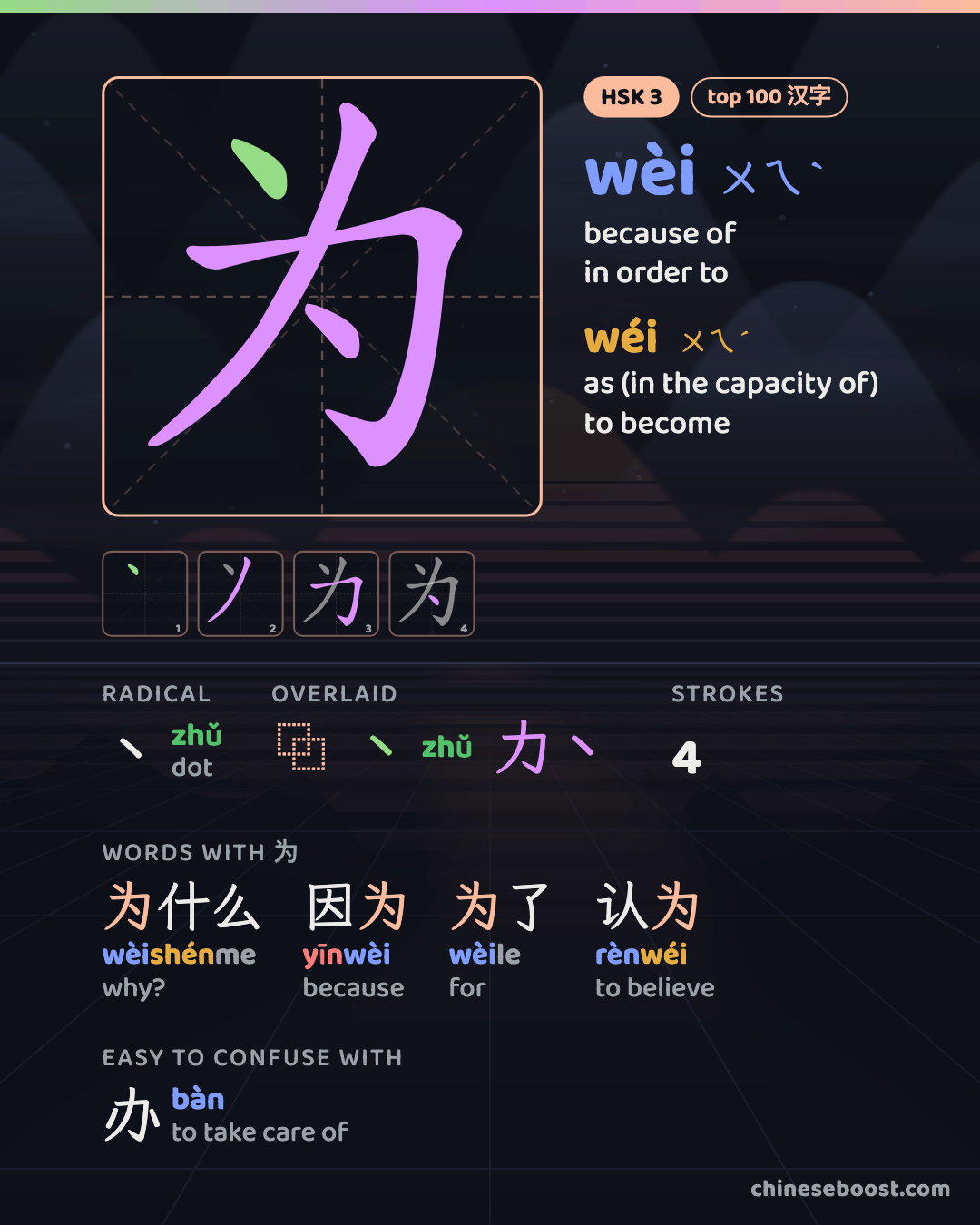
The stroke order and parts of 为
- 部首 radical
- 丶
- 笔画 strokes
- 4, with 3 after the 部首
- 结构 structure
- 镶嵌结构
- 偏旁 parts
- 丶力丶丶dot(placeholder)+力power(placeholder)+丶dot(placeholder)=for
- 仓颉 Cangjie code
- 戈大尸戈 IKSI
- 五笔 Wubi code
- YLYI
Learn to write the Chinese character 为 (wèi)this character
Trace 为, then write it from memory. Each stage is passed five times.
Create a free account to finish learning to write 为. You can also save it to your word list for review (复习).
Print a writing practice sheet for 为
Hanzi writing exercises that include 为: HSK 2 vocabulary, part 1: hanzi writing 5 of 10, HSK 3 vocabulary, part 1: hanzi writing 1 of 11, HSK 4 vocabulary, part 1: hanzi writing 5 of 12 and 16 more.
为 as a component 部件
为 is a direct component of 5 characters in this dictionary.
See all characters containing 为Easy to confuse with 为
-
办
Similar shape
办 (bàn, as in 办事) has a dot on each side of 力. 为 (wéi/wèi, as in 为人) has a different top, with the dot and hook inside. 办 means to handle; 为 means to act as or for.
Potential verbal descriptions
Words with 为
Starting with 为
Texts using 为 阅读閱讀
-
她不愿意让别人为自己担心。她不願意讓別人為自己擔心。她不願意讓別人為自己擔心。
Example sentences and grammar articles using 为
Save or share this card
Learn to write 为
Trace 为, then write it from memory.
Start without an account.
Go to the writing drill Practise 为 with other characters Print a practice sheet
Free: 5 new Exercises a day. Pro: no daily limit. About Pro
Ancient forms of 為 (古文字)


Chinese Boost Pro
Save as many words and example sentences as you like. Use Review and start new Exercises without daily limits. Your first subscription includes a 7-day free trial.
Sign up for a free Chinese Boost account
Save the words and sentences you find here to your own list, and hear them read aloud. You can export the list to your flashcards whenever you like.
Sources
- CC-CEDICT, CC BY-SA 4.0
- pinyinjs, Apache-2.0
- HSK 考试大纲, 中外语言交流合作中心, no licence stated
- Make Me a Hanzi, from fonts by Arphic Technology Co., Ltd., Arphic Public License
- Rime 五笔字型 (Wubi 86), from ibus-table, LGPL-3.0. Wubi was invented by Wang Yongmin (王永民).
- 《说文解字》 (许慎), from shuowen.org's transcription, Apache-2.0
- 《汉字源流字典》 (谷衍奎), 语文出版社, 2008
- Ancient Chinese Characters Project (Wikimedia Commons), after Richard Sears' Chinese Etymology, public domain