Study without daily limits with Pro
-
literary
-
-
literary
-
literary
literary
Cantonese: zi1
Classical Chinese 文言
之 zhī has 6 senses in Classical Chinese. 之 in Classical Chinese.
Other words read
Other words read
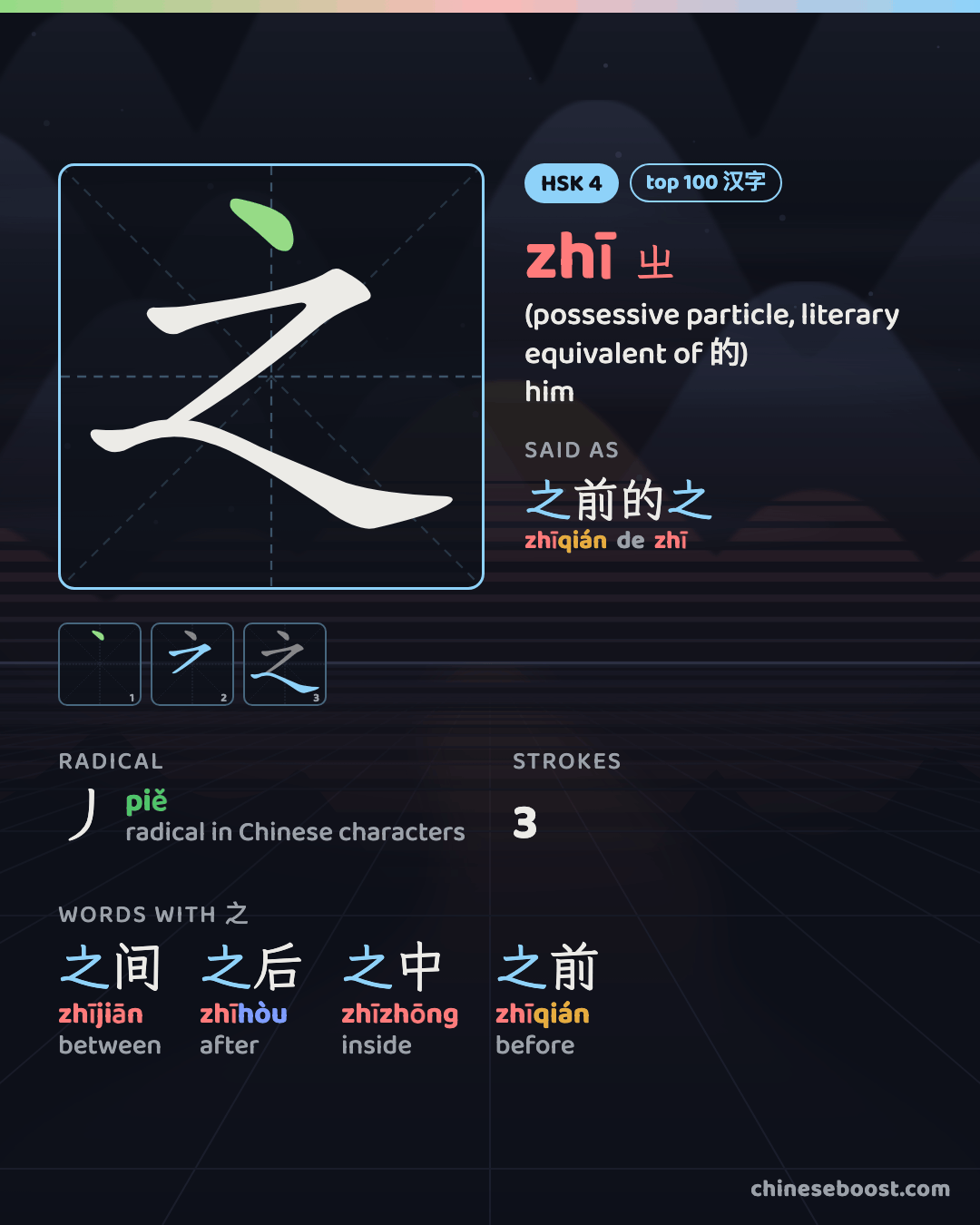
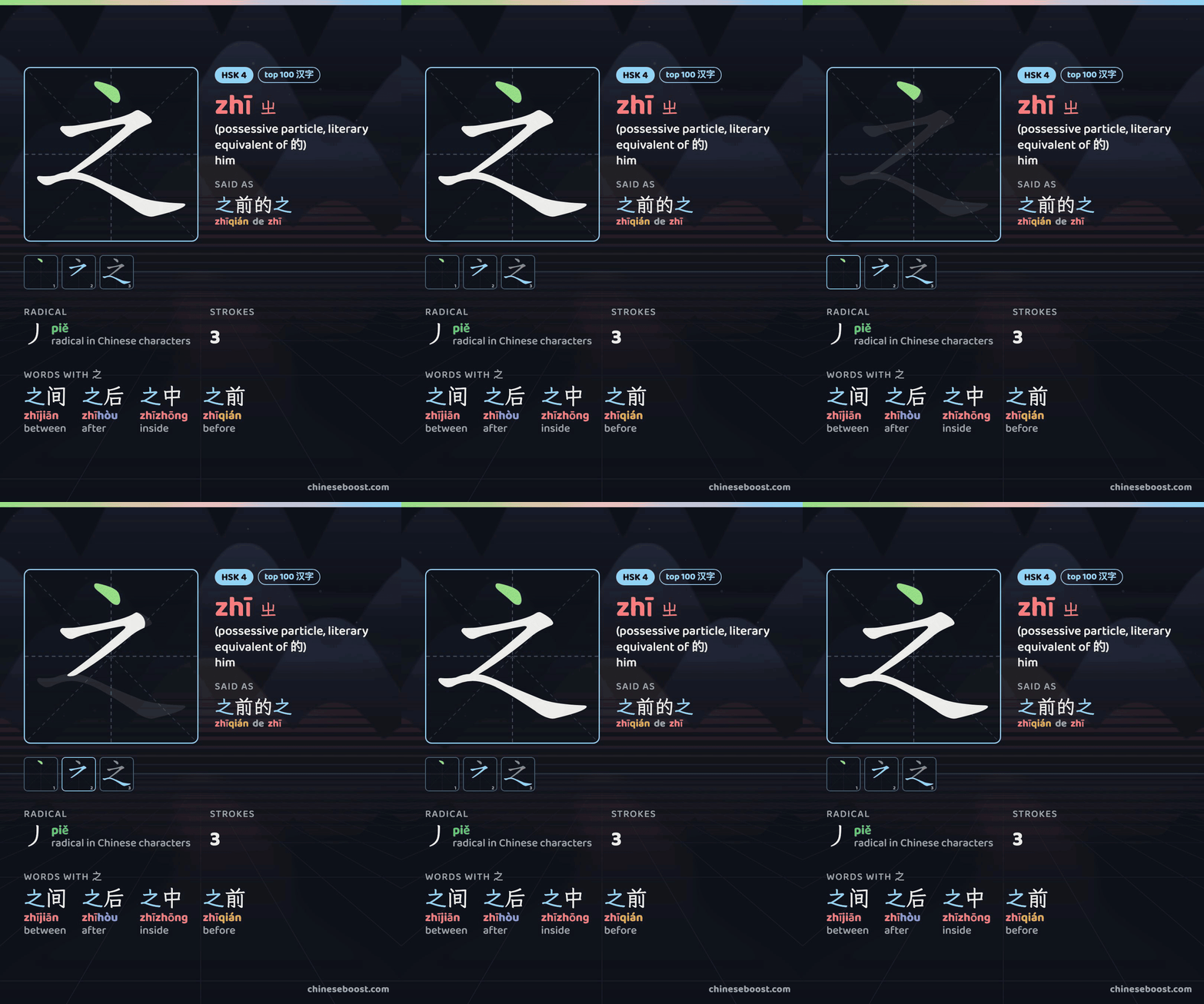
The stroke order and parts of 之
Learn to write the Chinese character 之 (zhī)this character
Trace 之, then write it from memory. Each stage is passed five times.
Create a free account to finish learning to write 之. You can also save it to your word list for review (复习).
Print a writing practice sheet for 之
Hanzi writing exercises that include 之: HSK 4 vocabulary, part 1: hanzi writing 1 of 12, HSK 5 vocabulary, part 20: hanzi writing 6 of 7, HSK 6 vocabulary, part 5: hanzi writing 9 of 10 and 15 more.
之 as a component 部件
之 appears in 11 characters in this dictionary, either directly (2 characters) or within a larger component.
See all characters containing 之Potential verbal descriptions
- 之前的之
Words with 之
Starting with 之
Ending with 之
- 总之 in a word
- 随之 thereupon
- 加之 moreover
- 反之 conversely...
- 次之 rank second
- 总而言之 in short
- 久而久之 over time
- 取而代之 replace
- 祖冲之 Zu Chongzhi (429-500), astronomer and mathematician
- 换言之 in other words
- 不了了之 settle a matter by leaving it unsettled
- 王羲之 Wang Xizhi (303-361), famous calligrapher of Eastern Jin, known as the sage of calligraphy 书圣
Containing 之
- 称之为 call it...
- 神来之笔 felicitous turn of phrase
- 张之洞 Zhang Zhidong (1837-1909), prominent politician in late Qing
- 除此之外 apart from this
- 意料之外 unexpected
- 所到之处 wherever one goes
- 相比之下 by comparison
- 当务之急 top priority job
- 丝绸之路 Silk Road
- 当之无愧 entirely worthy
- 安史之乱 An-Shi Rebellion (755-763) of 安禄山 ānlùshān and 史思明 shǐsīmíng, a catastrophic setback for Tang dynasty
- 行之有效 be effective
Words with 之
Starting with 之
Ending with 之
- 總之 in a word
- 隨之 thereupon
- 加之 moreover
- 反之 conversely...
- 次之 rank second
- 總而言之 in short
- 久而久之 over time
- 取而代之 replace
- 祖沖之 Zu Chongzhi (429-500), astronomer and mathematician
- 換言之 in other words
- 不了了之 settle a matter by leaving it unsettled
- 王羲之 Wang Xizhi (303-361), famous calligrapher of Eastern Jin, known as the sage of calligraphy 书圣
Containing 之
- 稱之為 call it...
- 神來之筆 felicitous turn of phrase
- 張之洞 Zhang Zhidong (1837-1909), prominent politician in late Qing
- 除此之外 apart from this
- 意料之外 unexpected
- 所到之處 wherever one goes
- 相比之下 by comparison
- 當務之急 top priority job
- 絲綢之路 Silk Road
- 當之無愧 entirely worthy
- 安史之亂 An-Shi Rebellion (755-763) of 安禄山 ānlùshān and 史思明 shǐsīmíng, a catastrophic setback for Tang dynasty
- 行之有效 be effective
Example sentences and grammar articles using 之
Save or share this card
Learn to write 之
Trace 之, then write it from memory.
Start without an account.
Go to the writing drill Practise 之 with other characters Print a practice sheet
Free: 5 new Exercises a day. Pro: no daily limit. About Pro
Ancient forms of 之 (古文字)


Chinese Boost Pro
Save as many words and example sentences as you like. Use Review and start new Exercises without daily limits. Your first subscription includes a 7-day free trial.
Sign up for a free Chinese Boost account
Save the words and sentences you find here to your own list, and hear them read aloud. You can export the list to your flashcards whenever you like.
Sources
- CC-CEDICT, CC BY-SA 4.0
- pinyinjs, Apache-2.0
- HSK 考试大纲, 中外语言交流合作中心, no licence stated
- Make Me a Hanzi, from fonts by Arphic Technology Co., Ltd., Arphic Public License
- Rime 五笔字型 (Wubi 86), from ibus-table, LGPL-3.0. Wubi was invented by Wang Yongmin (王永民).
- Ancient Chinese Characters Project (Wikimedia Commons), after Richard Sears' Chinese Etymology, public domain