Study without daily limits with Pro
Cantonese: se1
Classifiers (measure words)
Classical Chinese 文言
些 xiē has 1 sense in Classical Chinese. 些 in Classical Chinese.
Other words read
Other words read
-
literary
-
Classical Chinese 文言
些 suò has 1 sense in Classical Chinese. 些 in Classical Chinese.
Other words read
Other words read
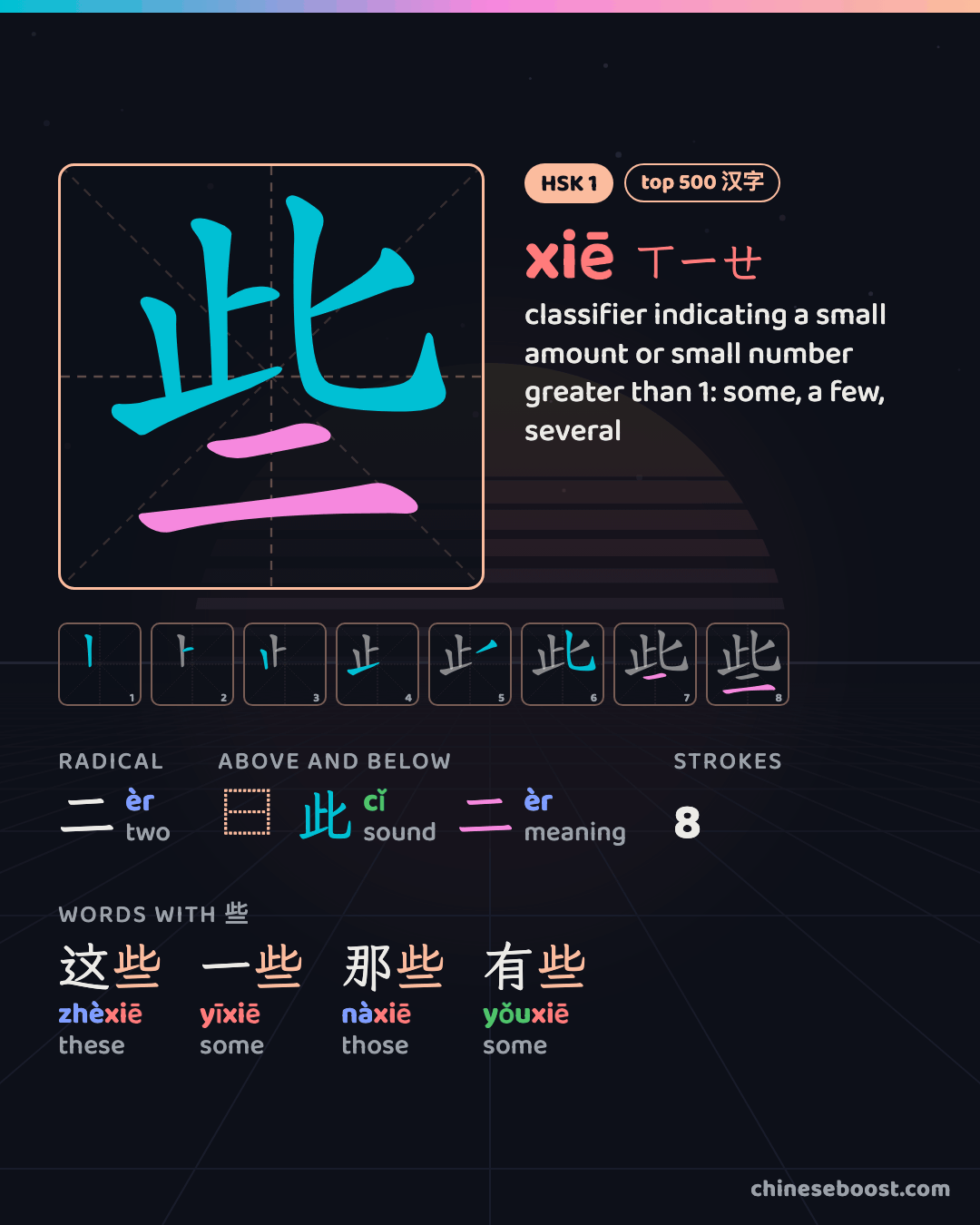
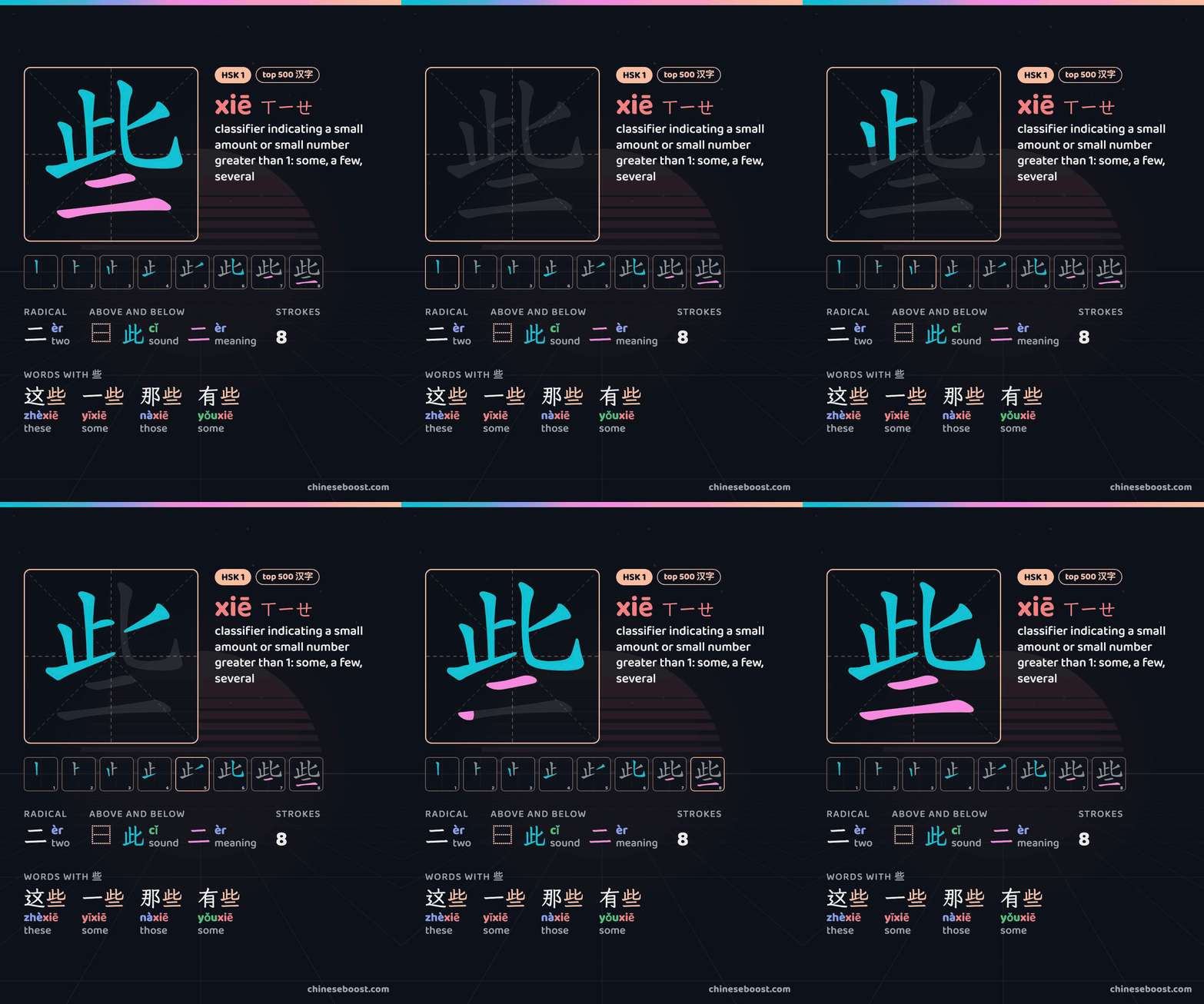
The stroke order and parts of 些
- 部首 radical
- 二
- 笔画 strokes
- 8, with 5 after the 部首
- 结构 structure
- 上下结构
- 偏旁 parts
- 此二此this+二two=someA story to help you remember, not the character’s history.“This, then two more: some.”
- 形旁 meaning
- 二
- 声旁 sound
- 此
- 仓颉 Cangjie code
- 卜心一一 YPMM
- 五笔 Wubi code
- HXFF
Learn to write the Chinese character 些 (xiē)this character
Trace 些, then write it from memory. Each stage is passed five times.
Create a free account to finish learning to write 些. You can also save it to your word list for review (复习).
Print a writing practice sheet for 些
Hanzi writing exercises that include 些: HSK 1 vocabulary, part 2: hanzi writing 2 of 9, Numbers and measures: HSK 1: hanzi writing 3 of 5, Chinese grammar rules: 5 general rules for Chinese grammar: hanzi writing 7 of 9 and 12 more.
Potential verbal descriptions
- 一些的些
Words with 些
Words with 些
Texts using 些 阅读閱讀
-
她决定给家人打个电话,再寄些礼物回去。她決定給家人打個電話,再寄些禮物回去。她決定給家人打個電話,再寄些禮物回去。
-
一天,山那边来了一个说话很客气的人,想买些大树带回去,越便宜越好。一天,山那邊來了一個說話很客氣的人,想買些大樹帶回去,越便宜越好。一天,山那邊來了一個説話很客氣的人,想買些大樹帶回去,越便宜越好。
-
过了好一会儿,他才松开一直攥着的拳头,问:“堵这个洞,要用些什么?”過了好一會兒,他才鬆開一直攥著的拳頭,問:“堵這個洞,要用些什麼?”過了好一會兒,他才鬆開一直攥着的拳頭,問:“堵這個洞,要用些什麼?”
Example sentences and grammar articles using 些
Save or share this card
Learn to write 些
Trace 些, then write it from memory.
Start without an account.
Go to the writing drill Practise 些 with other characters Print a practice sheet
Free: 5 new Exercises a day. Pro: no daily limit. About Pro
Ancient forms of 些 (古文字)

Chinese Boost Pro
Save as many words and example sentences as you like. Use Review and start new Exercises without daily limits. Your first subscription includes a 7-day free trial.
Sign up for a free Chinese Boost account
Save the words and sentences you find here to your own list, and hear them read aloud. You can export the list to your flashcards whenever you like.
Sources
- CC-CEDICT, CC BY-SA 4.0
- pinyinjs, Apache-2.0
- HSK 考试大纲, 中外语言交流合作中心, no licence stated
- Chinese Boost, CC BY-SA 4.0
- Make Me a Hanzi, from fonts by Arphic Technology Co., Ltd., Arphic Public License
- Rime 五笔字型 (Wubi 86), from ibus-table, LGPL-3.0. Wubi was invented by Wang Yongmin (王永民).
- 《说文解字》 (许慎), from shuowen.org's transcription, Apache-2.0
- 《汉字源流字典》 (谷衍奎), 语文出版社, 2008
- Ancient Chinese Characters Project (Wikimedia Commons), after Richard Sears' Chinese Etymology, public domain