Study without daily limits with Pro
Cantonese: loeng6
Classifiers (measure words)
- 亮了一下证件 flash one's pass briefly
Synonyms and antonyms
Synonyms 近义词
-
明
- 明亮 bright
- 月明星稀 the moon is bright and the stars are sparse
Classical Chinese 文言
亮 liàng has 9 senses in Classical Chinese. 亮 in Classical Chinese.
Other words read
In the same tone
Other words read
In the same tone
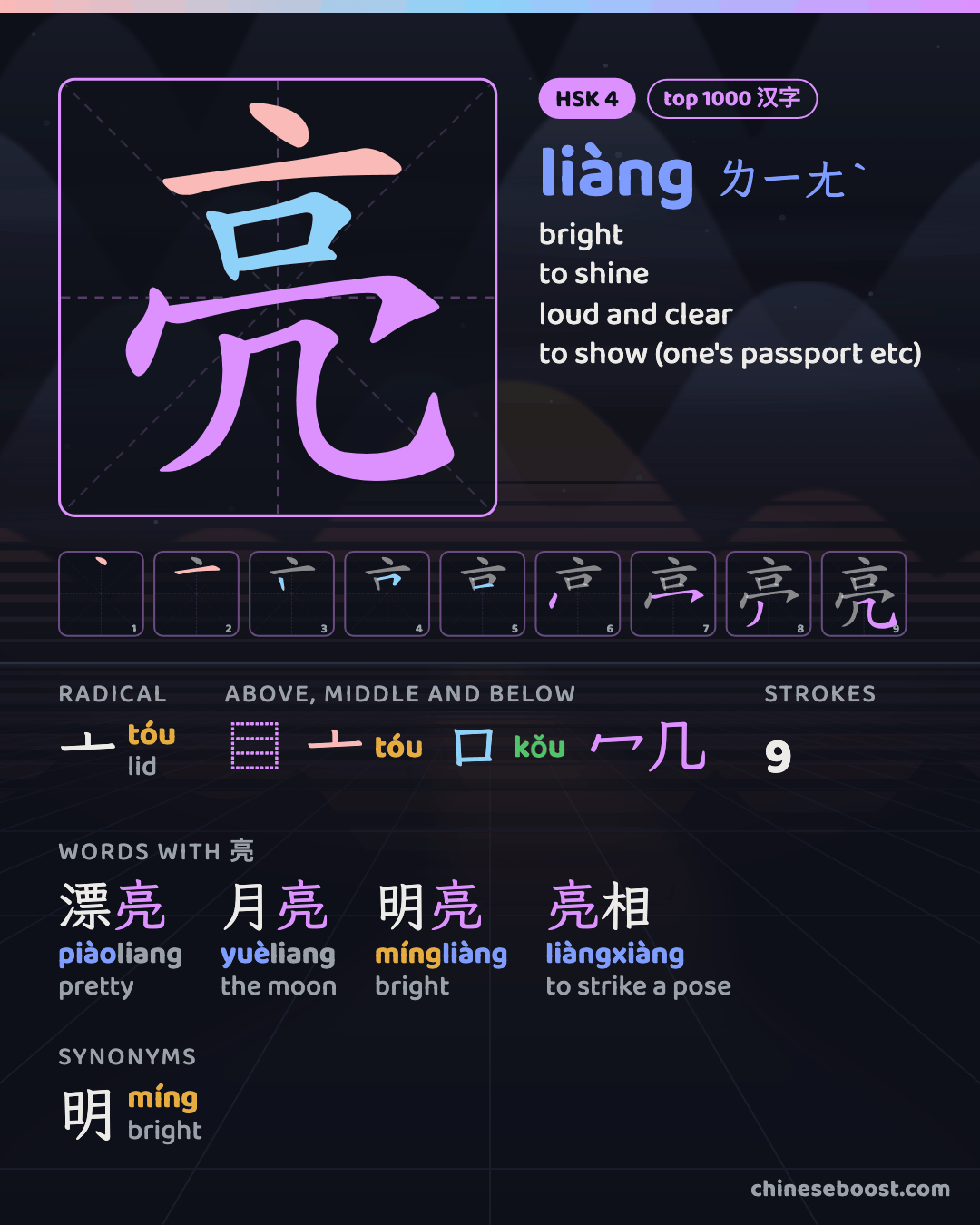
The stroke order and parts of 亮
- 部首 radical
- 亠
- 笔画 strokes
- 9, with 7 after the 部首
- 结构 structure
- 上中下结构
- 偏旁 parts
- 亠口冖几高tall+几person=brightA story to help you remember, not the character’s history.“A tall person stands out, shining bright.”
- 仓颉 Cangjie code
- 卜口月山 YRBU
- 五笔 Wubi code
- YPMB
Learn to write the Chinese character 亮 (liàng)this character
Trace 亮, then write it from memory. Each stage is passed five times.
Create a free account to finish learning to write 亮. You can also save it to your word list for review (复习).
Print a writing practice sheet for 亮
Hanzi writing exercises that include 亮: HSK 1 vocabulary, part 5: hanzi writing 4 of 7, HSK 3 vocabulary, part 8: hanzi writing 2 of 8, HSK 4 vocabulary, part 8: hanzi writing 7 of 7 and 7 more.
Easy to confuse with 亮
-
壳
Similar shape
The lower parts look alike, so check the top. 亮 (liàng) has 亠 on top and means bright, as in 明亮 (míngliàng). 壳 has 士 on top and is read qiào in 地壳 (dìqiào), or ké in 蛋壳 (dànké).
-
靓
Similar shape and sound
They share the reading liàng and look alike. 亮 (liàng) means bright or loud, as in 明亮 and 响亮. 靓 (liàng) means good-looking, as in 靓女. 靓 is also read jìng in 靓妆.
Potential verbal descriptions
- 明亮的亮
- 京字头的亮
Words with 亮
Starting with 亮
Ending with 亮
Containing 亮
- 高风亮节 of noble character and unquestionable integrity
- 打开天窗说亮话 not mince words
- 光亮度 brightness
- 漂亮话 fine-sounding but empty words
- 异亮氨酸 isoleucine (Ile), an essential amino acid
- 擦亮眼睛 be clear-eyed
- 打开窗户说亮话 speak frankly and openly
- 明厨亮灶 "transparent kitchen" – a kitchen (in a restaurant, school cafeteria etc) in which food preparation processes are made visible to customers (by means of transparent glass, live video etc) to promote hygiene and ensure accountability in food safety practices
- 月亮女神号 SELENE, Japanese lunar orbiter spacecraft, launched in 2007
- 月亮杯 menstrual cup
- 月亮门儿 moon gate
- 洪亮吉 Hong Liangji (1746-1809), poet and historian
Words with 亮
Starting with 亮
Ending with 亮
Containing 亮
- 高風亮節 of noble character and unquestionable integrity
- 打開天窗說亮話 not mince words
- 光亮度 brightness
- 漂亮話 fine-sounding but empty words
- 異亮氨酸 isoleucine (Ile), an essential amino acid
- 擦亮眼睛 be clear-eyed
- 打開窗戶說亮話 speak frankly and openly
- 明廚亮灶 "transparent kitchen" – a kitchen (in a restaurant, school cafeteria etc) in which food preparation processes are made visible to customers (by means of transparent glass, live video etc) to promote hygiene and ensure accountability in food safety practices
- 月亮女神號 SELENE, Japanese lunar orbiter spacecraft, launched in 2007
- 月亮杯 menstrual cup
- 月亮門兒 moon gate
- 洪亮吉 Hong Liangji (1746-1809), poet and historian
Example sentences and grammar articles using 亮
Save or share this card
Learn to write 亮
Trace 亮, then write it from memory.
Start without an account.
Go to the writing drill Practise 亮 with other characters Print a practice sheet
Free: 5 new Exercises a day. Pro: no daily limit. About Pro
Ancient forms of 亮 (古文字)


Chinese Boost Pro
Save as many words and example sentences as you like. Use Review and start new Exercises without daily limits. Your first subscription includes a 7-day free trial.
Sign up for a free Chinese Boost account
Save the words and sentences you find here to your own list, and hear them read aloud. You can export the list to your flashcards whenever you like.
Sources
- CC-CEDICT, CC BY-SA 4.0
- pinyinjs, Apache-2.0
- HSK 考试大纲, 中外语言交流合作中心, no licence stated
- Make Me a Hanzi, from fonts by Arphic Technology Co., Ltd., Arphic Public License
- Rime 五笔字型 (Wubi 86), from ibus-table, LGPL-3.0. Wubi was invented by Wang Yongmin (王永民).
- 《说文解字》 (许慎), from shuowen.org's transcription, Apache-2.0
- 《汉字源流字典》 (谷衍奎), 语文出版社, 2008
- Ancient Chinese Characters Project (Wikimedia Commons), after Richard Sears' Chinese Etymology, public domain