Study without daily limits with Pro
-
used before a negative
-
bound form
bound form
TW:
Cantonese: cung4, sung1, zung1
Classical Chinese 文言
從 cóng has 7 senses in Classical Chinese. 從 in Classical Chinese.
Other words read
In the same tone
-
literary
-
Classical Chinese 文言
從 sōng has 1 sense in Classical Chinese. 從 in Classical Chinese.
Other words read
In the same tone
-
literary
-
-
literary
-
-
literary
-
-
literary
-
-
literary
-
-
literary
-
Classical Chinese 文言
從 zòng has 6 senses in Classical Chinese. 從 in Classical Chinese.
Other words read
-
literary
-
-
literary
-
Classical Chinese 文言
從 zōng has 2 senses in Classical Chinese. 從 in Classical Chinese.
Other words read
The stroke order and parts of 从
- 部首 radical
- 人
- 笔画 strokes
- 4, with 2 after the 部首
- 结构 structure
- 左右结构
- 偏旁 parts
- 人人人person+人person=fromA traditional way to remember the parts that matches how the character was formed.二人从 Two people, one following the other. From 统编版《语文》一年级上册《日月明》
- 仓颉 Cangjie code
- 人人 OO
- 五笔 Wubi code
- WWY
Learn to write the Chinese character 从 (cóng)this character
Trace 从, then write it from memory. Each stage is passed five times.
Create a free account to finish learning to write 从. You can also save it to your word list for review (复习).
Print a writing practice sheet for 从
Hanzi writing exercises that include 从: HSK 2 vocabulary, part 1: hanzi writing 2 of 10, HSK 4 vocabulary, part 7: hanzi writing 7 of 8, HSK 5 vocabulary, part 5: hanzi writing 2 of 9 and 18 more.
从 as a component 部件
从 appears in 194 characters in this dictionary, either directly (26 characters) or within a larger component.
See all characters containing 从Easy to confuse with 从
-
丛
Similar shape and sound
Both are cóng. 从 (cóng) is two people following, as in 跟从 (gēncóng) and from, as in 从小 (cóng xiǎo); 丛 (cóng) has 一 below and means thicket or cluster, as in 草丛 (cǎocóng).
Potential verbal descriptions
- 服从的从
- 二人从
Words with 从
Starting with 从
Ending with 从
Containing 从
- 力不从心 lack the ability to do what one would wish
- 无从下手 not know where to start
- 喜从天降 joy from heaven
- 三从四德 Confucian moral injunctions for women, namely: obey in turn three men father, husband and son, plus the four virtues of morality 德 dé, physical charm 容, propriety in speech 言 and efficiency in needlework 功
- 沈从文 Shen Congwen (1902-1988), novelist
- 投笔从戎 join the military
- 病从口入 Illness enters by the mouth (idiom). Mind what you eat!
- 祸从口出 Trouble issues from the mouth (idiom). A loose tongue may cause a lot of trouble.
- 文从字顺 well-written and fluent
- 恭敬不如从命 deference is no substitute for obedience
- 祸从天降 calamity from nowhere
- 改恶从善 turn from evil to good
Texts using 从 阅读閱讀
-
从我家开车去要半个小时,但是早上车多,我想八点就开车去。從我家開車去要半個小時,但是早上車多,我想八點就開車去。從我家開車去要半個小時,但是早上車多,我想八點就開車去。
-
我从妹妹身边走了过去。我從妹妹身邊走了過去。我從妹妹身邊走了過去。
-
可是,从那以后,他笑得少了。可是,從那以後,他笑得少了。可是,從那以後,他笑得少了。
8 more texts using 从
-
女朋友拿过笔记本,看着第一页,把他自己从第一本书上记下来的话读了出来:“最重要的一条:困了就睡。”女朋友拿過筆記本,看著第一頁,把他自己從第一本書上記下來的話讀了出來:“最重要的一條:困了就睡。”女朋友拿過筆記本,看着第一頁,把他自己從第一本書上記下來的話讀了出來:“最重要的一條:困了就睡。”
-
她四十多岁,从很远的农村来,在这所大学当了三年宿舍管理员,平时总是笑着。她四十多歲,從很遠的農村來,在這所大學當了三年宿舍管理員,平時總是笑著。她四十多歲,從很遠的農村來,在這所大學當了三年宿舍管理員,平時總是笑着。
-
从那天起,他每天晚上七点都打来,问你有没有来吃饭,看起来高不高兴。從那天起,他每天晚上七點都打來,問你有沒有來吃飯,看起來高不高興。從那天起,他每天晚上七點都打來,問你有沒有來吃飯,看起來高不高興。
-
路上,有人正背着水从远处回来。路上,有人正背著水從遠處回來。路上,有人正背着水從遠處回來。
-
一天,她从自行车上摔了下来,在医院醒来后,发现自己不记得最近几年的事了:工作、住的地方、朋友,全忘了。一天,她從自行車上摔了下來,在醫院醒來後,發現自己不記得最近幾年的事了:工作、住的地方、朋友,全忘了。一天,她從自行車上摔了下來,在醫院醒來後,發現自己不記得最近幾年的事了:工作、住的地方、朋友,全忘了。
-
于是,她趁没人注意,偷偷从院墙翻了进去。於是,她趁沒人注意,偷偷從院牆翻了進去。
-
从那以后,妻子一不放心,就请朋友晚上再测一次。從那以後,妻子一不放心,就請朋友晚上再測一次。從那以後,妻子一不放心,就請朋友晚上再測一次。
-
面馆刚开不久,一天中午,一只灰色的老鼠从客人脚边跑过。麵館剛開不久,一天中午,一隻灰色的老鼠從客人腳邊跑過。麪館剛開不久,一天中午,一隻灰色的老鼠從客人腳邊跑過。
Example sentences and grammar articles using 从
Save or share this card
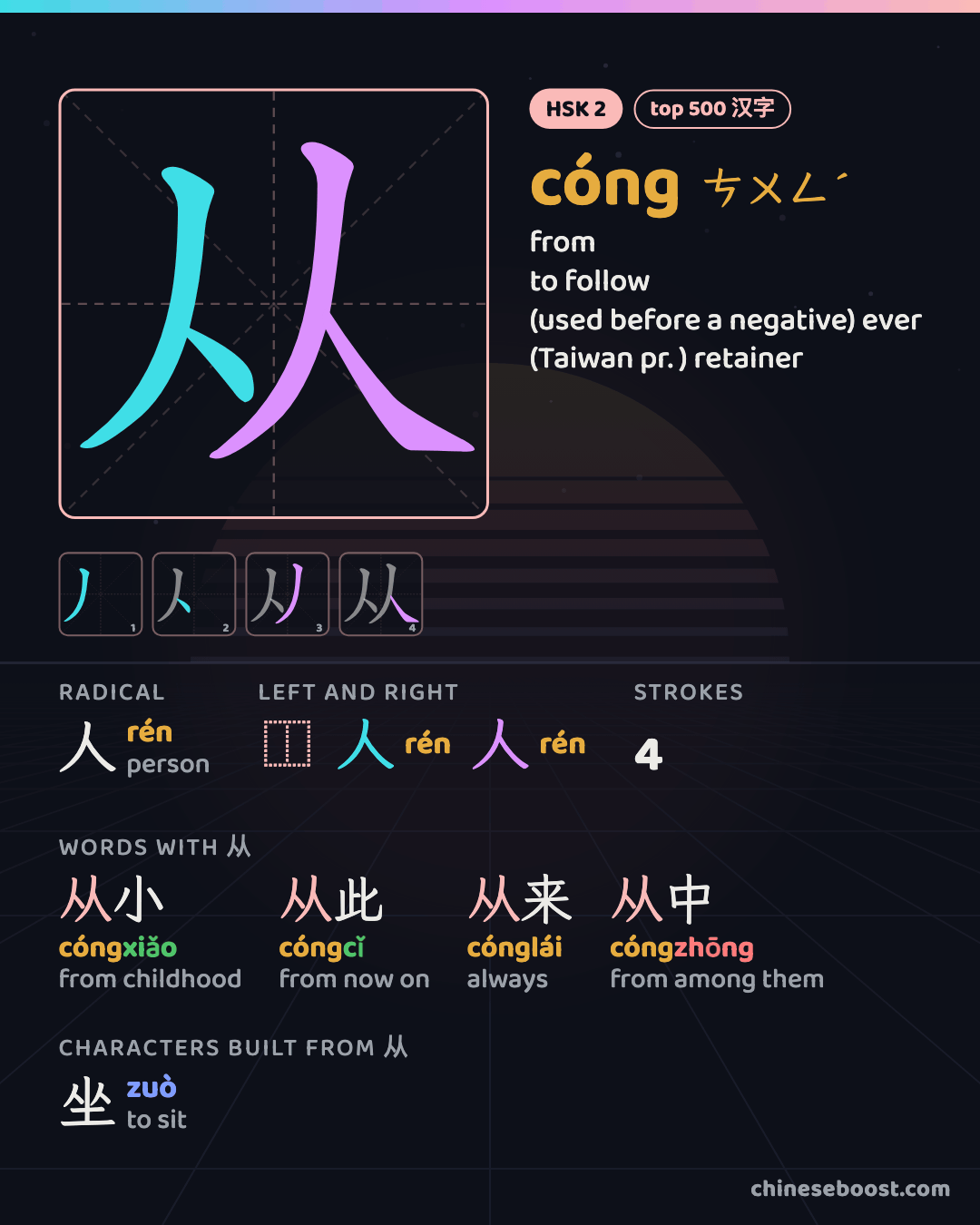
Learn to write 从
Trace 从, then write it from memory.
Start without an account.
Go to the writing drill Practise 从 with other characters Print a practice sheet
Free: 5 new Exercises a day. Pro: no daily limit. About Pro
Ancient forms of 从 (古文字)


Chinese Boost Pro
Save as many words and example sentences as you like. Use Review and start new Exercises without daily limits. Your first subscription includes a 7-day free trial.
Sign up for a free Chinese Boost account
Save the words and sentences you find here to your own list, and hear them read aloud. You can export the list to your flashcards whenever you like.
Sources
- CC-CEDICT, CC BY-SA 4.0
- pinyinjs, Apache-2.0
- HSK 考试大纲, 中外语言交流合作中心, no licence stated
- Chinese Boost, CC BY-SA 4.0
- Make Me a Hanzi, from fonts by Arphic Technology Co., Ltd., Arphic Public License
- Rime 五笔字型 (Wubi 86), from ibus-table, LGPL-3.0. Wubi was invented by Wang Yongmin (王永民).
- 《说文解字》 (许慎), from shuowen.org's transcription, Apache-2.0
- 《汉字源流字典》 (谷衍奎), 语文出版社, 2008
- Ancient Chinese Characters Project (Wikimedia Commons), after Richard Sears' Chinese Etymology, public domain