Study without daily limits with Pro
Cantonese: maai6
Classifiers (measure words)
- 卖了一次 sell once
Synonyms and antonyms
Classical Chinese 文言
賣 mài has 4 senses in Classical Chinese. 賣 in Classical Chinese.
Other words read
In the same tone
The stroke order and parts of 卖
- 部首 radical
- 十
- 笔画 strokes
- 8, with 6 after the 部首
- 结构 structure
- 上下结构
- 偏旁 parts
- 十买十ten(placeholder)+买buy=sellA story to help you remember, not the character’s history.“Buy it ten times over, then sell.”
- 形旁 meaning
- 买
- 声旁 sound
- 买
- 仓颉 Cangjie code
- 十弓卜大 JNYK
- 五笔 Wubi code
- FNUD
Learn to write the Chinese character 卖 (mài)this character
Trace 卖, then write it from memory. Each stage is passed five times.
Create a free account to finish learning to write 卖. You can also save it to your word list for review (复习).
Print a writing practice sheet for 卖
Hanzi writing exercises that include 卖: HSK 1 vocabulary, part 4: hanzi writing 2 of 8, HSK 3 vocabulary, part 10: hanzi writing 5 of 5, HSK 5 vocabulary, part 18: hanzi writing 4 of 5 and 18 more.
卖 as a component 部件
卖 appears in 12 characters in this dictionary, either directly (11 characters) or within a larger component.
See all characters containing 卖Easy to confuse with 卖
-
买
Similar shape and sound
They sound alike (mài and mǎi) and look alike. 卖 (mài) is 买 (mǎi) with 十 on top. 卖 means to sell; 买 means to buy.
Potential verbal descriptions
- 买卖的卖
- 十字头的卖
Words with 卖
Starting with 卖
Ending with 卖
Texts using 卖 阅读閱讀
-
其他村民看见他拿到了钱,也想这样轻松地赚一笔,就一家接一家地卖树。其他村民看見他拿到了錢,也想這樣輕鬆地賺一筆,就一家接一家地賣樹。其他村民看見他拿到了錢,也想這樣輕鬆地賺一筆,就一家接一家地賣樹。
-
有个人每个星期都带着骆驼走过沙漠,到沙漠那边去卖东西。有個人每個星期都帶著駱駝走過沙漠,到沙漠那邊去賣東西。有個人每個星期都帶着駱駝走過沙漠,到沙漠那邊去賣東西。
-
他们听说这家养了两头很胖的猪,能卖不少钱,就决定当天晚上去偷猪。他們聽說這家養了兩頭很胖的豬,能賣不少錢,就決定當天晚上去偷豬。他們聽説這家養了兩頭很胖的豬,能賣不少錢,就決定當天晚上去偷豬。
Example sentences and grammar articles using 卖
Save or share this card
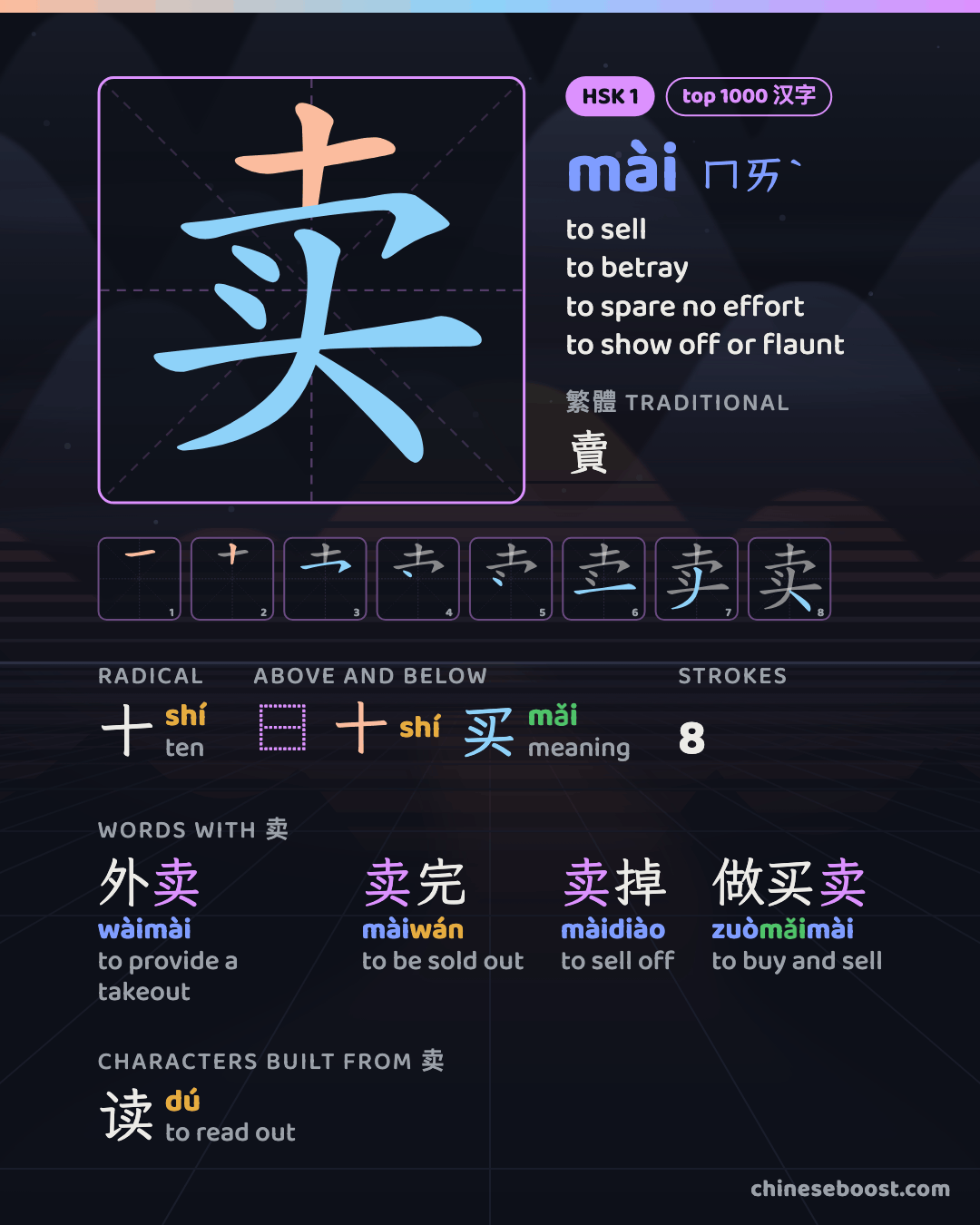
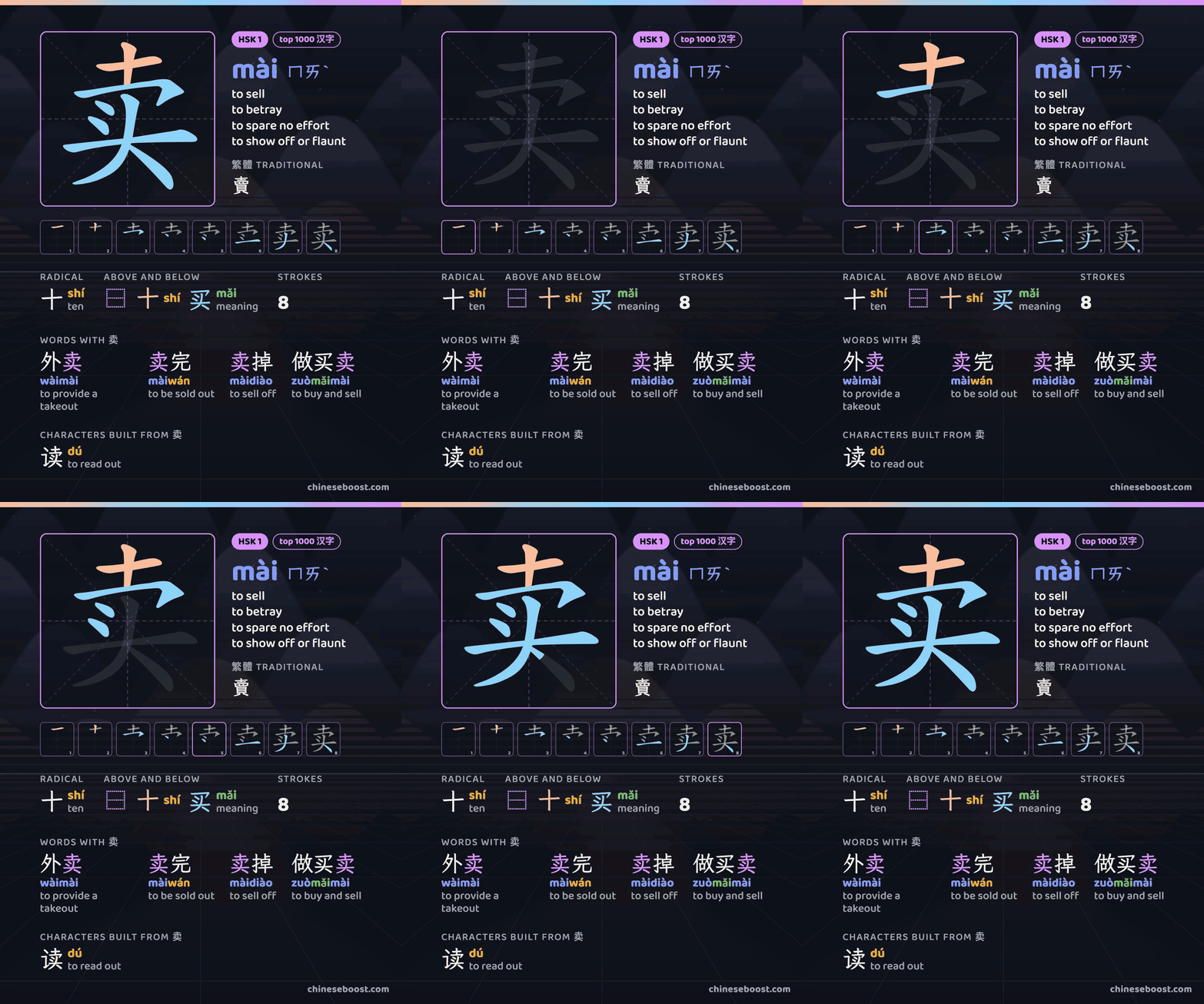
Learn to write 卖
Trace 卖, then write it from memory.
Start without an account.
Go to the writing drill Practise 卖 with other characters Print a practice sheet
Free: 5 new Exercises a day. Pro: no daily limit. About Pro
Ancient forms of 賣 (古文字)


Chinese Boost Pro
Save as many words and example sentences as you like. Use Review and start new Exercises without daily limits. Your first subscription includes a 7-day free trial.
Sign up for a free Chinese Boost account
Save the words and sentences you find here to your own list, and hear them read aloud. You can export the list to your flashcards whenever you like.
Sources
- CC-CEDICT, CC BY-SA 4.0
- pinyinjs, Apache-2.0
- HSK 考试大纲, 中外语言交流合作中心, no licence stated
- Make Me a Hanzi, from fonts by Arphic Technology Co., Ltd., Arphic Public License
- Rime 五笔字型 (Wubi 86), from ibus-table, LGPL-3.0. Wubi was invented by Wang Yongmin (王永民).
- 《说文解字》 (许慎), from shuowen.org's transcription, Apache-2.0
- 《汉字源流字典》 (谷衍奎), 语文出版社, 2008
- Ancient Chinese Characters Project (Wikimedia Commons), after Richard Sears' Chinese Etymology, public domain