Study without daily limits with Pro
-
prefix
-
literary
Cantonese: ho2, hak1
Classical Chinese 文言
可 kě has 9 senses in Classical Chinese. 可 in Classical Chinese.
Other words read
In the same tone
ke with other tones
- 科 field
- 克 be able to
- 客 customer
- 课 class
- 刻 moment
- 呵 used in 呵叻[Ke1 le4], Khorat (Nakhon Ratchasima), a place in Thailand
- 壳 shell
- 颗 classifier for small spheres, pearls, corn grains, teeth, hearts, satellites etc
- 喀 (only in 喀喀) retching sound
- 珂 jade-like stone
- 磕 tap
- 棵 classifier for trees, cabbages, plants etc
Other words read
In the same tone
ke with other tones
- 科 field
- 剋 subdue
- 客 customer
- 課 class
- 刻 moment
- 呵 used in 呵叻[Ke1 le4], Khorat (Nakhon Ratchasima), a place in Thailand
- 殼 shell
- 顆 classifier for small spheres, pearls, corn grains, teeth, hearts, satellites etc
- 喀 (only in 喀喀) retching sound
- 珂 jade-like stone
- 磕 tap
- 棵 classifier for trees, cabbages, plants etc
Classical Chinese 文言
可 kè has 1 sense in Classical Chinese. 可 in Classical Chinese.
Other words read
Other words read
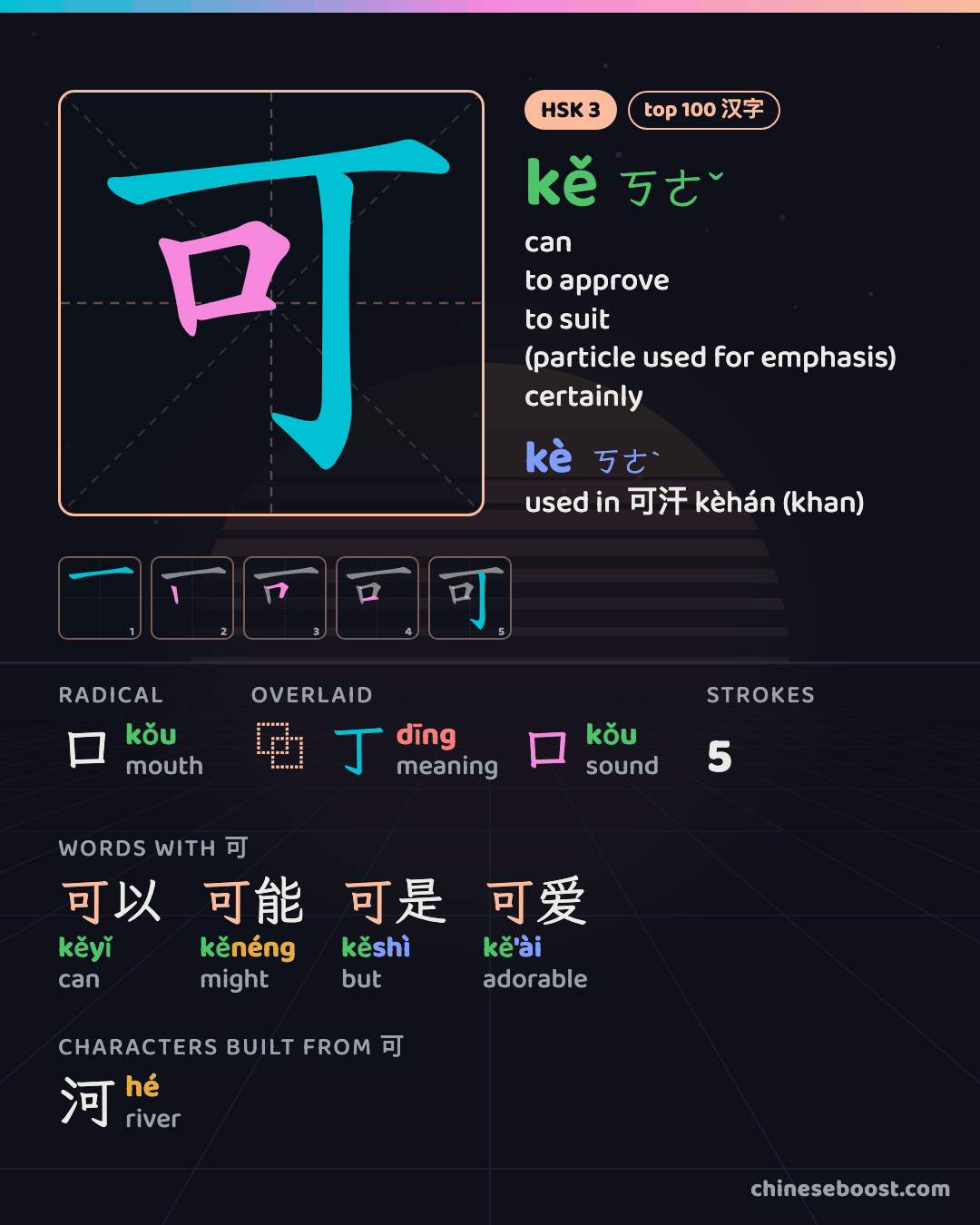
The stroke order and parts of 可
- 部首 radical
- 口
- 笔画 strokes
- 5, with 2 after the 部首
- 结构 structure
- 镶嵌结构
- 偏旁 parts
- 丁口丂breath+口mouth=canA story to help you remember, not the character’s history.“A mouth with breath in it says: you can.”
- 形旁 meaning
- 丁
- 声旁 sound
- 口
- 仓颉 Cangjie code
- 一弓口 MNR
- 五笔 Wubi code
- SKD
Songs and sayings about parts
- 横竖勾,是个丁,藏个口字就可以,小可大可做哥哥 A horizontal stroke and a hooked vertical make 丁. Tuck in 口 for 可, and stack two 可 for big brother (哥).
Learn to write the Chinese character 可 (kě)this character
Trace 可, then write it from memory. Each stage is passed five times.
Create a free account to finish learning to write 可. You can also save it to your word list for review (复习).
Print a writing practice sheet for 可
Hanzi writing exercises that include 可: HSK 1 vocabulary, part 1: hanzi writing 8 of 9, HSK 2 vocabulary, part 1: hanzi writing 6 of 10, HSK 3 vocabulary, part 1: hanzi writing 1 of 11 and 35 more.
可 as a component 部件
可 appears in 67 characters in this dictionary, either directly (28 characters) or within a larger component.
See all characters containing 可Easy to confuse with 可
- 司 Similar shape
Potential verbal descriptions
- 可以的可
Words with 可
Starting with 可
Ending with 可
Words with 可
Starting with 可
Ending with 可
Texts using 可 阅读閱讀
-
弟弟说:“我可不穿这个去考试。”弟弟說:“我可不穿這個去考試。”弟弟説:“我可不穿這個去考試。”
-
高磊想了想,说:“这是第一本书上说的,可第二本书比第一本新。”高磊想了想,說:“這是第一本書上說的,可第二本書比第一本新。”高磊想了想,説:“這是第一本書上説的,可第二本書比第一本新。”
-
她很需要这份工作,可家那么远,她也想回去陪妈妈过节。她很需要這份工作,可家那麼遠,她也想回去陪媽媽過節。她很需要這份工作,可家那麼遠,她也想回去陪媽媽過節。
10 more texts using 可
-
可她不能辞职:到了这个年纪,她找不到比这更好的工作,家里也需要这份收入。可她不能辭職:到了這個年紀,她找不到比這更好的工作,家裡也需要這份收入。可她不能辭職:到了這個年紀,她找不到比這更好的工作,家裏也需要這份收入。
-
经理不想丢掉工作,可又不能去找老板抱怨,更不能说有人听到了隔壁的谈话。經理不想丟掉工作,可又不能去找老板抱怨,更不能說有人聽到了隔壁的談話。經理不想丟掉工作,可又不能去找老板抱怨,更不能説有人聽到了隔壁的談話。
-
有人越想越生气:他把树全买走了,我们可怎么办?有人越想越生氣:他把樹全買走了,我們可怎麼辦?有人越想越生氣:他把樹全買走了,我們可怎麼辦?
-
妈妈担心地说:可你以前说过,你有男朋友。媽媽擔心地說:可你以前說過,你有男朋友。媽媽擔心地説:可你以前説過,你有男朋友。
-
老管家早就提醒过我,可我没有听他的话。老管家早就提醒過我,可我沒有聽他的話。
-
他们正把两头猪往里屋赶,可丈夫动作太慢,刚赶进去,两头猪又都跑了出来。他們正把兩頭豬往里屋趕,可丈夫動作太慢,剛趕進去,兩頭豬又都跑了出來。他們正把兩頭豬往里屋趕,可丈夫動作太慢,剛趕進去,兩頭豬又都跑了出來。
-
妻子看不懂屏幕上的结果,可她完全相信老朋友,高兴极了。妻子看不懂屏幕上的結果,可她完全相信老朋友,高興極了。妻子看不懂屏幕上的結果,可她完全相信老朋友,高興極了。
-
他本来想说有警察,可他了解大勇:大勇一定会笑着说,小路也能走。他本來想說有警察,可他了解大勇:大勇一定會笑著說,小路也能走。他本來想説有警察,可他了解大勇:大勇一定會笑着説,小路也能走。
-
他实在不愿意,可眼看生意一天天冷清下去,妻子急得吃不下饭,他又说不出一个“不”字。他實在不願意,可眼看生意一天天冷清下去,妻子急得吃不下飯,他又說不出一個“不”字。他實在不願意,可眼看生意一天天冷清下去,妻子急得吃不下飯,他又説不出一個“不”字。
-
你可千万别听他的!你可千萬別聽他的!你可千萬別聽他的!
Example sentences and grammar articles using 可
Save or share this card
Learn to write 可
Trace 可, then write it from memory.
Start without an account.
Go to the writing drill Practise 可 with other characters Print a practice sheet
Free: 5 new Exercises a day. Pro: no daily limit. About Pro
Ancient forms of 可 (古文字)


Chinese Boost Pro
Save as many words and example sentences as you like. Use Review and start new Exercises without daily limits. Your first subscription includes a 7-day free trial.
Sign up for a free Chinese Boost account
Save the words and sentences you find here to your own list, and hear them read aloud. You can export the list to your flashcards whenever you like.
Sources
- CC-CEDICT, CC BY-SA 4.0
- pinyinjs, Apache-2.0
- Chinese Boost, CC BY-SA 4.0
- HSK 考试大纲, 中外语言交流合作中心, no licence stated
- Make Me a Hanzi, from fonts by Arphic Technology Co., Ltd., Arphic Public License
- Rime 五笔字型 (Wubi 86), from ibus-table, LGPL-3.0. Wubi was invented by Wang Yongmin (王永民).
- 《说文解字》 (许慎), from shuowen.org's transcription, Apache-2.0
- 《汉字源流字典》 (谷衍奎), 语文出版社, 2008
- Ancient Chinese Characters Project (Wikimedia Commons), after Richard Sears' Chinese Etymology, public domain