Study without daily limits with Pro
-
bound form
TW:
-
after a numeral
-
Cantonese: do1
Synonyms and antonyms
Antonyms 反义词
-
少
- 少数 minority
- 稀少 scarce
- 缺少 lack
- 必不可少 indispensable
Classical Chinese 文言
多 duō has 4 senses in Classical Chinese. 多 in Classical Chinese.
Other words read
In the same tone
Other words read
In the same tone
Foreign names译名譯名
The standard Chinese form of the foreign names Dau, Daue and Do.
Browse foreign names in Chinese
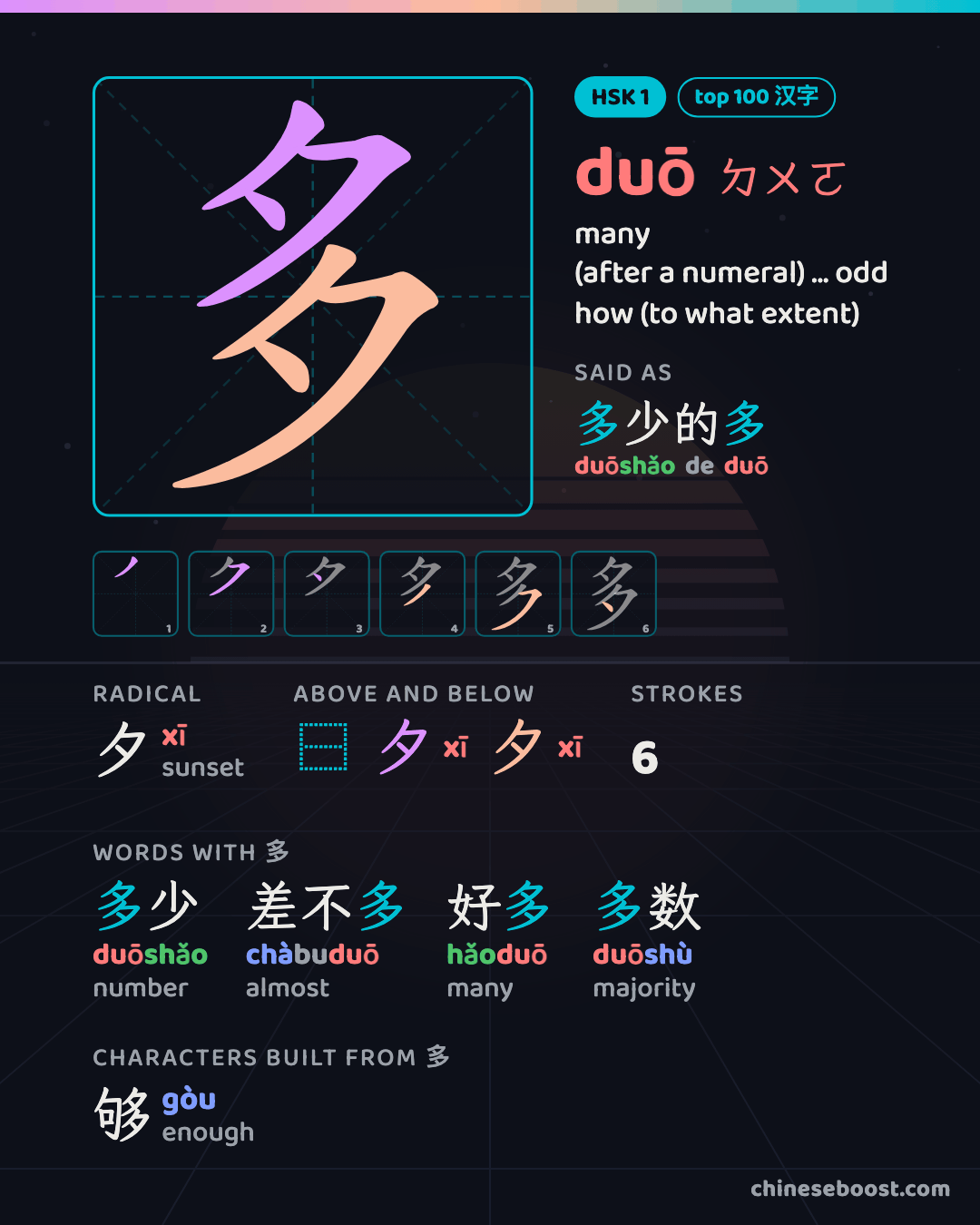
The stroke order and parts of 多
- 部首 radical
- 夕
- 笔画 strokes
- 6, with 3 after the 部首
- 结构 structure
- 上下结构
- 偏旁 parts
- 夕夕夕evening+夕evening=manyA story to help you remember, not the character’s history.“Evenings doubled over become many evenings.”
- 仓颉 Cangjie code
- 弓戈弓戈 NINI
- 五笔 Wubi code
- QQU
Learn to write the Chinese character 多 (duō)this character
Trace 多, then write it from memory. Each stage is passed five times.
Create a free account to finish learning to write 多. You can also save it to your word list for review (复习).
Print a writing practice sheet for 多
Hanzi writing exercises that include 多: HSK 1 vocabulary, part 1: hanzi writing 6 of 9, HSK 3 vocabulary, part 6: hanzi writing 7 of 8, HSK 4 vocabulary, part 1: hanzi writing 10 of 12 and 42 more.
多 as a component 部件
多 appears in 17 characters in this dictionary, either directly (14 characters) or within a larger component.
See all characters containing 多Potential verbal descriptions
- 多少的多
Words with 多
Starting with 多
- 多少 number
- 多年 longstanding
- 多种 multiple
- 多次 repeatedly
- 多数 majority
- 多个 many
- 多么 how
- 多半 most
- 多久 how long?
- 多尔衮 Dorgon (1612-1651), fourteenth son of Nurhaci 努尔哈赤 nǔ'ěrhāchì, successful general, instrumental in Manchu conquest of China, ruled China as regent 1644-1650 for his nephew Emperor Shunzhi 顺治帝 shùnzhìdì
- 多于 more than
- 多谢 many thanks
Ending with 多
Containing 多
Words with 多
Starting with 多
- 多少 number
- 多年 longstanding
- 多種 multiple
- 多次 repeatedly
- 多數 majority
- 多個 many
- 多麼 how
- 多半 most
- 多久 how long?
- 多爾袞 Dorgon (1612-1651), fourteenth son of Nurhaci 努尔哈赤 nǔ'ěrhāchì, successful general, instrumental in Manchu conquest of China, ruled China as regent 1644-1650 for his nephew Emperor Shunzhi 顺治帝 shùnzhìdì
- 多於 more than
- 多謝 many thanks
Ending with 多
Containing 多
Texts using 多 阅读閱讀
-
从我家开车去要半个小时,但是早上车多,我想八点就开车去。從我家開車去要半個小時,但是早上車多,我想八點就開車去。從我家開車去要半個小時,但是早上車多,我想八點就開車去。
-
店里人很多,一个我不认识的人坐在我对面。店裡人很多,一個我不認識的人坐在我對面。店裏人很多,一個我不認識的人坐在我對面。
-
看病前,有些人想问医生很多问题,可是一见到医生,就不知道要问什么了。看病前,有些人想問醫生很多問題,可是一見到醫生,就不知道要問什麼了。看病前,有些人想問醫生很多問題,可是一見到醫生,就不知道要問什麼了。
17 more texts using 多
-
不过,晚上店里的面包不多,有时候没有你喜欢吃的。不過,晚上店裡的麵包不多,有時候沒有你喜歡吃的。不過,晚上店裏的麪包不多,有時候沒有你喜歡吃的。
-
听到妈妈说了这么多话,小美和弟弟都很高兴。聽到媽媽說了這麼多話,小美和弟弟都很高興。聽到媽媽説了這麼多話,小美和弟弟都很高興。
-
下个月四号,很多人要来这里听他们唱歌。下個月四號,很多人要來這裡聽他們唱歌。下個月四號,很多人要來這裏聽他們唱歌。
-
对面的书店很大,有很多中文书。對面的書店很大,有很多中文書。對面的書店很大,有很多中文書。
-
我以后不吃这么多了。我以後不吃這麼多了。
-
好多了!
-
家里一下子人多起来了!家裡一下子人多起來了!家裏一下子人多起來了!
-
我们已经一年多没见面了。我們已經一年多沒見面了。我們已經一年多沒見面了。
-
假期只有三天,不多请一天,回家就来不及。假期只有三天,不多請一天,回家就來不及。假期只有三天,不多請一天,回家就來不及。
-
这一次,旁边的保安听得出来,她心里有多高兴。這一次,旁邊的保安聽得出來,她心裡有多高興。這一次,旁邊的保安聽得出來,她心裏有多高興。
-
他说:‘我带了很多钱,不怕路远。’他說:‘我帶了很多錢,不怕路遠。’他説:‘我帶了很多錢,不怕路遠。’
-
我感冒了,给他发短信,他只回了一句:“多喝热水。”我感冒了,給他發短信,他只回了一句:“多喝熱水。”我感冒了,給他發短信,他只回了一句:“多喝熱水。”
-
他要那么多树,到底有什么用?他要那麼多樹,到底有什麼用?他要那麼多樹,到底有什麼用?
-
他知道了会多难过!他知道了會多難過!他知道了會多難過!
-
他办公室里的女同事很多,她越想越不放心。他辦公室裡的女同事很多,她越想越不放心。他辦公室裏的女同事很多,她越想越不放心。
-
县官没有多想,回答道:我看他没有罪。縣官沒有多想,回答道:我看他沒有罪。縣官沒有多想,回答道:我看他沒有罪。
-
一天晚上,他很晚才回到家,酒喝多了,走路都走不稳,却拿起车钥匙就要出门。一天晚上,他很晚才回到家,酒喝多了,走路都走不穩,卻拿起車鑰匙就要出門。一天晚上,他很晚才回到家,酒喝多了,走路都走不穩,卻拿起車鑰匙就要出門。
Example sentences and grammar articles using 多
Save or share this card
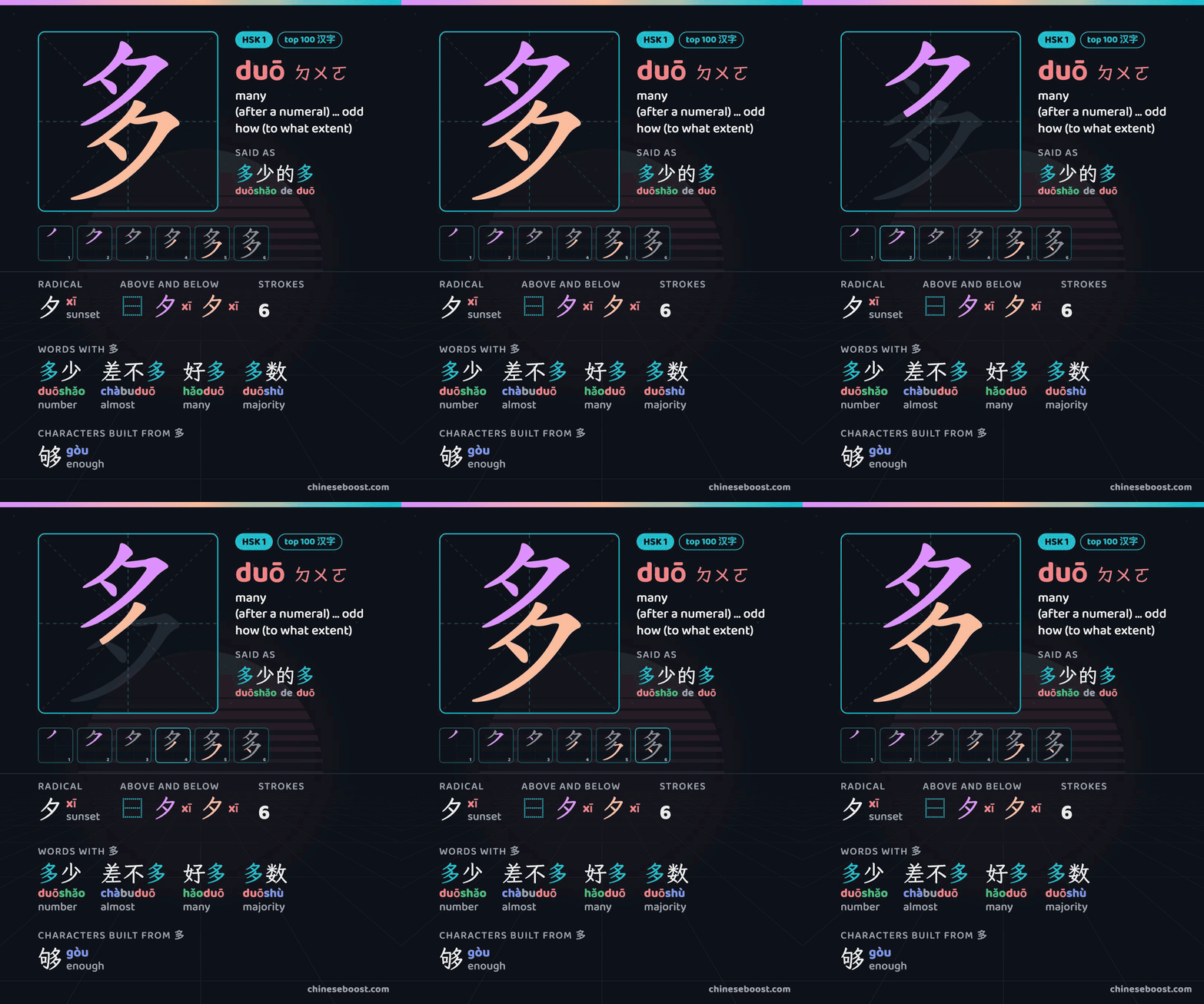
Learn to write 多
Trace 多, then write it from memory.
Start without an account.
Go to the writing drill Practise 多 with other characters Print a practice sheet
Free: 5 new Exercises a day. Pro: no daily limit. About Pro
Ancient forms of 多 (古文字)


Chinese Boost Pro
Save as many words and example sentences as you like. Use Review and start new Exercises without daily limits. Your first subscription includes a 7-day free trial.
Sign up for a free Chinese Boost account
Save the words and sentences you find here to your own list, and hear them read aloud. You can export the list to your flashcards whenever you like.
Sources
- CC-CEDICT, CC BY-SA 4.0
- pinyinjs, Apache-2.0
- HSK 考试大纲, 中外语言交流合作中心, no licence stated
- Make Me a Hanzi, from fonts by Arphic Technology Co., Ltd., Arphic Public License
- Rime 五笔字型 (Wubi 86), from ibus-table, LGPL-3.0. Wubi was invented by Wang Yongmin (王永民).
- 《说文解字》 (许慎), from shuowen.org's transcription, Apache-2.0
- 《汉字源流字典》 (谷衍奎), 语文出版社, 2008
- Ancient Chinese Characters Project (Wikimedia Commons), after Richard Sears' Chinese Etymology, public domain