Study without daily limits with Pro
Cantonese: jyun4
Classical Chinese 文言
完 wán has 4 senses in Classical Chinese. 完 in Classical Chinese.
Other words read
Other words read
The stroke order and parts of 完
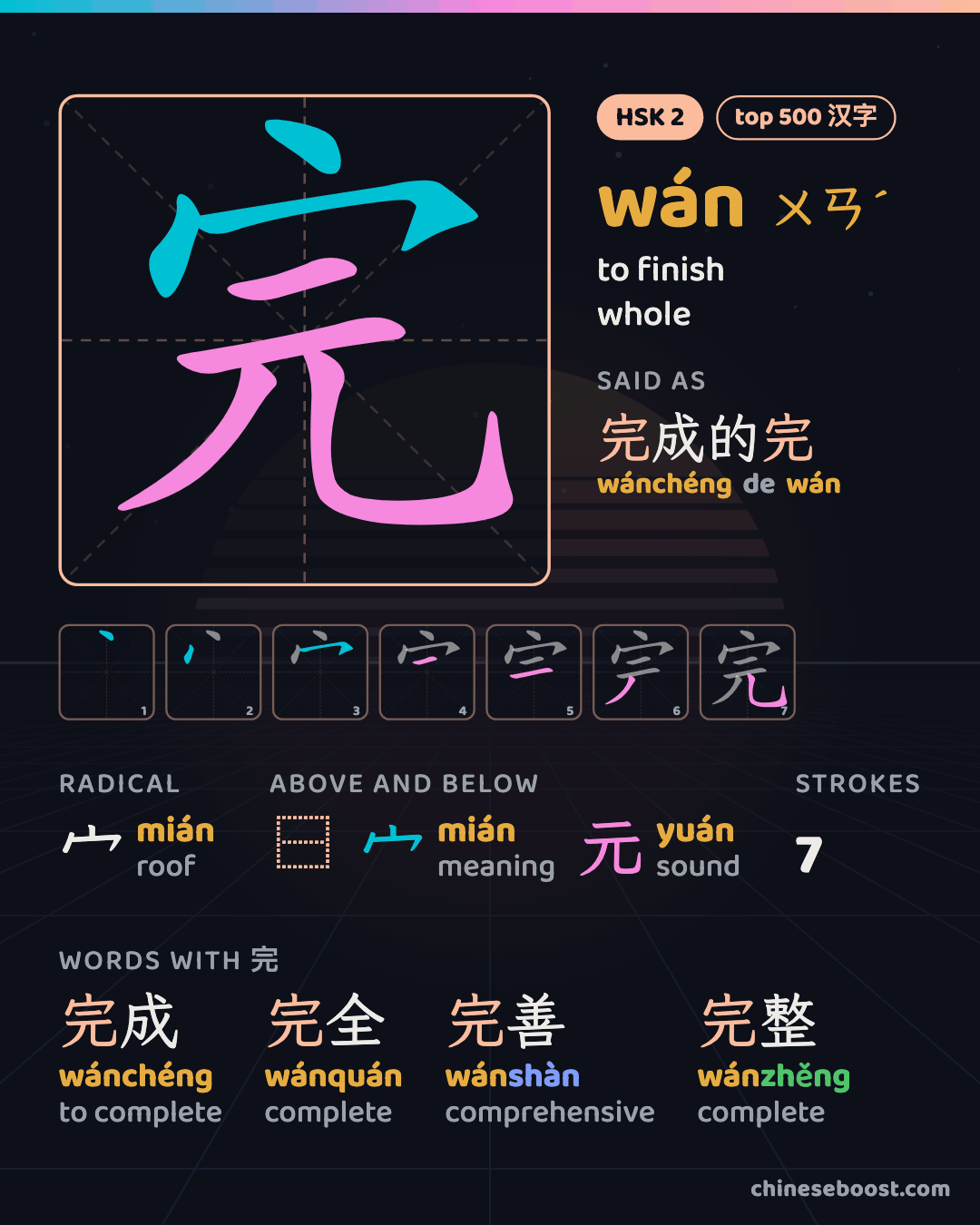
- 部首 radical
- 宀
- 笔画 strokes
- 7, with 4 after the 部首
- 结构 structure
- 上下结构
- 偏旁 parts
- 宀元宀roof+元=finishA story to help you remember, not the character’s history.“Back to the origin under a roof: finished.”
- 形旁 meaning
- 宀
- 声旁 sound
- 元
- 仓颉 Cangjie code
- 十一一山 JMMU
- 五笔 Wubi code
- PFQB
Learn to write the Chinese character 完 (wán)this character
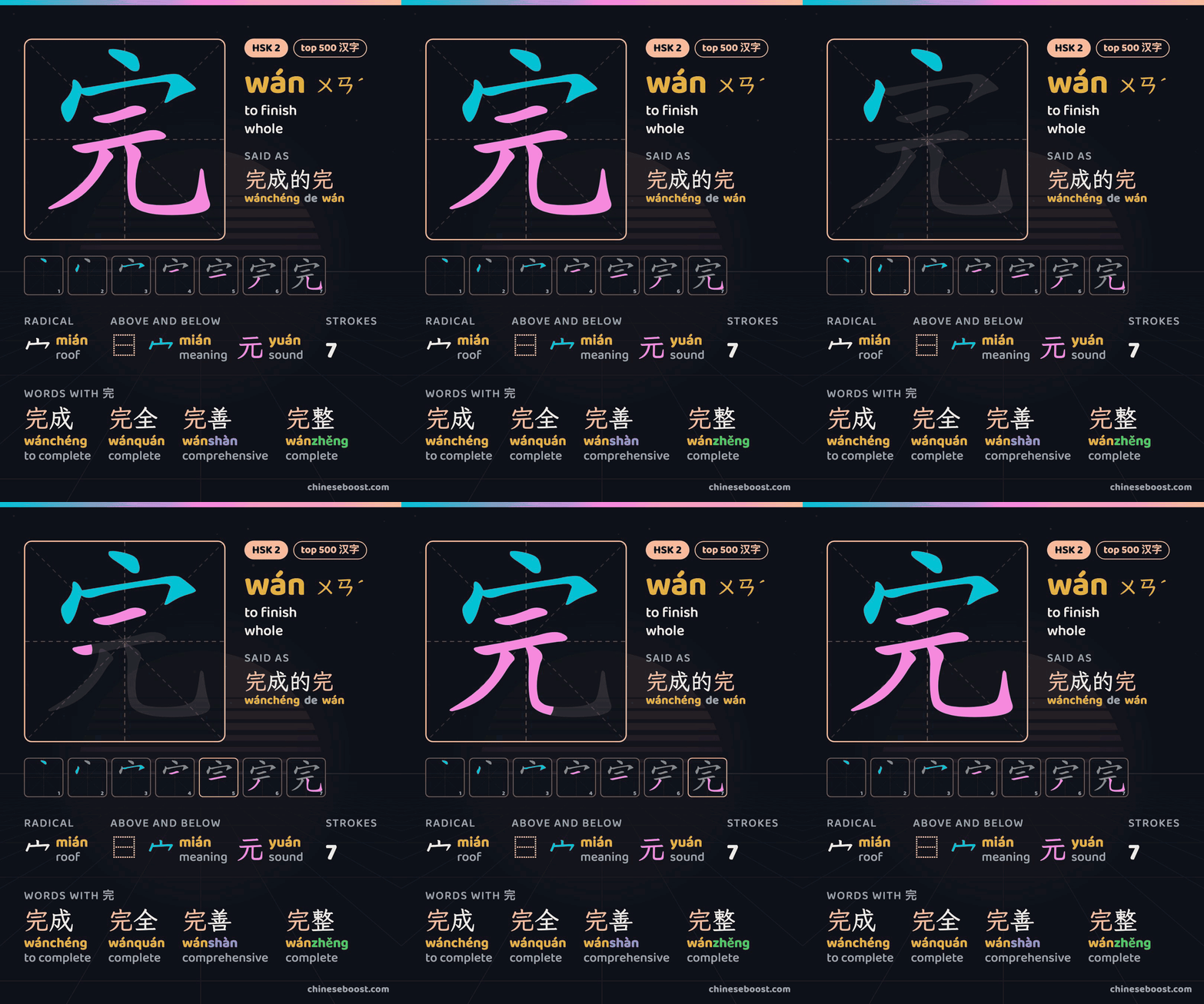
Trace 完, then write it from memory. Each stage is passed five times.
Create a free account to finish learning to write 完. You can also save it to your word list for review (复习).
Print a writing practice sheet for 完
Hanzi writing exercises that include 完: HSK 2 vocabulary, part 2: hanzi writing 3 of 9, HSK 3 vocabulary, part 2: hanzi writing 6 of 11, HSK 4 vocabulary, part 3: hanzi writing 1 of 10 and 13 more.
完 as a component 部件
完 is a direct component of 11 characters in this dictionary.
See all characters containing 完Potential verbal descriptions
- 完成的完
- 宝盖头的完
- 宝盖的完
Words with 完
Starting with 完
Ending with 完
Containing 完
- 没完没了 without end
- 体无完肤 fig. totally refuted
- 人无完人 nobody is perfect
- 臻于完善 attain perfection
- 领土完整 territorial integrity
- 不完全叶 stipule
- 不完全归纳推理 inference by incomplete induction
- 不完善 imperfect
- 功完行满 fully achieve one's ambitions
- 吃不完兜着走 you'll face serious consequences if things go wrong
- 售完即止 while stocks last
- 引号完毕 unquote
Words with 完
Starting with 完
Ending with 完
Containing 完
- 沒完沒了 without end
- 體無完膚 fig. totally refuted
- 人無完人 nobody is perfect
- 臻於完善 attain perfection
- 領土完整 territorial integrity
- 不完全葉 stipule
- 不完全歸納推理 inference by incomplete induction
- 不完善 imperfect
- 功完行滿 fully achieve one's ambitions
- 吃不完兜著走 you'll face serious consequences if things go wrong
- 售完即止 while stocks last
- 引號完畢 unquote
Texts using 完 阅读閱讀
-
听完以后,我想起本子上的那只猫。聽完以後,我想起本子上的那隻貓。聽完以後,我想起本子上的那隻貓。
-
小美的弟弟今年十八岁,快要读完高中了。小美的弟弟今年十八歲,快要讀完高中了。
-
说完,他在沙发旁坐好,继续等十一点。說完,他在沙發旁坐好,繼續等十一點。説完,他在沙發旁坐好,繼續等十一點。
5 more texts using 完
-
一天晚上,擦完地,她轻轻叹了口气,又赶紧看看四周,怕别人听见。一天晚上,擦完地,她輕輕嘆了口氣,又趕緊看看四周,怕別人聽見。一天晚上,擦完地,她輕輕嘆了口氣,又趕緊看看四周,怕別人聽見。
-
说完,我笑了。說完,我笑了。説完,我笑了。
-
说完,李成拿出四支箭,在马车的轮子上敲了几下,把箭头都弄掉了。說完,李成拿出四支箭,在馬車的輪子上敲了幾下,把箭頭都弄掉了。説完,李成拿出四支箭,在馬車的輪子上敲了幾下,把箭頭都弄掉了。
-
说完,他摆摆手,让朋友回去了。說完,他擺擺手,讓朋友回去了。説完,他擺擺手,讓朋友回去了。
-
说完,他回了自己的房间,重重地关上门。說完,他回了自己的房間,重重地關上門。説完,他回了自己的房間,重重地關上門。
Example sentences and grammar articles using 完
Save or share this card
Learn to write 完
Trace 完, then write it from memory.
Start without an account.
Go to the writing drill Practise 完 with other characters Print a practice sheet
Free: 5 new Exercises a day. Pro: no daily limit. About Pro
Chinese Boost Pro
Save as many words and example sentences as you like. Use Review and start new Exercises without daily limits. Your first subscription includes a 7-day free trial.
Sign up for a free Chinese Boost account
Save the words and sentences you find here to your own list, and hear them read aloud. You can export the list to your flashcards whenever you like.
Sources
- CC-CEDICT, CC BY-SA 4.0
- pinyinjs, Apache-2.0
- HSK 考试大纲, 中外语言交流合作中心, no licence stated
- Make Me a Hanzi, from fonts by Arphic Technology Co., Ltd., Arphic Public License
- Rime 五笔字型 (Wubi 86), from ibus-table, LGPL-3.0. Wubi was invented by Wang Yongmin (王永民).
- 《说文解字》 (许慎), from shuowen.org's transcription, Apache-2.0
- 《汉字源流字典》 (谷衍奎), 语文出版社, 2008