Study without daily limits with Pro
-
bound form
-
-
bound form
-
Cantonese: gei3
Classifiers (measure words)
- 寄了一次 send by post once
Other words read
Other words read
The stroke order and parts of 寄
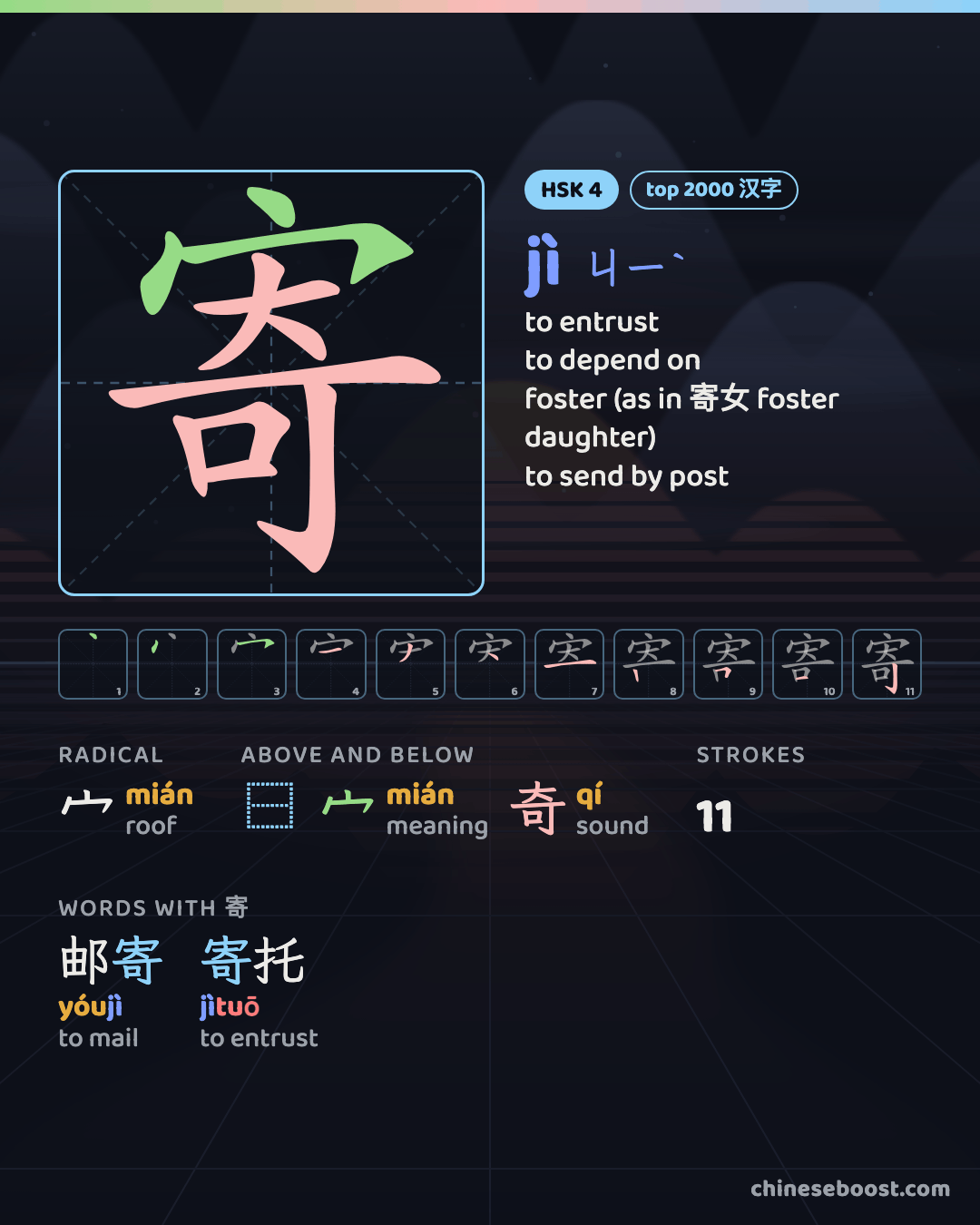
- 部首 radical
- 宀
- 笔画 strokes
- 11, with 8 after the 部首
- 结构 structure
- 上下结构
- 偏旁 parts
- 宀奇宀roof+奇strange=mailA story to help you remember, not the character’s history.“Send the strange thing out from under your roof: mail.”
- 形旁 meaning
- 宀
- 声旁 sound
- 奇
- 仓颉 Cangjie code
- 十大一口 JKMR
- 五笔 Wubi code
- PDSK
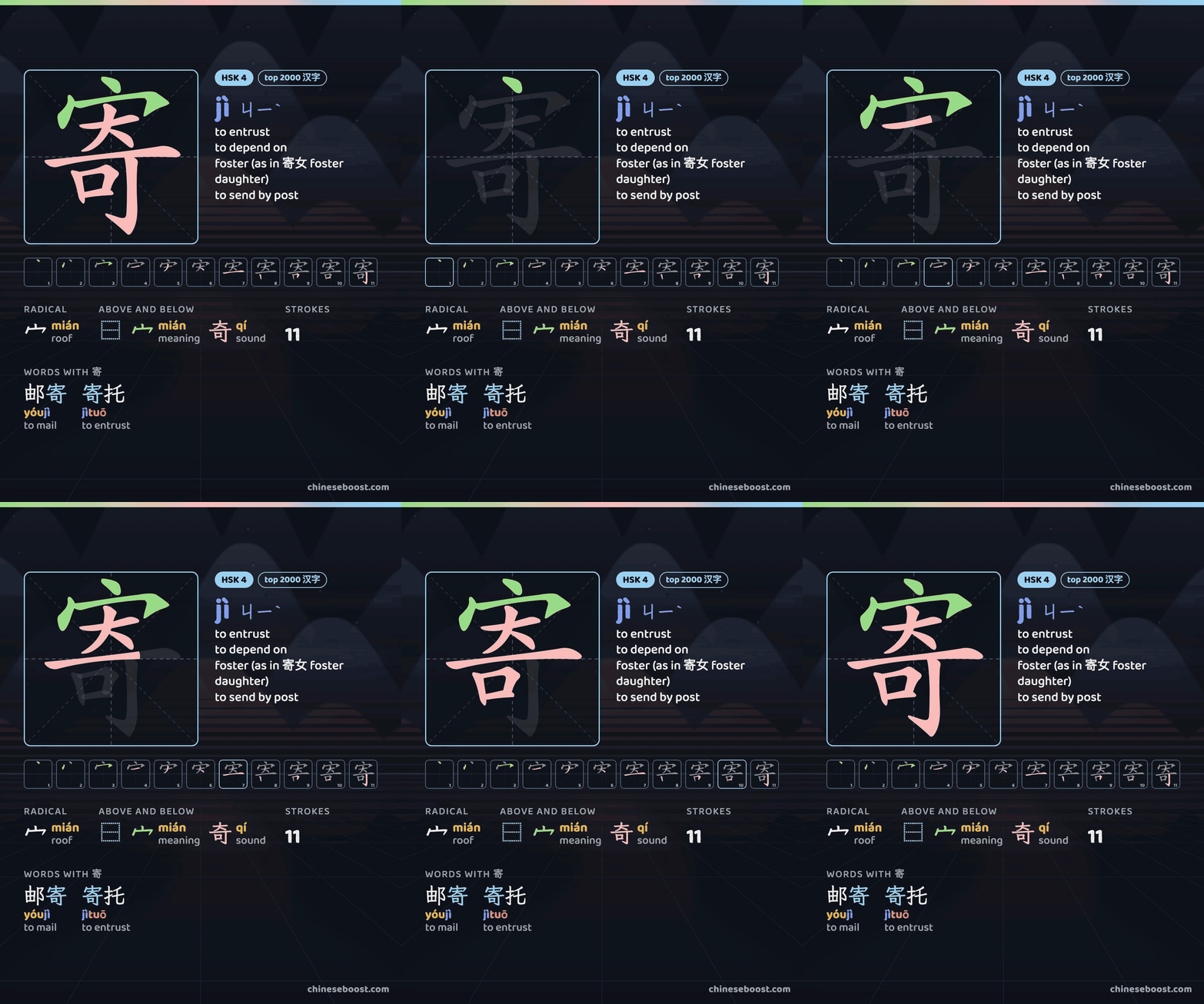
Learn to write the Chinese character 寄 (jì)this character
Trace 寄, then write it from memory. Each stage is passed five times.
Create a free account to finish learning to write 寄. You can also save it to your word list for review (复习).
Print a writing practice sheet for 寄
Hanzi writing exercises that include 寄: HSK 4 vocabulary, part 12: hanzi writing 1 of 6, HSK 5 vocabulary, part 31: hanzi writing 3 of 6, HSK 7-9 vocabulary, part 22: hanzi writing 7 of 7 and 5 more.
Potential verbal descriptions
- 宝盖头的寄
Words with 寄
Starting with 寄
Words with 寄
Starting with 寄
Texts using 寄 阅读閱讀
-
她买了一盒月饼,放在公司门口的桌子上,准备跟公司的东西一起寄走。她買了一盒月餅,放在公司門口的桌子上,準備跟公司的東西一起寄走。她買了一盒月餅,放在公司門口的桌子上,準備跟公司的東西一起寄走。
-
她决定给家人打个电话,再寄些礼物回去。她決定給家人打個電話,再寄些禮物回去。她決定給家人打個電話,再寄些禮物回去。
Example sentences and grammar articles using 寄
Classical Chinese 文言
寄 has 3 senses in Classical Chinese. 寄 in Classical Chinese.
Save or share this card
Learn to write 寄
Trace 寄, then write it from memory.
Start without an account.
Go to the writing drill Practise 寄 with other characters Print a practice sheet
Free: 3 new Exercises a day. Pro: no daily limit. About Pro
Chinese Boost Pro
Save as many words and example sentences as you like. Use Review and start new Exercises without daily limits. Your first subscription includes a 7-day free trial.
Sign up for a free Chinese Boost account
Save the words and sentences you find here to your own list, and hear them read aloud. You can export the list to your flashcards whenever you like.
Sources
- CC-CEDICT, CC BY-SA 4.0
- pinyinjs, Apache-2.0
- HSK 考试大纲, 中外语言交流合作中心, no licence stated
- Make Me a Hanzi, from fonts by Arphic Technology Co., Ltd., Arphic Public License
- Rime 五笔字型 (Wubi 86), from ibus-table, LGPL-3.0. Wubi was invented by Wang Yongmin (王永民).
- 《说文解字》 (许慎), from shuowen.org's transcription, Apache-2.0
- 《汉字源流字典》 (谷衍奎), 语文出版社, 2008