Study without daily limits with Pro
-
particle
As in 说得很好 (shuō de hěn hǎo).
-
particle
Cantonese: dak1
Other words read
Other words read
-
verb
Colloquial, and stronger than 要 (yào).
-
verb
Other words read
dei with other tones
- 嘚 gee up
- verb
Synonyms and antonyms
Antonyms 反义词
-
失
- 失去 lose
- 丢失 lose (something)
Classical Chinese 文言
得 dé has 6 senses in Classical Chinese. 得 in Classical Chinese.
Other words read
Other words read
The stroke order and parts of 得
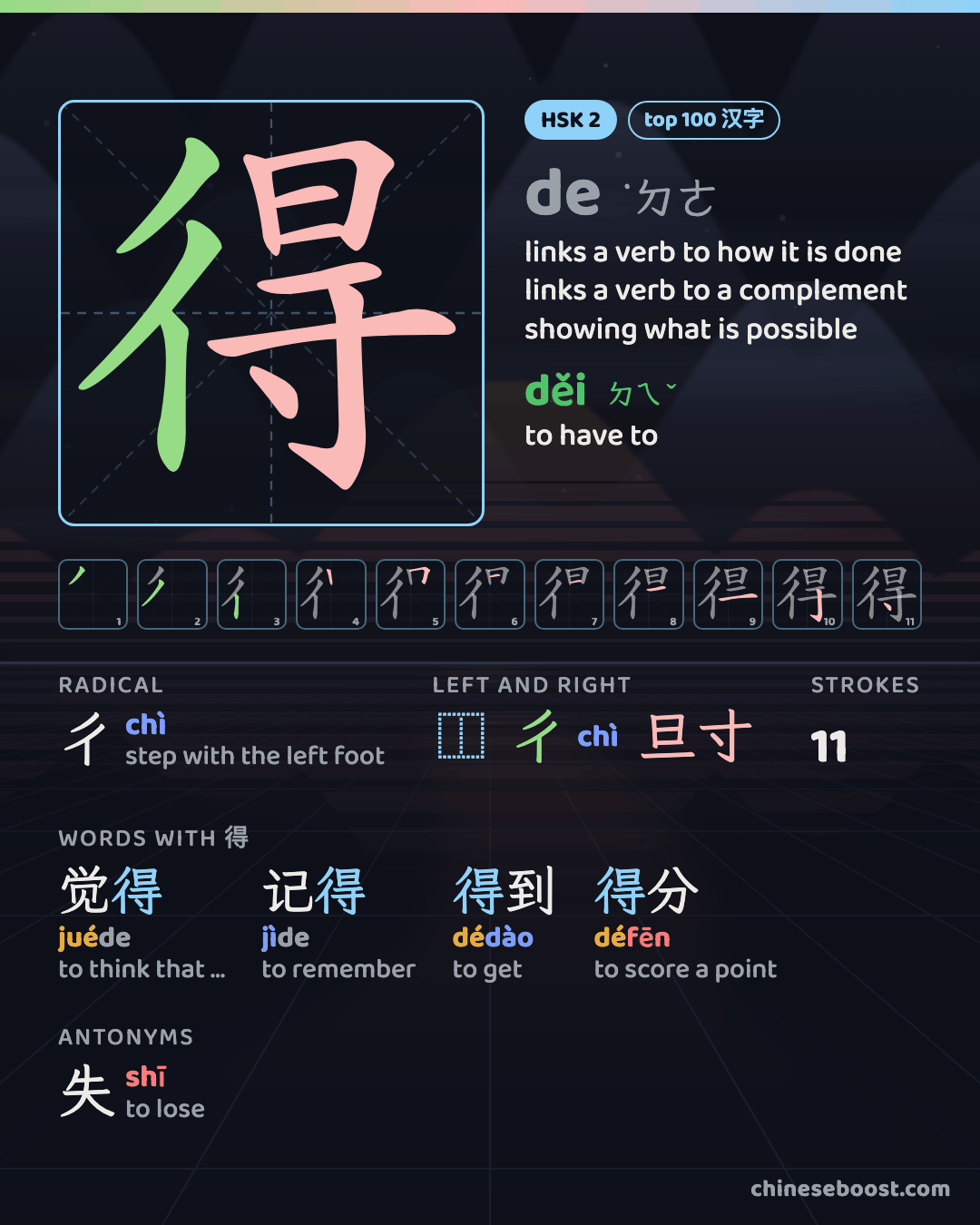
- 部首 radical
- 彳
- 笔画 strokes
- 11, with 8 after the 部首
- 结构 structure
- 左右结构
- 偏旁 parts
- 彳旦寸彳step+㝵obtain=getA story to help you remember, not the character’s history.“One step further and you obtain it: get.”
- 仓颉 Cangjie code
- 竹人日一戈 HOAMI
- 五笔 Wubi code
- TJGF
Learn to write the Chinese character 得 (de)this character
Trace 得, then write it from memory. Each stage is passed five times.
Create a free account to finish learning to write 得. You can also save it to your word list for review (复习).
Print a writing practice sheet for 得
Hanzi writing exercises that include 得: HSK 1 vocabulary, part 3: hanzi writing 3 of 8, HSK 2 vocabulary, part 1: hanzi writing 1 of 10, HSK 3 vocabulary, part 2: hanzi writing 4 of 11 and 28 more.
Easy to confuse with 得
-
地
Similar sound
Both are particles read de. 地 (de) goes before a verb, as in 慢慢地走 (mànmàn de zǒu); 得 (de) goes after a verb or adjective, as in 走得慢 (zǒu de màn).
-
的
Similar sound
Both are particles read de. 的 (de) follows a modifier before a noun, as in 我的书 (wǒ de shū); 得 (de) introduces a complement after a verb, as in 跑得快 (pǎo de kuài).
Potential verbal descriptions
- 得到的得
- 双人旁的得
Words with 得
Starting with 得
Words with 得
Starting with 得
Texts using 得 阅读閱讀
-
她唱得很好听。她唱得很好聽。她唱得很好聽。
-
有的狗玩得很高兴,不想回家。有的狗玩得很高興,不想回家。有的狗玩得很高興,不想回家。
-
我笑着对女儿说:“看来,你得在别的本子上也画只猫了!”我笑著對女兒說:“看來,你得在別的本子上也畫只貓了!”我笑着對女兒説:“看來,你得在別的本子上也畫只貓了!”
17 more texts using 得
-
您游得真好,我今天第一次游泳。您遊得真好,我今天第一次游泳。您遊得真好,我今天第一次游泳。
-
妈妈拿出一条红裤子,说:“考试穿红色的,能考得好!”媽媽拿出一條紅褲子,說:“考試穿紅色的,能考得好!”媽媽拿出一條紅褲子,説:“考試穿紅色的,能考得好!”
-
不过,我想了很久,这份工作,你能比别人做得更好。不過,我想了很久,這份工作,你能比別人做得更好。不過,我想了很久,這份工作,你能比別人做得更好。
-
可是,从那以后,他笑得少了。可是,從那以後,他笑得少了。可是,從那以後,他笑得少了。
-
小唐看得太快,以为过节那周不能请假。小唐看得太快,以為過節那周不能請假。小唐看得太快,以為過節那周不能請假。
-
她又叹了口气,这一次叹得更长,眼泪掉在了屏幕上。她又嘆了口氣,這一次嘆得更長,眼淚掉在了屏幕上。她又嘆了口氣,這一次嘆得更長,眼淚掉在了屏幕上。
-
他说:‘我的马很好,跑得快。’他說:‘我的馬很好,跑得快。’他説:‘我的馬很好,跑得快。’
-
我以前没一个人住过,他每天晚上都打电话来,问我吃饭没有、门关好没有、衣服穿得暖不暖。我以前沒一個人住過,他每天晚上都打電話來,問我吃飯沒有、門關好沒有、衣服穿得暖不暖。我以前沒一個人住過,他每天晚上都打電話來,問我吃飯沒有、門關好沒有、衣服穿得暖不暖。
-
直到现在,我们还得去很远的地方取水。直到現在,我們還得去很遠的地方取水。直到現在,我們還得去很遠的地方取水。
-
苏琪想早点回去工作,可是连用手机都得重新学。蘇琪想早點回去工作,可是連用手機都得重新學。蘇琪想早點回去工作,可是連用手機都得重新學。
-
有一天,管家病得很重,眼看就要去世了。
-
两个人怕得转身就跑,连头也不敢回。兩個人怕得轉身就跑,連頭也不敢回。兩個人怕得轉身就跑,連頭也不敢回。
-
在你爸爸家住得怎么样?在你爸爸家住得怎麼樣?
-
妻子高兴得笑了起来,拉着朋友的手聊起天来。妻子高興得笑了起來,拉著朋友的手聊起天來。妻子高興得笑了起來,拉着朋友的手聊起天來。
-
赶车的人不明白:“他的箭射得那么准,您怎么反而放心了?”趕車的人不明白:“他的箭射得那麼準,您怎麼反而放心了?”趕車的人不明白:“他的箭射得那麼準,您怎麼反而放心了?”
-
他实在不愿意,可眼看生意一天天冷清下去,妻子急得吃不下饭,他又说不出一个“不”字。他實在不願意,可眼看生意一天天冷清下去,妻子急得吃不下飯,他又說不出一個“不”字。他實在不願意,可眼看生意一天天冷清下去,妻子急得吃不下飯,他又説不出一個“不”字。
-
一路上虽然有几段坡路,但驴走得很稳。一路上雖然有幾段坡路,但驢走得很穩。
Example sentences and grammar articles using 得
Save or share this card
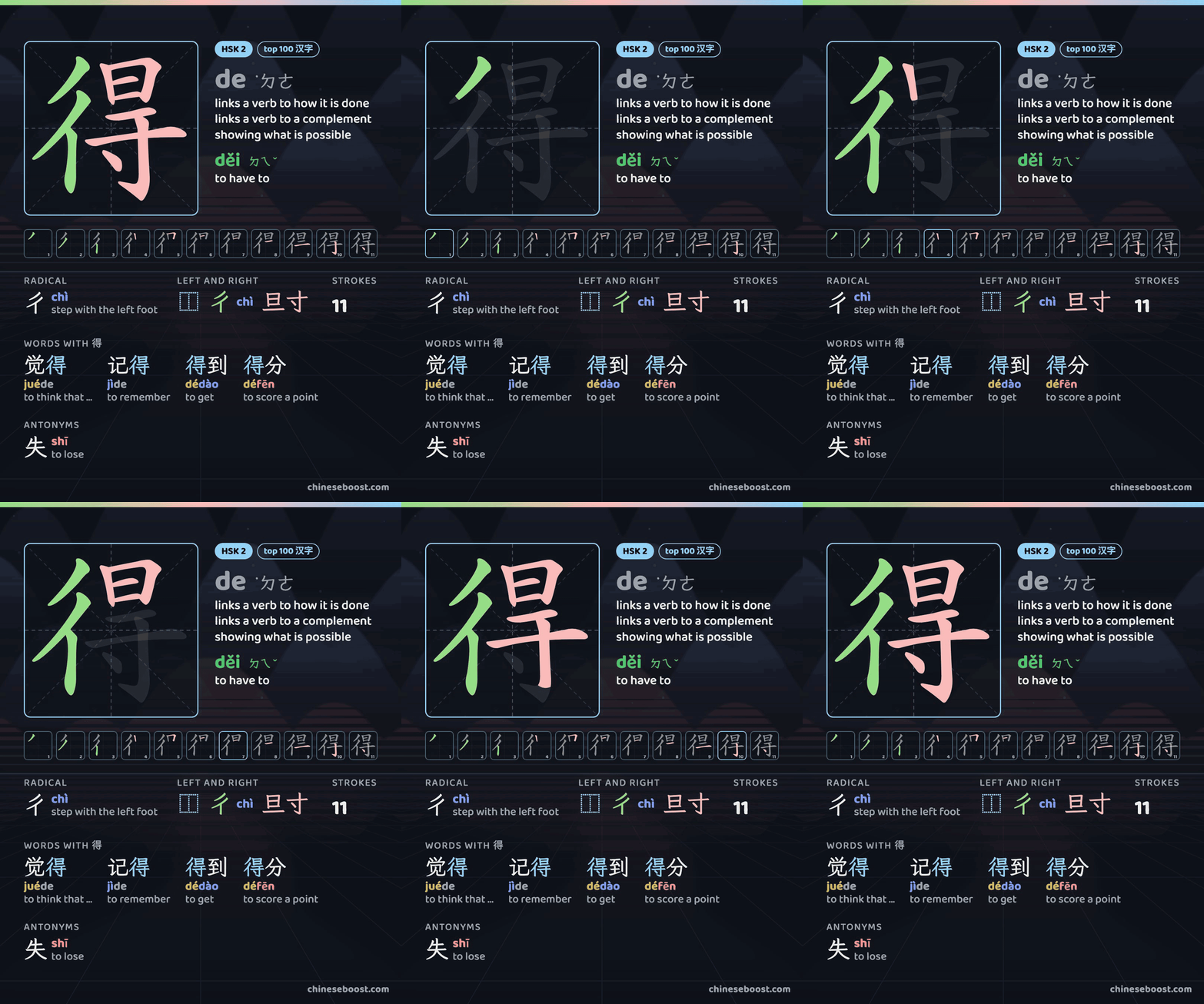
Learn to write 得
Trace 得, then write it from memory.
Start without an account.
Go to the writing drill Practise 得 with other characters Print a practice sheet
Free: 5 new Exercises a day. Pro: no daily limit. About Pro
Ancient forms of 得 (古文字)


Chinese Boost Pro
Save as many words and example sentences as you like. Use Review and start new Exercises without daily limits. Your first subscription includes a 7-day free trial.
Sign up for a free Chinese Boost account
Save the words and sentences you find here to your own list, and hear them read aloud. You can export the list to your flashcards whenever you like.
Sources
- CC-CEDICT, CC BY-SA 4.0
- pinyinjs, Apache-2.0
- HSK 考试大纲, 中外语言交流合作中心, no licence stated
- Make Me a Hanzi, from fonts by Arphic Technology Co., Ltd., Arphic Public License
- Rime 五笔字型 (Wubi 86), from ibus-table, LGPL-3.0. Wubi was invented by Wang Yongmin (王永民).
- 《说文解字》 (许慎), from shuowen.org's transcription, Apache-2.0
- 《汉字源流字典》 (谷衍奎), 语文出版社, 2008
- Ancient Chinese Characters Project (Wikimedia Commons), after Richard Sears' Chinese Etymology, public domain