Study without daily limits with Pro
Cantonese: mong4
Classical Chinese 文言
忘 wàng has 3 senses in Classical Chinese. 忘 in Classical Chinese.
Other words read
Other words read
The stroke order and parts of 忘
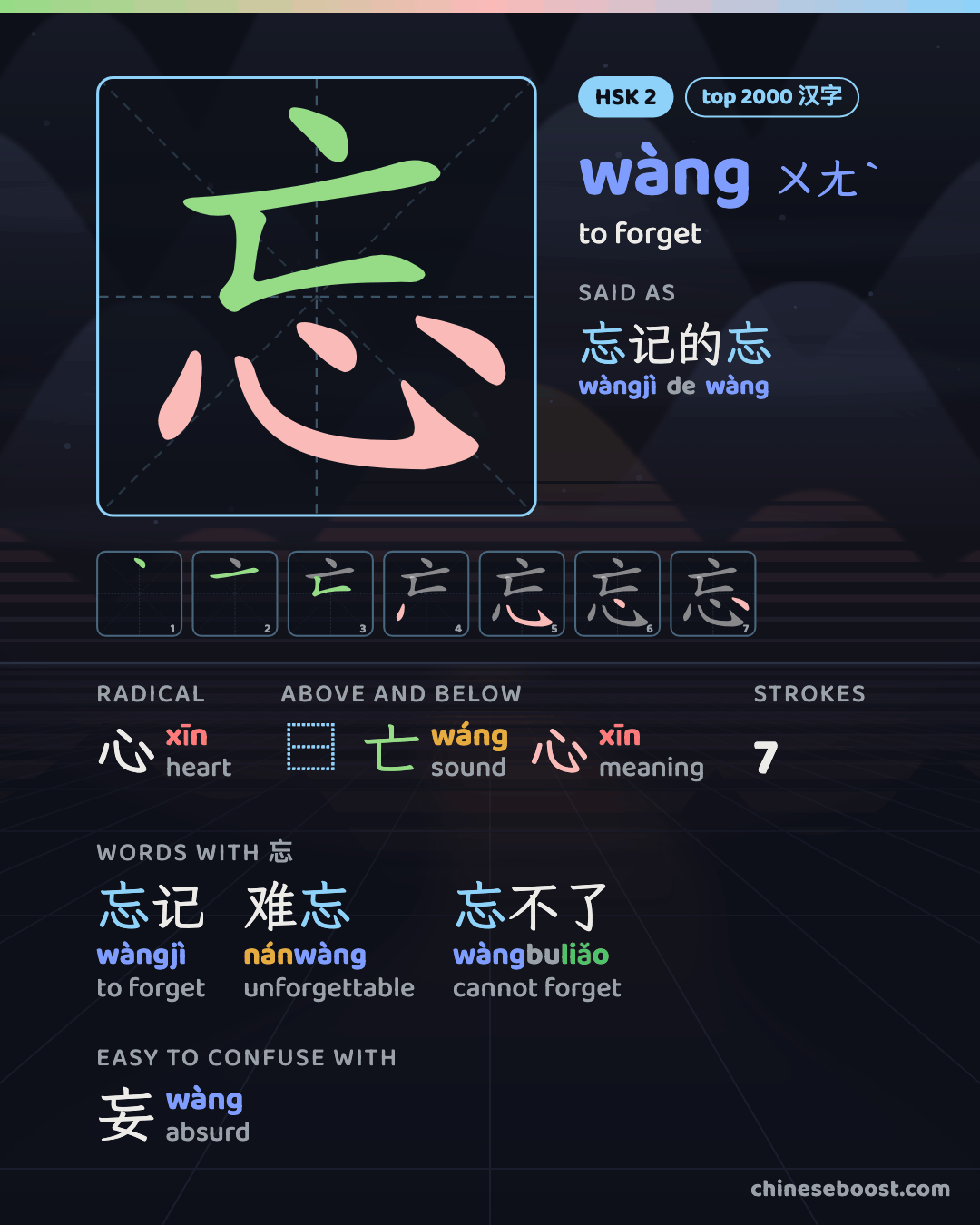
- 部首 radical
- 心
- 笔画 strokes
- 7, with 3 after the 部首
- 结构 structure
- 上下结构
- 偏旁 parts
- 亡心亡perish+心heart=forgetA story to help you remember, not the character’s history.“Let the heart perish and you forget.”
- 形旁 meaning
- 心
- 声旁 sound
- 亡
- 仓颉 Cangjie code
- 卜女心 YVP
- 五笔 Wubi code
- YNNU
Songs and sayings about parts
-
Show full song From 连心歌 田在心上思想好 田 over 心: good thinking (思). 士在心上斗志高 士 over 心: fighting spirit (志). 秋在心上真发愁 秋 over 心: real worry (愁). 奴在心上怒火烧 奴 over 心: burning anger (怒). 咸在心上谈感想 咸 over 心: sharing impressions (感). 原在心上说愿望 原 over 心: speaking of wishes (愿). 亡在心上爱忘事 亡 over 心: always forgetting (忘). 非在心上要悲伤 非 over 心: sorrow (悲).
Learn to write the Chinese character 忘 (wàng)this character
Trace 忘, then write it from memory. Each stage is passed five times.
Create a free account to finish learning to write 忘. You can also save it to your word list for review (复习).
Print a writing practice sheet for 忘
Hanzi writing exercises that include 忘: HSK 2 vocabulary, part 3: hanzi writing 2 of 8, HSK 3 vocabulary, part 6: hanzi writing 8 of 8, HSK 4 vocabulary, part 18: hanzi writing 2 of 6 and 7 more.
Easy to confuse with 忘
-
妄
Similar shape and sound
Both wàng, both with 亡 on top. 妄 (wàng) has 女 below and means rash or absurd (妄想); 忘 (wàng) has 心 below and means to forget (忘记).
Potential verbal descriptions
- 忘记的忘
- 亡心忘
- 心字底的忘
Words with 忘
Starting with 忘
Ending with 忘
Containing 忘
- 备忘录 memorandum
- 流连忘返 linger
- 舍生忘死 undaunted by perils
- 得意忘形 so pleased as to lose one's sense of measure
- 废寝忘食 skip one's sleep and meals
- 见利忘义 abandon moral principles in the pursuit of profit
- 数典忘祖 forget one's roots
- 公而忘私 behave altruistically
- 舍死忘生 risk one's life
- 得意忘言 once the meaning is grasped, forget the words
- 勿忘我 forget-me-not, genus Myosotis
- 乐而忘返 enjoy oneself so much as to forget to go home
Words with 忘
Starting with 忘
Ending with 忘
Containing 忘
- 備忘錄 memorandum
- 流連忘返 linger
- 捨生忘死 undaunted by perils
- 得意忘形 so pleased as to lose one's sense of measure
- 廢寢忘食 skip one's sleep and meals
- 見利忘義 abandon moral principles in the pursuit of profit
- 數典忘祖 forget one's roots
- 公而忘私 behave altruistically
- 捨死忘生 risk one's life
- 得意忘言 once the meaning is grasped, forget the words
- 勿忘我 forget-me-not, genus Myosotis
- 樂而忘返 enjoy oneself so much as to forget to go home
Texts using 忘 阅读閱讀
-
她笑着说:“我忘了给自己点。”她笑著說:“我忘了給自己點。”她笑着説:“我忘了給自己點。”
-
以前的事,我们都忘了吧。以前的事,我們都忘了吧。
-
一天,她从自行车上摔了下来,在医院醒来后,发现自己不记得最近几年的事了:工作、住的地方、朋友,全忘了。一天,她從自行車上摔了下來,在醫院醒來後,發現自己不記得最近幾年的事了:工作、住的地方、朋友,全忘了。一天,她從自行車上摔了下來,在醫院醒來後,發現自己不記得最近幾年的事了:工作、住的地方、朋友,全忘了。
4 more texts using 忘
-
我都快忘了自己为什么要用这个软件了。我都快忘了自己為什麼要用這個軟件了。我都快忘了自己為什麼要用這個軟件了。
-
时间一长,老人渐渐忘了管家的提醒。時間一長,老人漸漸忘了管家的提醒。
-
早上得到的东西,晚上就忘了;走在路上,忘了自己正在走路;回到家,连坐下也忘了。早上得到的東西,晚上就忘了;走在路上,忘了自己正在走路;回到家,連坐下也忘了。早上得到的東西,晚上就忘了;走在路上,忘了自己正在走路;回到家,連坐下也忘了。
-
白天做饭,他不是把菜烧糊,就是忘了客人点了什么。白天做飯,他不是把菜燒糊,就是忘了客人點了什麼。白天做飯,他不是把菜燒糊,就是忘了客人點了什麼。
Example sentences and grammar articles using 忘
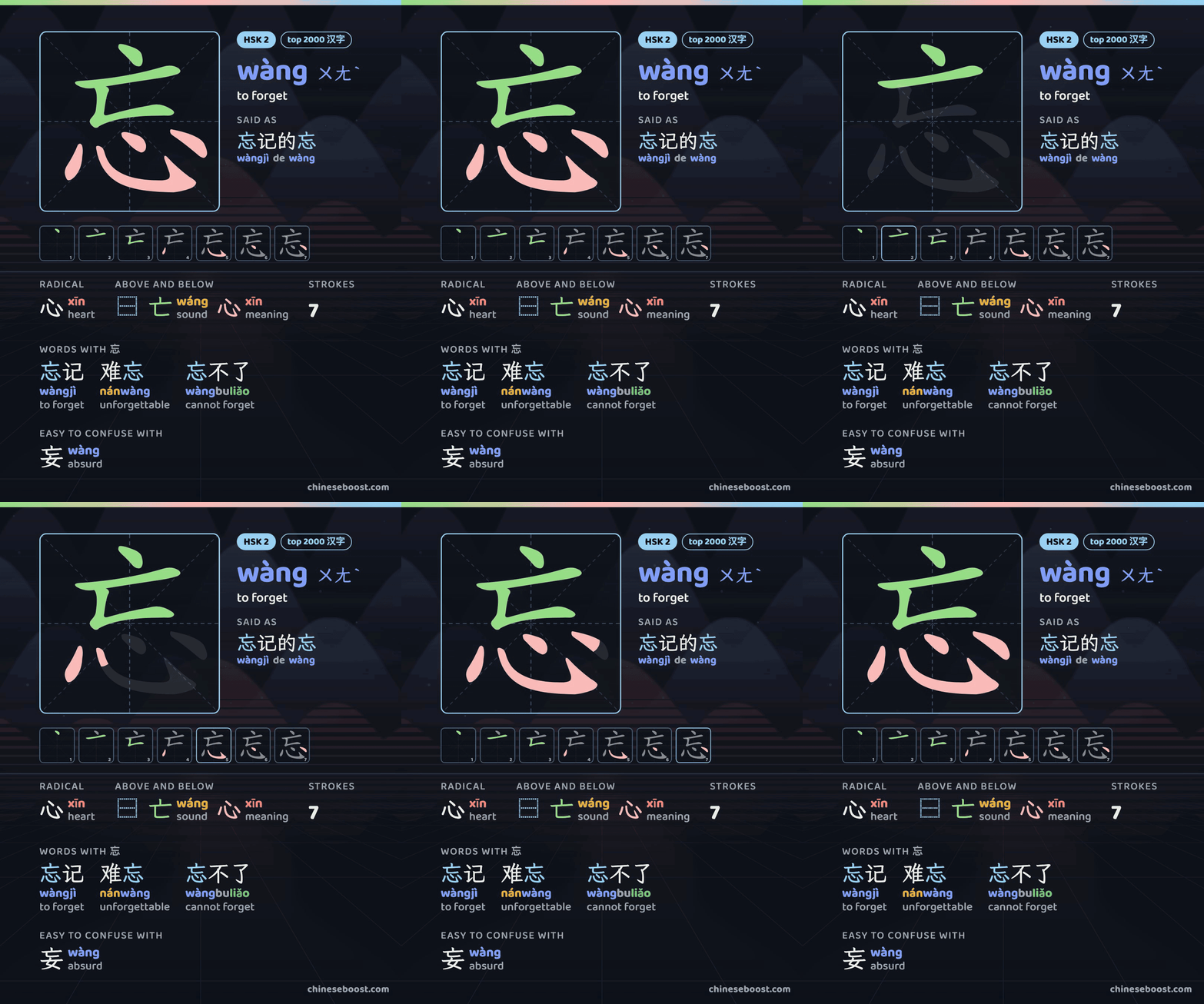
Save or share this card
Learn to write 忘
Trace 忘, then write it from memory.
Start without an account.
Go to the writing drill Practise 忘 with other characters Print a practice sheet
Free: 5 new Exercises a day. Pro: no daily limit. About Pro
Ancient forms of 忘 (古文字)


Chinese Boost Pro
Save as many words and example sentences as you like. Use Review and start new Exercises without daily limits. Your first subscription includes a 7-day free trial.
Sign up for a free Chinese Boost account
Save the words and sentences you find here to your own list, and hear them read aloud. You can export the list to your flashcards whenever you like.
Sources
- CC-CEDICT, CC BY-SA 4.0
- pinyinjs, Apache-2.0
- HSK 考试大纲, 中外语言交流合作中心, no licence stated
- Make Me a Hanzi, from fonts by Arphic Technology Co., Ltd., Arphic Public License
- Rime 五笔字型 (Wubi 86), from ibus-table, LGPL-3.0. Wubi was invented by Wang Yongmin (王永民).
- 《说文解字》 (许慎), from shuowen.org's transcription, Apache-2.0
- 《汉字源流字典》 (谷衍奎), 语文出版社, 2008
- Ancient Chinese Characters Project (Wikimedia Commons), after Richard Sears' Chinese Etymology, public domain