Study without daily limits with Pro
Cantonese: gap1
Synonyms and antonyms
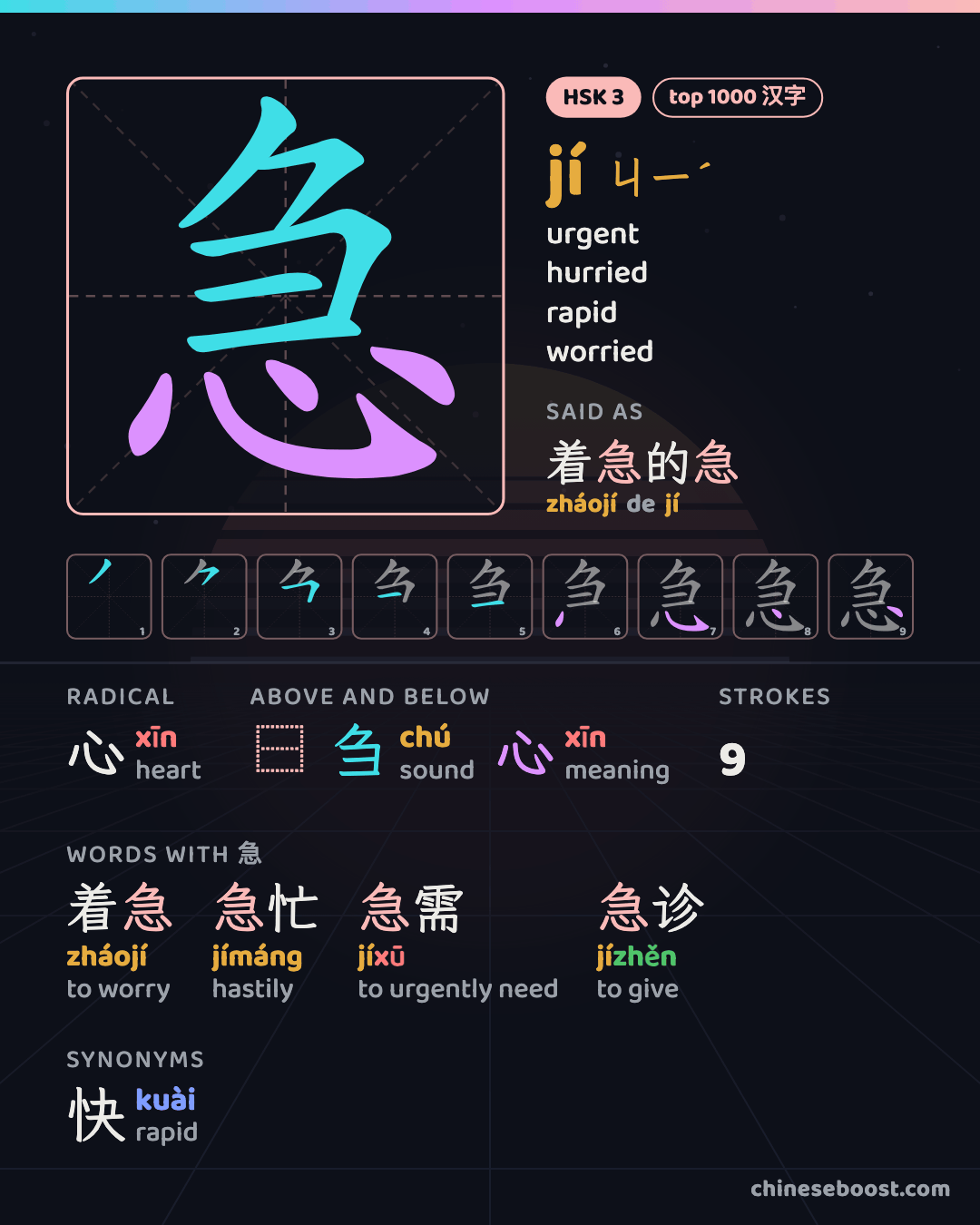
hurried; urgent; rapid
Synonyms 近义词
-
快
- 快车 express train
- 跑得快 to run fast
Antonyms 反义词
worried
Synonyms 近义词
-
躁
- 烦躁 irritable and restless
- 脾气躁 short-tempered
Classical Chinese 文言
急 jí has 9 senses in Classical Chinese. 急 in Classical Chinese.
Other words read
Other words read
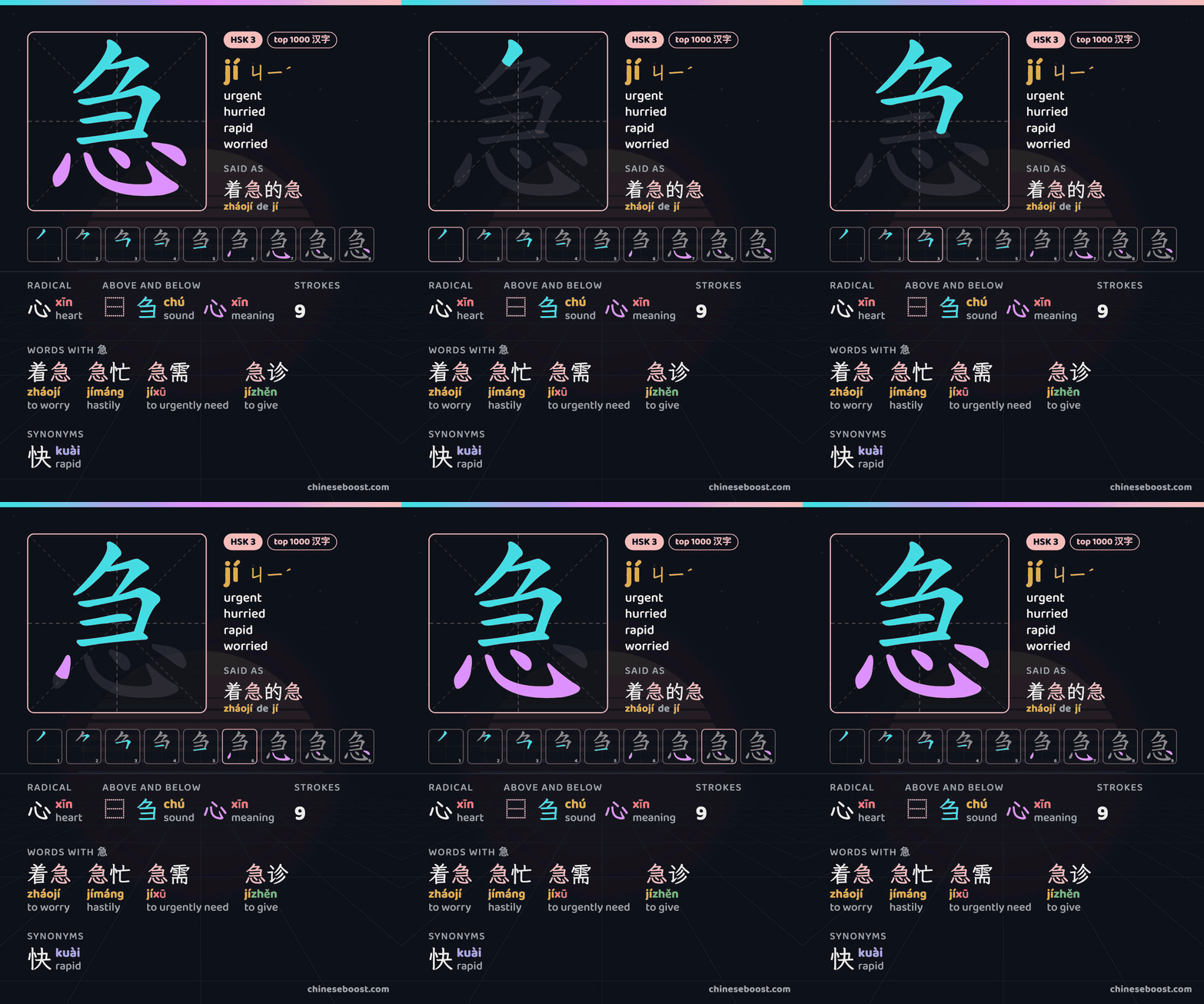
The stroke order and parts of 急
- 部首 radical
- 心
- 笔画 strokes
- 9, with 5 after the 部首
- 结构 structure
- 上下结构
- 偏旁 parts
- 刍心刍hay(placeholder)+心heart=hurriedA story to help you remember, not the character’s history.“Hay piled on the heart makes it hurried.”
- 形旁 meaning
- 心
- 声旁 sound
- 刍
- 仓颉 Cangjie code
- 弓尸心 NSP
- 五笔 Wubi code
- QVNU
Learn to write the Chinese character 急 (jí)this character
Trace 急, then write it from memory. Each stage is passed five times.
Create a free account to finish learning to write 急. You can also save it to your word list for review (复习).
Print a writing practice sheet for 急
Hanzi writing exercises that include 急: HSK 3 vocabulary, part 3: hanzi writing 2 of 10, HSK 5 vocabulary, part 15: hanzi writing 1 of 7, HSK 6 vocabulary, part 29: hanzi writing 3 of 4 and 7 more.
急 as a component 部件
急 appears in 4 characters in this dictionary, either directly (3 characters) or within a larger component.
See all characters containing 急Easy to confuse with 急
-
极
Similar sound
Both are read jí. 极 (jí) has 木 and means extreme, as in 极了 (jíle); 急 (jí) has 心 (heart) and means anxious or urgent, as in 着急 (zháojí).
-
疾
Similar sound
Both are read jí and mean fast. 疾 (jí) has 疒 (sickness) and means illness or swift, as in 疾病 (jíbìng); 急 (jí) has 心 and means anxious or urgent, as in 着急 (zháojí).
-
亟
Similar sound
Both are read jí and mean urgent. 亟 (jí) is literary, as in 亟需 (jíxū); 急 (jí) has 心 and is the everyday word, as in 紧急 (jǐnjí).
Potential verbal descriptions
- 着急的急
- 心字底的急
Words with 急
Starting with 急
Ending with 急
Containing 急
- 紧急状态 state of emergency
- 气急败坏 flustered and exasperated
- 情急之下 in a moment of desperation
- 心急如焚 burning with anxiety
- 心急火燎 extremely anxious
- 情急智生 inspiration in a moment of desperation
- 狗急跳墙 cornered dog will jump over the wall
- 病急乱投医 fig. to try anyone or anything in a crisis
- 不急之务 matter of no great urgency
- 火急火燎 flustered and anxious
- 心急如火 extremely anxious
- 亚急性 subacute
Words with 急
Starting with 急
Ending with 急
Containing 急
- 緊急狀態 state of emergency
- 氣急敗壞 flustered and exasperated
- 情急之下 in a moment of desperation
- 心急如焚 burning with anxiety
- 心急火燎 extremely anxious
- 情急智生 inspiration in a moment of desperation
- 狗急跳牆 cornered dog will jump over the wall
- 病急亂投醫 fig. to try anyone or anything in a crisis
- 不急之務 matter of no great urgency
- 火急火燎 flustered and anxious
- 心急如火 extremely anxious
- 亞急性 subacute
Texts using 急 阅读閱讀
-
医生说:别急着让她想起以前的事,这样会给她压力。醫生說:別急著讓她想起以前的事,這樣會給她壓力。醫生説:別急着讓她想起以前的事,這樣會給她壓力。
-
她又急又怕,想找人帮忙,却担心老人等不了那么久。她又急又怕,想找人幫忙,卻擔心老人等不了那麼久。
-
他实在不愿意,可眼看生意一天天冷清下去,妻子急得吃不下饭,他又说不出一个“不”字。他實在不願意,可眼看生意一天天冷清下去,妻子急得吃不下飯,他又說不出一個“不”字。他實在不願意,可眼看生意一天天冷清下去,妻子急得吃不下飯,他又説不出一個“不”字。
Example sentences and grammar articles using 急
Save or share this card
Learn to write 急
Trace 急, then write it from memory.
Start without an account.
Go to the writing drill Practise 急 with other characters Print a practice sheet
Free: 5 new Exercises a day. Pro: no daily limit. About Pro
Ancient forms of 急 (古文字)

Chinese Boost Pro
Save as many words and example sentences as you like. Use Review and start new Exercises without daily limits. Your first subscription includes a 7-day free trial.
Sign up for a free Chinese Boost account
Save the words and sentences you find here to your own list, and hear them read aloud. You can export the list to your flashcards whenever you like.
Sources
- CC-CEDICT, CC BY-SA 4.0
- pinyinjs, Apache-2.0
- HSK 考试大纲, 中外语言交流合作中心, no licence stated
- Make Me a Hanzi, from fonts by Arphic Technology Co., Ltd., Arphic Public License
- Rime 五笔字型 (Wubi 86), from ibus-table, LGPL-3.0. Wubi was invented by Wang Yongmin (王永民).
- 《说文解字》 (许慎), from shuowen.org's transcription, Apache-2.0
- 《汉字源流字典》 (谷衍奎), 语文出版社, 2008
- Ancient Chinese Characters Project (Wikimedia Commons), after Richard Sears' Chinese Etymology, public domain