Study without daily limits with Pro
literary
Cantonese: goi1
Classical Chinese 文言
該 gāi has 6 senses in Classical Chinese. 該 in Classical Chinese.
Other words read
In the same tone
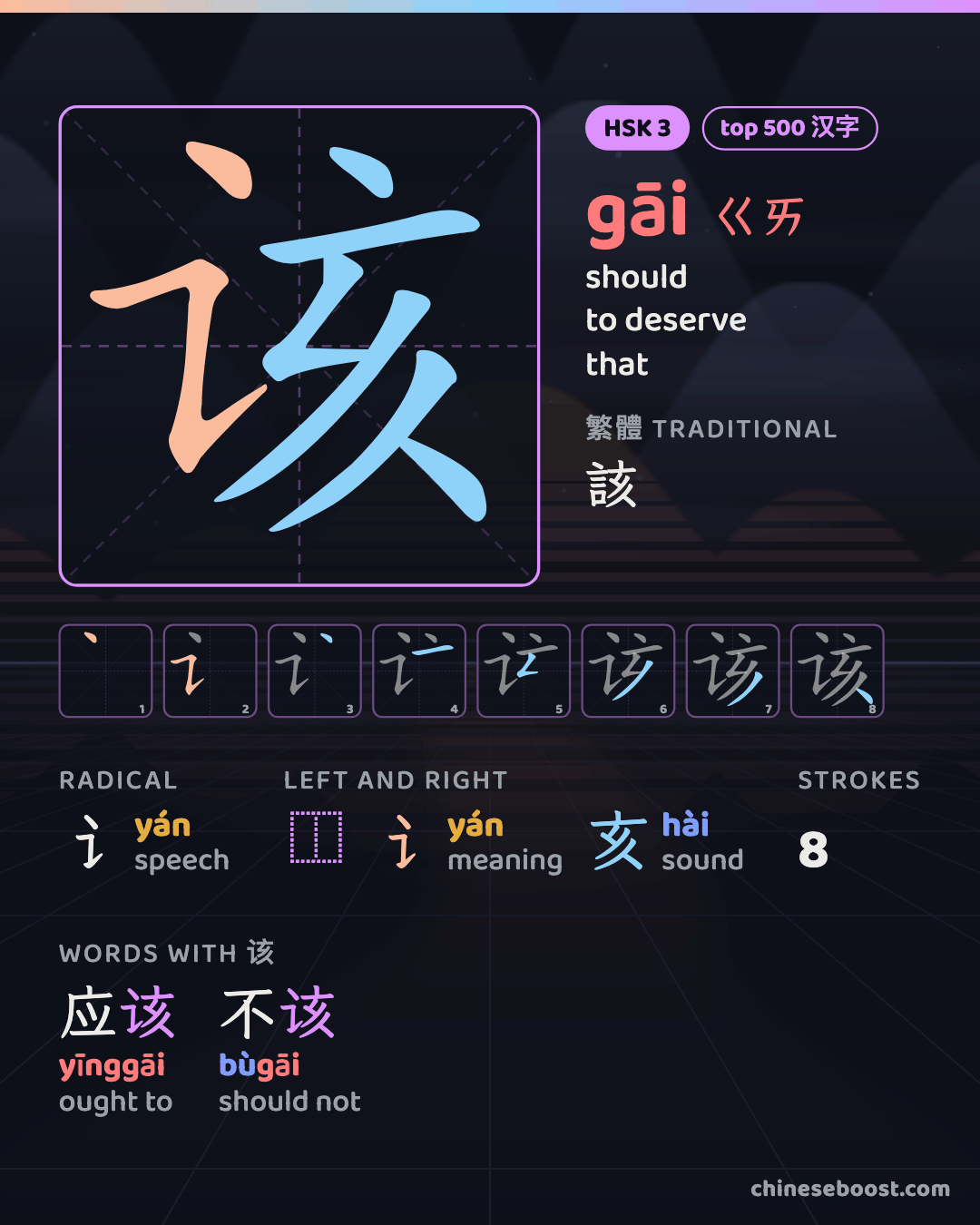
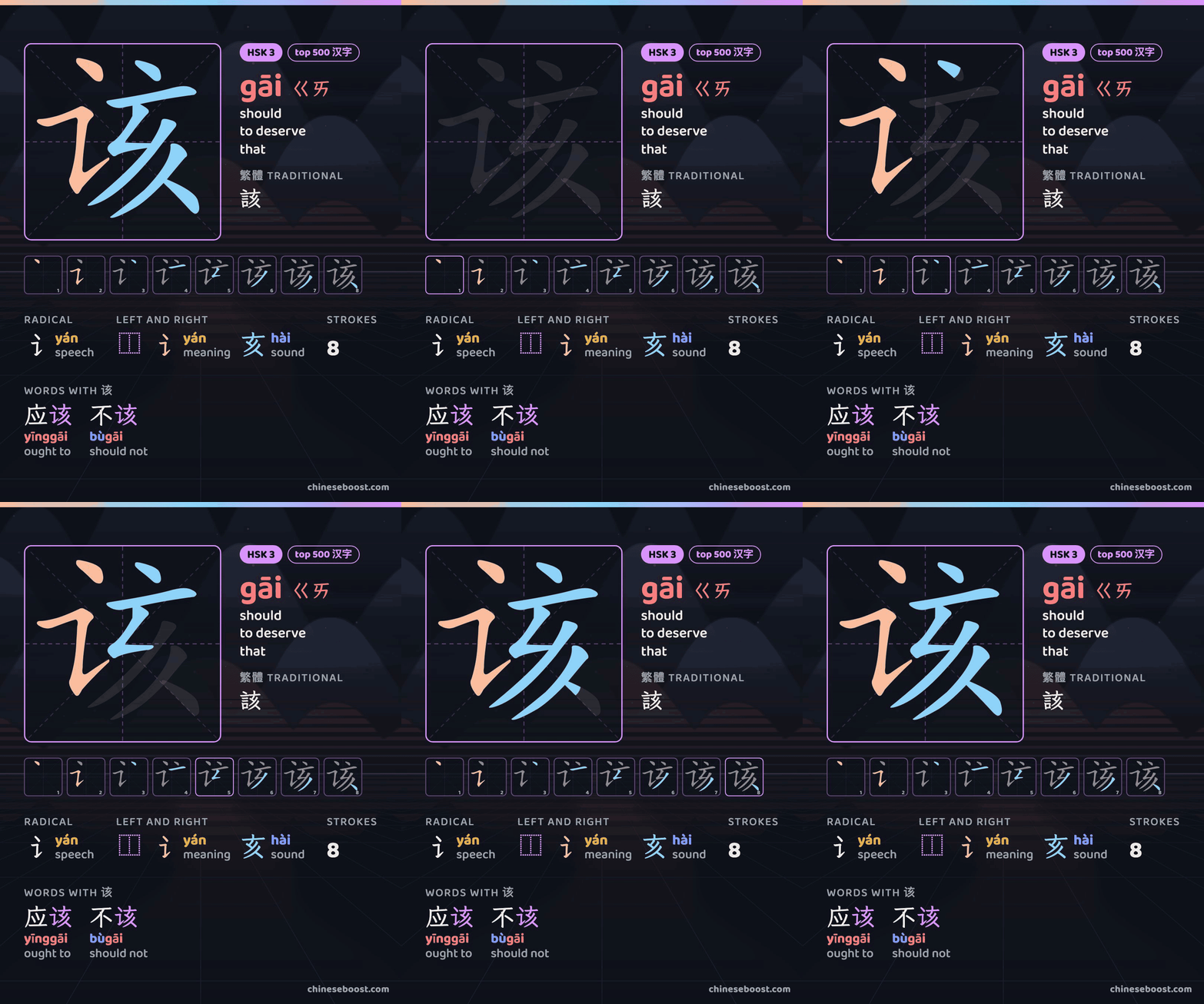
The stroke order and parts of 该
- 部首 radical
- 讠
- 笔画 strokes
- 8, with 6 after the 部首
- 结构 structure
- 左右结构
- 偏旁 parts
- 讠亥讠speech+亥=shouldA story to help you remember, not the character’s history.“A pig's speech tells you what you should do.”
- 形旁 meaning
- 讠
- 声旁 sound
- 亥
- 仓颉 Cangjie code
- 戈女卜女人 IVYVO
- 五笔 Wubi code
- YYNW
Learn to write the Chinese character 该 (gāi)this character
Trace 该, then write it from memory. Each stage is passed five times.
Create a free account to finish learning to write 该. You can also save it to your word list for review (复习).
Print a writing practice sheet for 该
Hanzi writing exercises that include 该: HSK 3 vocabulary, part 1: hanzi writing 8 of 11, HSK 7-9 vocabulary, part 88: hanzi writing 2 of 2, The difference between 想 (xiǎng), 要 (yào) and 想要 (xiǎngyào): hanzi writing 10 of 15 and 4 more.
Potential verbal descriptions
- 应该的该
- 言字旁的该
Words with 该
Starting with 该
Ending with 该
Texts using 该 阅读閱讀
-
老人坐在他的床边,难过地问:“你走了以后,我该怎么办?”老人坐在他的床邊,難過地問:“你走了以後,我該怎麼辦?”老人坐在他的牀邊,難過地問:“你走了以後,我該怎麼辦?”
-
书生听了半天,还是不知道该选哪条路。書生聽了半天,還是不知道該選哪條路。書生聽了半天,還是不知道該選哪條路。
Example sentences and grammar articles using 该
Save or share this card
Learn to write 该
Trace 该, then write it from memory.
Start without an account.
Go to the writing drill Practise 该 with other characters Print a practice sheet
Free: 5 new Exercises a day. Pro: no daily limit. About Pro
Chinese Boost Pro
Save as many words and example sentences as you like. Use Review and start new Exercises without daily limits. Your first subscription includes a 7-day free trial.
Sign up for a free Chinese Boost account
Save the words and sentences you find here to your own list, and hear them read aloud. You can export the list to your flashcards whenever you like.
Sources
- CC-CEDICT, CC BY-SA 4.0
- pinyinjs, Apache-2.0
- HSK 考试大纲, 中外语言交流合作中心, no licence stated
- Make Me a Hanzi, from fonts by Arphic Technology Co., Ltd., Arphic Public License
- Rime 五笔字型 (Wubi 86), from ibus-table, LGPL-3.0. Wubi was invented by Wang Yongmin (王永民).
- 《说文解字》 (许慎), from shuowen.org's transcription, Apache-2.0
- 《汉字源流字典》 (谷衍奎), 语文出版社, 2008