Study without daily limits with Pro
Cantonese: zau2
Classifiers (measure words)
Usually
Classical Chinese 文言
走 zǒu has 9 senses in Classical Chinese. 走 in Classical Chinese.
Other words read
In the same tone
- 搊 seize
Other words read
In the same tone
- 搊 seize
The stroke order and parts of 走
Learn to write the Chinese character 走 (zǒu)this character
Trace 走, then write it from memory. Each stage is passed five times.
Create a free account to finish learning to write 走. You can also save it to your word list for review (复习).
Print a writing practice sheet for 走
Hanzi writing exercises that include 走: HSK 2 vocabulary, part 1: hanzi writing 3 of 10, HSK 5 vocabulary, part 22: hanzi writing 2 of 4, HSK 6 vocabulary, part 20: hanzi writing 5 of 5 and 22 more.
走 as a radical 部首
走 is a 部首 (bùshǒu), a radical. Chinese dictionaries file characters under radicals. This dictionary files 28 characters under 走 as a radical. Look a character up by the 走 radical
走 as a component 部件
走 appears in 30 characters in this dictionary, either directly (29 characters) or within a larger component.
See all characters containing 走Potential verbal descriptions
- 走路的走
Words with 走
Starting with 走
Ending with 走
Containing 走
- 河西走廊 Hexi Corridor (or Gansu Corridor), a string of oases running the length of Gansu, forming part of the Northern Silk Road
- 铤而走险 take a risk out of desperation
- 远走高飞 go far away
- 一走了之 quit
- 行尸走肉 walking corpse
- 飞沙走石 (of a gale) fierce
- 迷走神经 vagus nerve
- 奔走相告 spread the news
- 奔走呼号 rush about appealing for support for a cause
- 飞禽走兽 birds and animals
- 飞檐走壁 leap onto roofs and vault over walls
- 贩夫走卒 common people
Words with 走
Starting with 走
Ending with 走
Containing 走
- 河西走廊 Hexi Corridor (or Gansu Corridor), a string of oases running the length of Gansu, forming part of the Northern Silk Road
- 鋌而走險 take a risk out of desperation
- 遠走高飛 go far away
- 一走了之 quit
- 行屍走肉 walking corpse
- 飛沙走石 (of a gale) fierce
- 迷走神經 vagus nerve
- 奔走相告 spread the news
- 奔走呼號 rush about appealing for support for a cause
- 飛禽走獸 birds and animals
- 飛檐走壁 leap onto roofs and vault over walls
- 販夫走卒 common people
Texts using 走 阅读閱讀
-
上班还是要看电脑,但是每工作一个小时,我就起来走几分钟,看看外面的花。上班還是要看電腦,但是每工作一個小時,我就起來走幾分鐘,看看外面的花。上班還是要看電腦,但是每工作一個小時,我就起來走幾分鐘,看看外面的花。
-
我从妹妹身边走了过去。我從妹妹身邊走了過去。我從妹妹身邊走了過去。
-
好了,你走吧。
11 more texts using 走
-
有一次,他说:“第一个月的钱还没拿到,没钱坐公交车,只好每天走一个小时去上班。”有一次,他說:“第一個月的錢還沒拿到,沒錢坐公交車,只好每天走一個小時去上班。”有一次,他説:“第一個月的錢還沒拿到,沒錢坐公交車,只好每天走一個小時去上班。”
-
她买了一盒月饼,放在公司门口的桌子上,准备跟公司的东西一起寄走。她買了一盒月餅,放在公司門口的桌子上,準備跟公司的東西一起寄走。她買了一盒月餅,放在公司門口的桌子上,準備跟公司的東西一起寄走。
-
通知没说谁留下,她以为他们俩都不能走了,心里更难受。通知沒說誰留下,她以為他們倆都不能走了,心裡更難受。通知沒説誰留下,她以為他們倆都不能走了,心裏更難受。
-
大臣对国王说:我以前在路上遇到过一个人,坐着马车往北走。大臣對國王說:我以前在路上遇到過一個人,坐著馬車往北走。大臣對國王説:我以前在路上遇到過一個人,坐着馬車往北走。
-
我走到街上,搬来以后第一次给爸爸打了电话。我走到街上,搬來以後第一次給爸爸打了電話。我走到街上,搬來以後第一次給爸爸打了電話。
-
不到一年,那人就用大车把树一棵一棵地拉走了,山上连一棵树也没剩下。不到一年,那人就用大車把樹一棵一棵地拉走了,山上連一棵樹也沒剩下。不到一年,那人就用大車把樹一棵一棵地拉走了,山上連一棵樹也沒剩下。
-
他和苏琪一起做饭,陪她去公园走走。他和蘇琪一起做飯,陪她去公園走走。他和蘇琪一起做飯,陪她去公園走走。
-
老人坐在他的床边,难过地问:“你走了以后,我该怎么办?”老人坐在他的床邊,難過地問:“你走了以後,我該怎麼辦?”老人坐在他的牀邊,難過地問:“你走了以後,我該怎麼辦?”
-
按照当时处理这类案子的规矩,如果他被判有罪,房子就会被县里收走,再由县官决定给谁。按照當時處理這類案子的規矩,如果他被判有罪,房子就會被縣裡收走,再由縣官決定給誰。按照當時處理這類案子的規矩,如果他被判有罪,房子就會被縣裏收走,再由縣官決定給誰。
-
一天晚上,他很晚才回到家,酒喝多了,走路都走不稳,却拿起车钥匙就要出门。一天晚上,他很晚才回到家,酒喝多了,走路都走不穩,卻拿起車鑰匙就要出門。一天晚上,他很晚才回到家,酒喝多了,走路都走不穩,卻拿起車鑰匙就要出門。
-
有人说可以坐船沿着河走,有人说可以走田间的小路,还有人建议走山路。有人說可以坐船沿著河走,有人說可以走田間的小路,還有人建議走山路。有人説可以坐船沿着河走,有人説可以走田間的小路,還有人建議走山路。
Example sentences and grammar articles using 走
Save or share this card
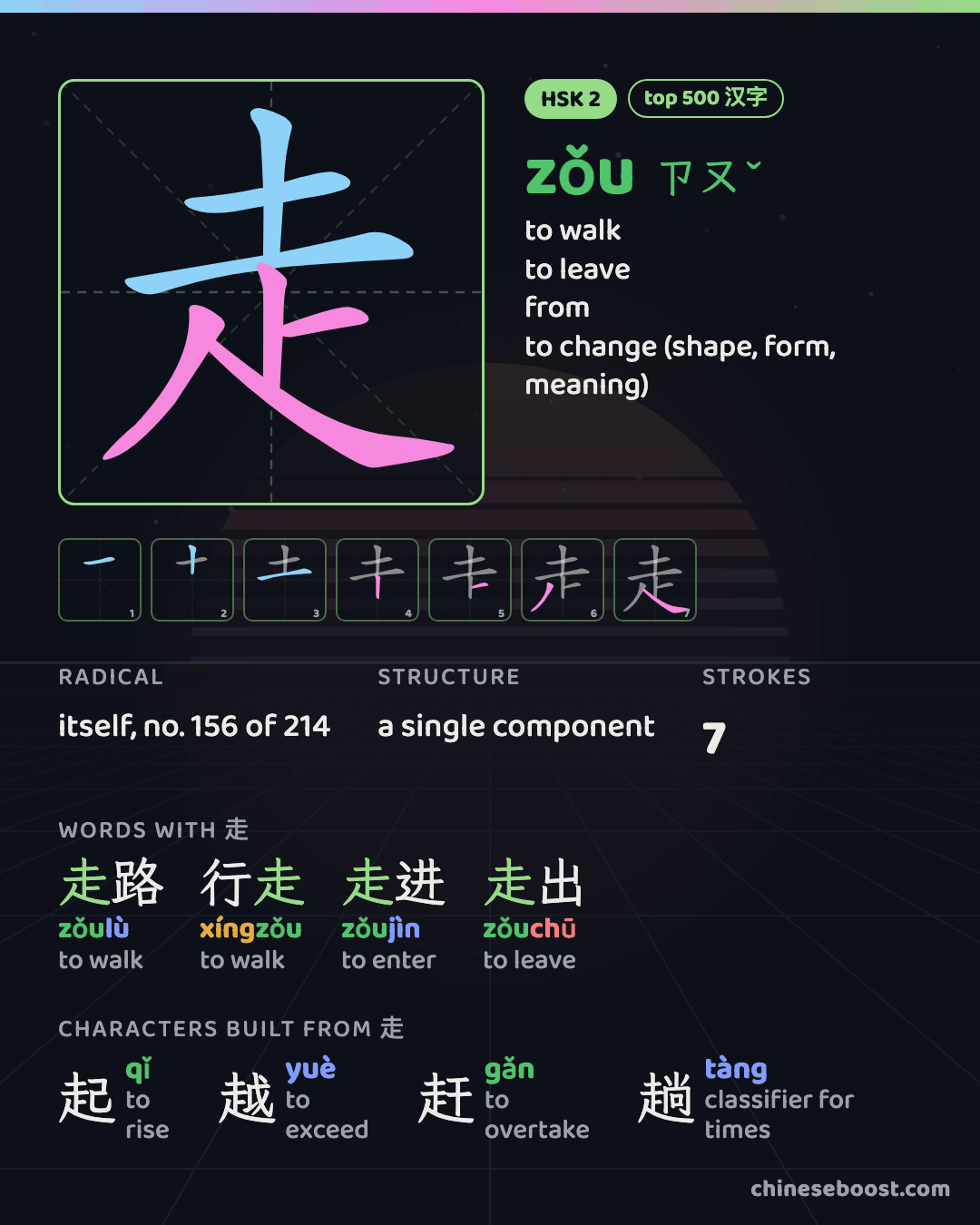
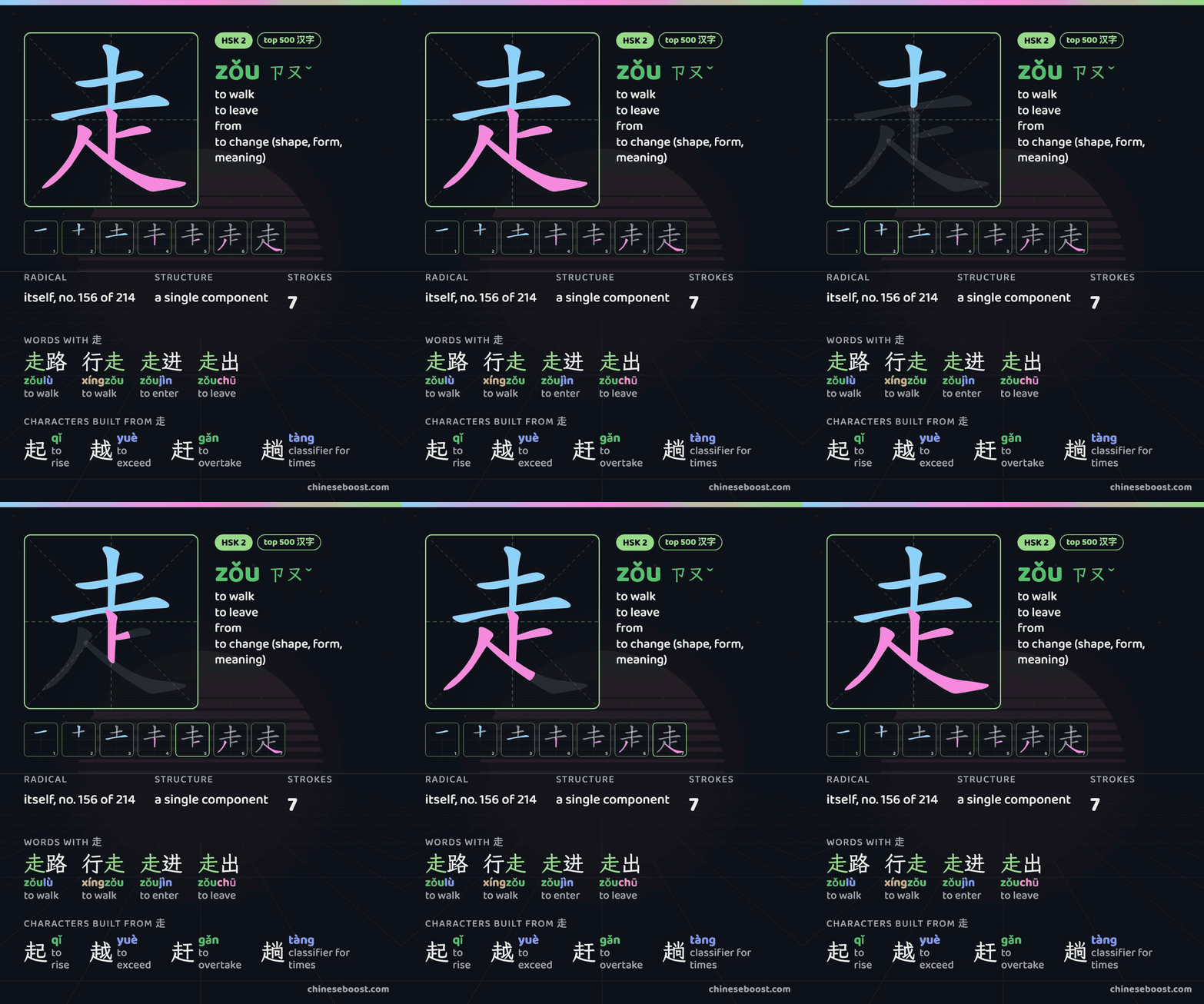
Learn to write 走
Trace 走, then write it from memory.
Start without an account.
Go to the writing drill Practise 走 with other characters Print a practice sheet
Free: 5 new Exercises a day. Pro: no daily limit. About Pro
Ancient forms of 走 (古文字)


Chinese Boost Pro
Save as many words and example sentences as you like. Use Review and start new Exercises without daily limits. Your first subscription includes a 7-day free trial.
Sign up for a free Chinese Boost account
Save the words and sentences you find here to your own list, and hear them read aloud. You can export the list to your flashcards whenever you like.
Sources
- CC-CEDICT, CC BY-SA 4.0
- pinyinjs, Apache-2.0
- HSK 考试大纲, 中外语言交流合作中心, no licence stated
- Make Me a Hanzi, from fonts by Arphic Technology Co., Ltd., Arphic Public License
- Rime 五笔字型 (Wubi 86), from ibus-table, LGPL-3.0. Wubi was invented by Wang Yongmin (王永民).
- Ancient Chinese Characters Project (Wikimedia Commons), after Richard Sears' Chinese Etymology, public domain