Study without daily limits with Pro
-
TW: 裡
HK: 裏
-
里
-
里
-
Tw
Cantonese: lei5
Classifiers (measure words)
Synonyms and antonyms
Synonyms 近义词
-
内
- 内部 interior
- 室内 indoors
Classical Chinese 文言
里 lǐ has 5 senses in Classical Chinese. 里 in Classical Chinese.
裡 lǐ has 4 senses in Classical Chinese. 裡 in Classical Chinese.
Other words read
Other words read
Foreign names译名譯名
The standard Chinese form of the foreign name Rie.
Browse foreign names in Chinese
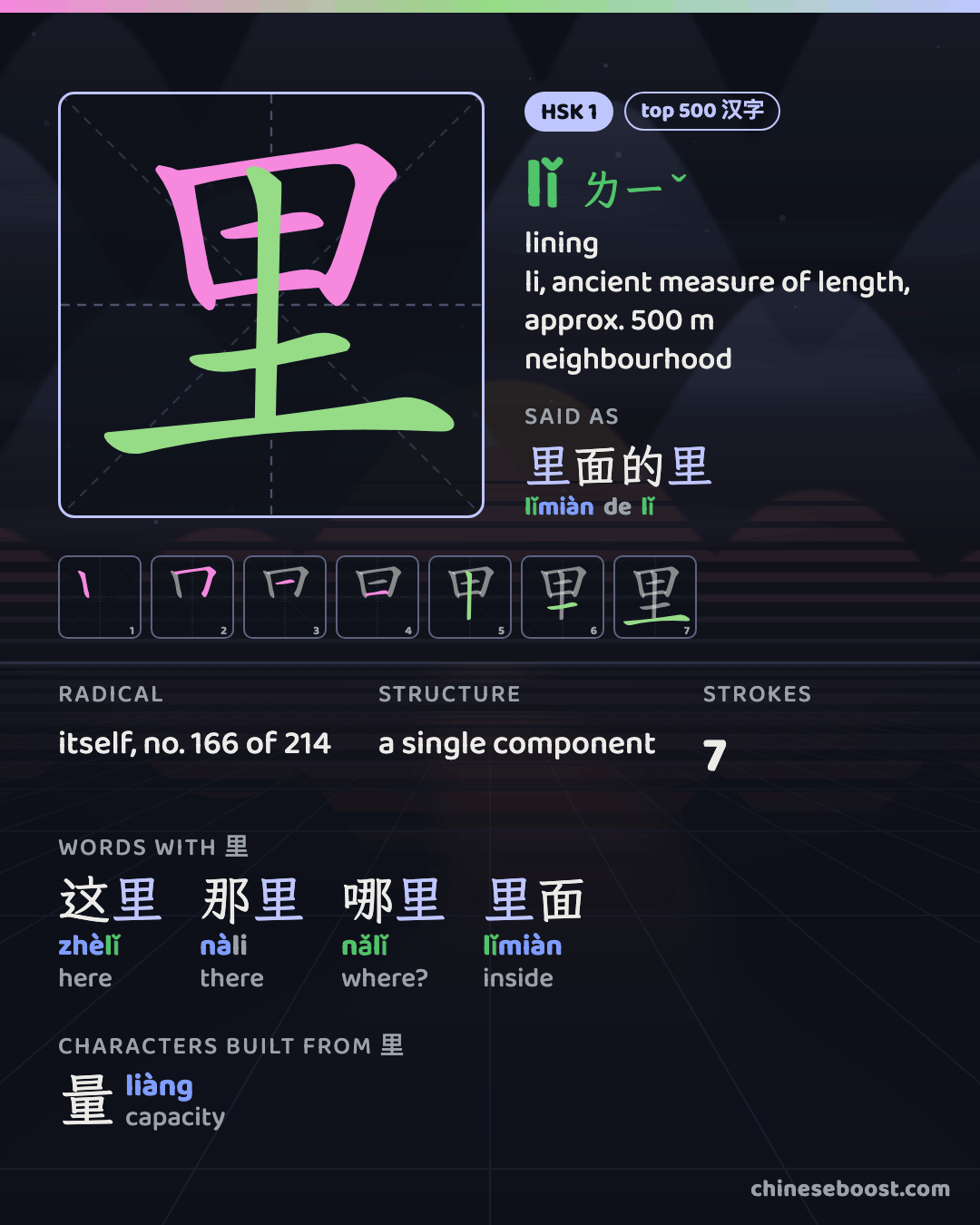
The stroke order and parts of 里
Learn to write the Chinese character 里 (lǐ)this character
Trace 里, then write it from memory. Each stage is passed five times.
Create a free account to finish learning to write 里. You can also save it to your word list for review (复习).
Print a writing practice sheet for 里
Hanzi writing exercises that include 里: HSK 1 vocabulary, part 1: hanzi writing 7 of 9, HSK 2 vocabulary, part 3: hanzi writing 1 of 8, HSK 3 vocabulary, part 3: hanzi writing 3 of 10 and 32 more.
里 as a radical 部首
里 is a 部首 (bùshǒu), a radical. Chinese dictionaries file characters under radicals. This dictionary files 5 characters under 里 as a radical. Look a character up by the 里 radical
里 as a component 部件
里 appears in 45 characters in this dictionary, either directly (20 characters) or within a larger component.
See all characters containing 里Potential verbal descriptions
- 里面的里
Words with 里
Starting with 里
Ending with 里
Containing 里
- 克里特 Crete
- 亚里士多德 Aristotle (384-322 BC), Greek philosopher
- 斯里兰卡 Sri Lanka
- 死里逃生 narrow escape
- 二里头 Erlitou
- 欧几里得 Euclid of Alexandria (c. 300 BC), Greek geometer and author of the Elements 几何原本 jǐhéyuánběn
- 城里人 townspeople
- 心里话 true feelings
- 墨索里尼 Benito Mussolini (1883-1945), Italian fascist dictator, "Il Duce", president 1922-1943
- 克里特岛 Crete
- 千里迢迢 from a great distance
- 塔里木盆地 Tarim Basin depression in southern Xinjiang
Texts using 里 阅读閱讀
-
店里人很多,一个我不认识的人坐在我对面。店裡人很多,一個我不認識的人坐在我對面。店裏人很多,一個我不認識的人坐在我對面。
-
他说书里的医生是个好人,我不这么想。他說書裡的醫生是個好人,我不這麼想。他説書裏的醫生是個好人,我不這麼想。
-
不过,晚上店里的面包不多,有时候没有你喜欢吃的。不過,晚上店裡的麵包不多,有時候沒有你喜歡吃的。不過,晚上店裏的麪包不多,有時候沒有你喜歡吃的。
14 more texts using 里
-
我家后面有几只狗在雪地里玩,我家的狗也跟它们一起玩。我家後面有幾隻狗在雪地裡玩,我家的狗也跟它們一起玩。我家後面有幾隻狗在雪地裏玩,我家的狗也跟它們一起玩。
-
店里的人说:对不起,我们这儿没有书。店裡的人說:對不起,我們這兒沒有書。店裏的人説:對不起,我們這兒沒有書。
-
星期一早上,公司里很忙。星期一早上,公司裡很忙。星期一早上,公司裏很忙。
-
丈夫说:“下来吧,外面冷,水里不冷。”丈夫說:“下來吧,外面冷,水裡不冷。”丈夫説:“下來吧,外面冷,水裏不冷。”
-
许静在一家公司上班,一个人住在旧楼里。許靜在一家公司上班,一個人住在舊樓裡。許靜在一家公司上班,一個人住在舊樓裏。
-
她怕问了让人觉得自己不好好工作,以后不让她留下,就没敢问,只在电话里告诉妈妈:“工作太忙,今年不回去了。”她怕問了讓人覺得自己不好好工作,以後不讓她留下,就沒敢問,只在電話裡告訴媽媽:“工作太忙,今年不回去了。”她怕問了讓人覺得自己不好好工作,以後不讓她留下,就沒敢問,只在電話裏告訴媽媽:“工作太忙,今年不回去了。”
-
这时,学校办公室发来通知:为了安全,春节期间宿舍里必须有人。這時,學校辦公室發來通知:為了安全,春節期間宿舍裡必須有人。這時,學校辦公室發來通知:為了安全,春節期間宿舍裏必須有人。
-
阿姨正在厨房里忙着煮面。阿姨正在廚房裡忙著煮面。阿姨正在廚房裏忙着煮面。
-
妈妈以前没见过女儿的男朋友,只听女儿在电话里说起过。媽媽以前沒見過女兒的男朋友,只聽女兒在電話裡說起過。媽媽以前沒見過女兒的男朋友,只聽女兒在電話裏説起過。
-
他们把老人关在后院的一间屋子里,锁上院门,不让其他人进去。他們把老人關在後院的一間屋子裡,鎖上院門,不讓其他人進去。他們把老人關在後院的一間屋子裏,鎖上院門,不讓其他人進去。
-
他办公室里的女同事很多,她越想越不放心。他辦公室裡的女同事很多,她越想越不放心。他辦公室裏的女同事很多,她越想越不放心。
-
按照当时处理这类案子的规矩,如果他被判有罪,房子就会被县里收走,再由县官决定给谁。按照當時處理這類案子的規矩,如果他被判有罪,房子就會被縣裡收走,再由縣官決定給誰。按照當時處理這類案子的規矩,如果他被判有罪,房子就會被縣裏收走,再由縣官決定給誰。
-
他在厨房做饭,妻子负责接待客人,店里只请了一名服务员。他在廚房做飯,妻子負責接待客人,店裡只請了一名服務員。他在廚房做飯,妻子負責接待客人,店裏只請了一名服務員。
-
吃晚饭的时候,他向店里的人打听去下一个村子的路。吃晚飯的時候,他向店裡的人打聽去下一個村子的路。吃晚飯的時候,他向店裏的人打聽去下一個村子的路。
Example sentences and grammar articles using 里
Save or share this card
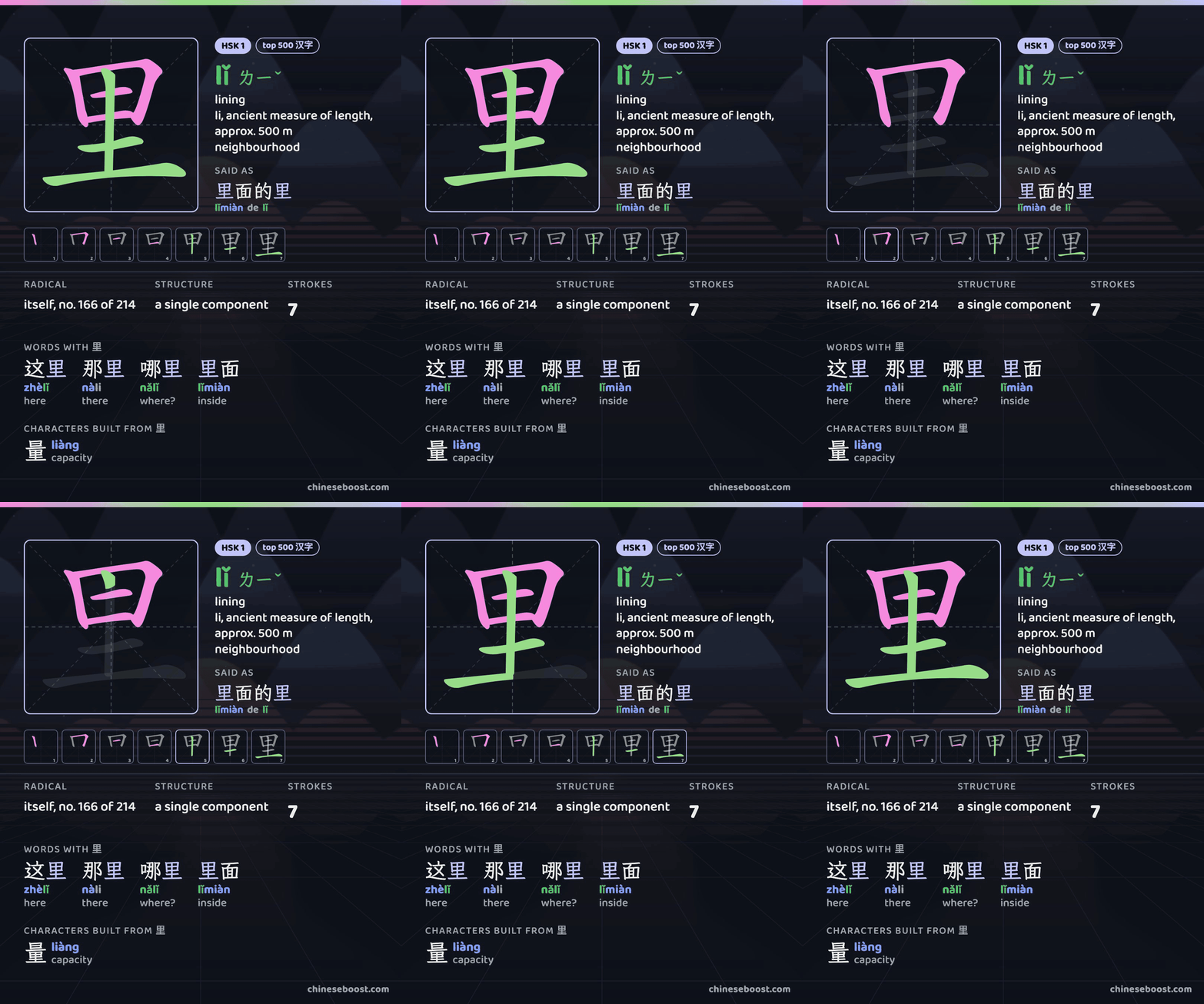
Learn to write 里
Trace 里, then write it from memory.
Start without an account.
Go to the writing drill Practise 里 with other characters Print a practice sheet
Free: 5 new Exercises a day. Pro: no daily limit. About Pro
Ancient forms of 里 (古文字)


Chinese Boost Pro
Save as many words and example sentences as you like. Use Review and start new Exercises without daily limits. Your first subscription includes a 7-day free trial.
Sign up for a free Chinese Boost account
Save the words and sentences you find here to your own list, and hear them read aloud. You can export the list to your flashcards whenever you like.
Sources
- CC-CEDICT, CC BY-SA 4.0
- pinyinjs, Apache-2.0
- HSK 考试大纲, 中外语言交流合作中心, no licence stated
- Make Me a Hanzi, from fonts by Arphic Technology Co., Ltd., Arphic Public License
- Rime 五笔字型 (Wubi 86), from ibus-table, LGPL-3.0. Wubi was invented by Wang Yongmin (王永民).
- Ancient Chinese Characters Project (Wikimedia Commons), after Richard Sears' Chinese Etymology, public domain