Video lesson: 的话 (dehuà) for saying “if” in Mandarin Chinese grammar, part 1 of 2
视频课:用“的话”说“如果”(一)
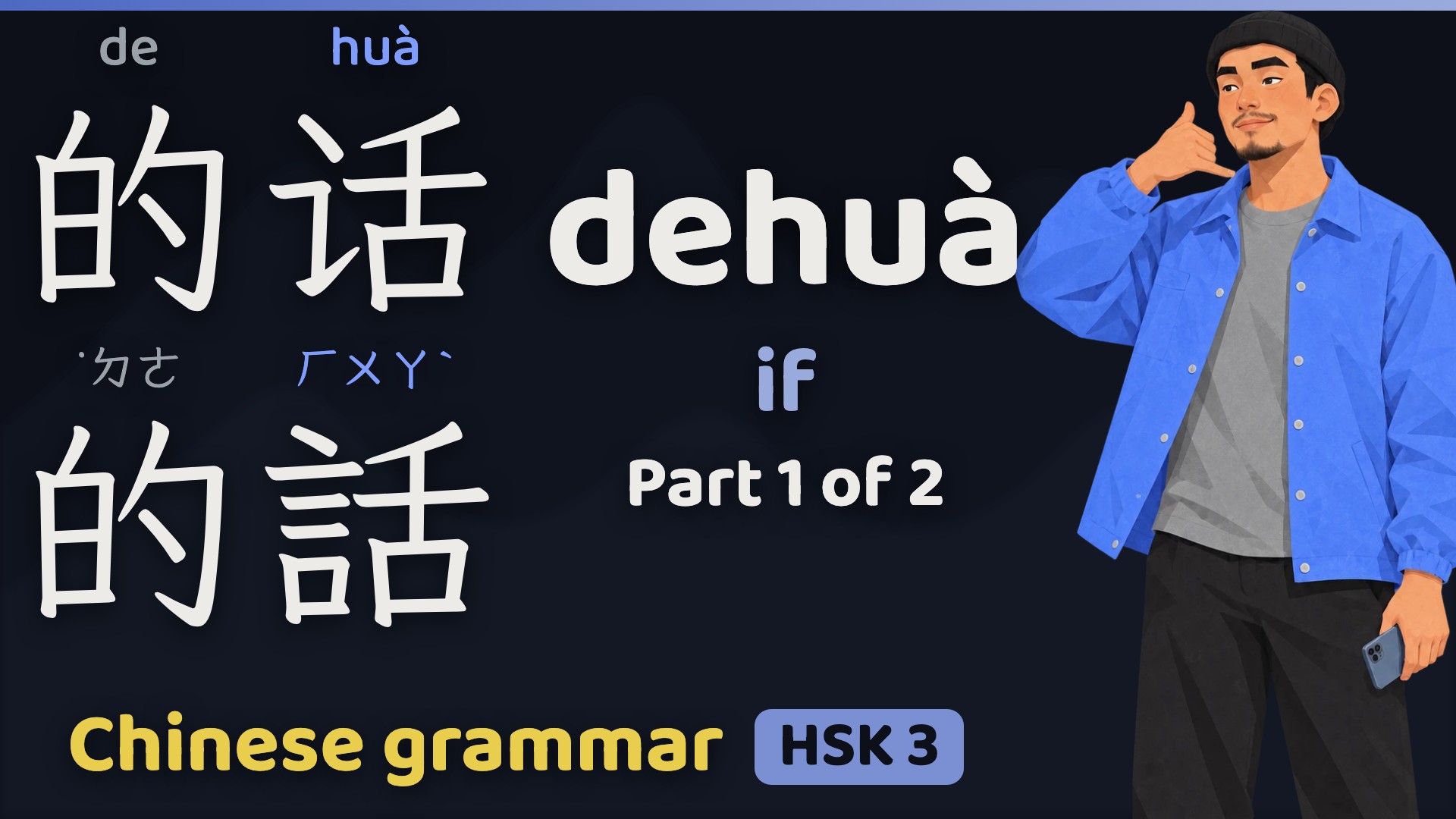
的话 (dehuà) means "if", and it goes at the end of the condition rather than the front. This first part shows where it goes, with example sentences built up a word at a time, how 就 links the two halves, and the two everyday words that go in front of it, 要是 and 如果.
The grammar guide: Chinese grammar de hua (的话): expressing "if" in Chinese with de hua
Chapters
Example sentences
Practise 练习
3 grammar exercises and 18 writing drills.
Start without an account.
Start exercise 1 See all exercises
Free: 5 new Exercises a day. Pro: no daily limit. About Pro
Vocabulary list 词单
- Vocabulary list: Video lesson: 的话 (dehuà) for saying “if” in Mandarin Chinese grammar, part 1 of 2 语法:的话、的、话、要、是、如、果、假、倘、若 49 words and 7 example sentences
Exercises 练习
- Exercises: Chinese grammar de hua (的话): expressing "if" in Chinese with de hua 语法:的话、的、话、要、是、如、果、假、倘、若 练习 2 drills over 10 characters, and 1 grammar exercise over 2 items
Transcript
-
0:05
If you learn one way to say 'if' in Chinese, make it this one. It goes at the end of the condition, not the front. Here it is.
-
0:15
的话。 It means if.
-
0:18
This is part one of two. We'll use this word on its own, then with two other words for 'if'. You don't need to catch every detail. For now, listen for where 'if' goes. First, let's watch the characters being written.
-
0:34
The first character is the one from our video on three kinds of “的”.
-
0:38
白勺“的”。 It has eight strokes, and it's the same in simplified and traditional Chinese.
-
0:43
And that character splits into two parts, left and right.
-
0:49
Yes. White on the left, and a ladle on the right. That's why people call it 白勺“的”.
-
0:55
What about the second character?
-
0:58
The second is “话”, and it has a left and right structure too. On the left is the speech radical. Simplified Chinese writes that radical in two strokes, so the whole character has eight. Traditional Chinese writes the radical in full, so it has thirteen.
-
1:15
And what's on the right?
-
1:16
The character for tongue.
-
1:18
Speech on the left, tongue on the right. That helps me remember the shape. What does the second character mean on its own?
-
1:26
Words, or speech, as in 电话, a phone call, and 普通话, Mandarin.
-
1:36
So where does the whole word for 'if' go in a sentence?
-
1:41
At the end of the condition. In English, if comes first. In Chinese, 的话 comes last.
-
1:51
So it's like saying 'it rains, if'. The condition comes first, then the word for 'if'.
-
1:58
Here's the first sentence, about the weather. Before we add 'if', the sentence is only a forecast. 明天下雨。
-
2:07
'It'll rain tomorrow.' Bring a coat.
-
2:10
Now put the word for if after the condition, and say what happens. 明天下雨的话,我就不去。
-
2:20
'If it rains tomorrow, I'm not going.' Let's go word by word.
-
2:26
明天。
-
2:27
Tomorrow.
-
2:28
下雨。
-
2:30
Rain. Literally, rain falls.
-
2:33
的话。
-
2:34
If.
-
2:35
我。
-
2:36
I.
-
2:37
就。
-
2:38
Then.
-
2:39
不。
-
2:39
Not.
-
2:41
去。
-
2:42
Go.
-
2:42
Once more. 明天下雨的话,我就不去。
-
2:46
So 'it rains tomorrow' is the condition. The word for 'if' comes after the condition. How often do we use the word for 'then' in the second half?
-
2:57
Very often. The word for then goes before the verb in the second half, and links the two halves. 的话,就。
-
3:07
If this, then that. This next sentence is something you'll hear at dinner.
-
3:16
你喜欢的话,就多吃点。
-
3:21
'If you like it, eat a bit more.' Well, if you insist. Let's go word by word.
-
3:29
你。
-
3:30
You.
-
3:31
喜欢。
-
3:32
Like.
-
3:33
的话。
-
3:33
If.
-
3:34
就。
-
3:35
Then.
-
3:36
多。
-
3:37
More.
-
3:38
吃。
-
3:38
Eat.
-
3:39
点。
-
3:40
A bit.
-
3:41
Once more. 你喜欢的话,就多吃点。
-
3:46
There's 'a bit' from our last lesson, without the R sound. Suppose we can't find our keys. Can the condition describe something that might already have happened?
-
3:56
Yes. This next sentence is about something you can't find. 我们弄丢了的话,怎么办?
-
4:07
'If we've lost it, what'll we do?' Have you checked down the back of the sofa? Let's go word by word.
-
4:15
我们。
-
4:17
We.
-
4:18
弄丢。
-
4:19
Lose.
-
4:20
“了”。
-
4:21
Here, this marks a completed action.
-
4:24
的话。
-
4:25
If.
-
4:26
怎么办。
-
4:27
What do we do?
-
4:28
Once more. 我们弄丢了的话,怎么办?
-
4:32
We don't know yet whether we've lost the keys. This sentence works without the word for 'then'. And if you've lost your glasses, check the top of your head. Quick quiz! Which sentence means 'If you're tired, have a rest'? Have a think.
-
5:00
It's this sentence. 你累的话,就休息一下。 The word for if comes after 'you're tired'.
-
5:08
'If you're tired, have a rest.' Good advice. Now, what are those two words that can go at the front?
-
5:15
The first is 要是. This word goes at the front of the condition, and the word for if stays at the end.
-
5:24
So there's an 'if' at each end of the condition, like a sandwich. Is this a formal way to say 'if'?
-
5:31
No, the word at the front is the most casual of these words. Here's the first sentence, about a phone call. With only the word at the end, you'd say: 你有空的话,给我打电话。
-
5:45
'If you're free, give me a call.' We've already got 'if' at the end of 'you're free'.
-
5:51
Now add the casual word at the front. 要是你有空的话,给我打电话。
-
6:00
'If you're free, give me a call.' Same meaning. Now there's a word for 'if' before 'you're free' as well as after. Let's go word by word.
-
6:11
要是。
-
6:13
If.
-
6:14
你。
-
6:15
You.
-
6:16
有空。
-
6:17
Have free time.
-
6:19
的话。
-
6:19
If.
-
6:20
给。
-
6:21
To.
-
6:22
我。
-
6:23
Me.
-
6:24
打电话。
-
6:26
Make a phone call. There's that character for speech again.
-
6:30
Once more. 要是你有空的话,给我打电话。
-
6:34
If, you, have free time, if. Do we need both ends of the sandwich?
-
6:39
No. Either one can go. 要是你有空的话。要是你有空。你有空的话。
-
6:48
All three mean 'if you're free'. You can use either word on its own, or both together.
-
6:56
This next sentence is advice for a trip. 要是去北京的话,一定要去爬长城。
-
7:05
'If you go to Beijing, definitely go and climb the Great Wall.' Bring comfortable shoes. Let's go word by word.
-
7:14
要是。
-
7:16
If.
-
7:17
去。
-
7:18
Go.
-
7:18
北京。
-
7:19
Beijing.
-
7:20
的话。
-
7:21
If.
-
7:22
一定。
-
7:23
Definitely.
-
7:24
要。
-
7:25
Must.
-
7:26
去。
-
7:26
Go.
-
7:27
爬。
-
7:28
Climb.
-
7:29
长城。
-
7:30
The Great Wall. Literally, the long wall.
-
7:34
Once more. 要是去北京的话,一定要去爬长城。
-
7:39
We say 'you' in English, but this Chinese sentence leaves 'you' out. We know who the advice is for. What's the other word for 'if'?
-
7:49
如果。 It's a little more formal than the casual word, and you'll hear it in speech and see it in writing.
-
7:57
So this word works with friends and in emails.
-
8:01
Exactly. Here's the first sentence, about work. 如果有问题的话,请告诉我。
-
8:11
'If there are any problems, please let me know.' Half the work emails in the world end like that. Let's go word by word.
-
8:22
如果。
-
8:23
If.
-
8:24
有。
-
8:24
There is.
-
8:25
问题。
-
8:26
A problem, or a question.
-
8:29
的话。
-
8:30
If.
-
8:31
请。
-
8:32
Please.
-
8:33
告诉。
-
8:34
Tell.
-
8:35
我。
-
8:36
Me.
-
8:37
Once more. 如果有问题的话,请告诉我。
-
8:41
The same sandwich, with a different word at the front. Is there a famous 'if' in Chinese films?
-
8:48
There is, but you don't need to memorise it. In A Chinese Odyssey Part Two, Stephen Chow's film from 1995, his character says this with a sword at his throat. 如果非要在这份爱上加上一个期限,我希望是……一万年!
-
9:12
'If I have to put a time limit on this love, I hope it's… ten thousand years!' That's a lot of anniversaries. People still quote this sentence. Here, the word for 'if' at the front works on its own.
-
9:28
Time for one more quiz. Which sentence sounds more casual? Have a think.
-
9:45
It's this sentence. 要是你有空的话…… The first word is the more casual one.
-
9:51
'If you're free...' That's the more casual version. Let's go back over what we've seen. One: the word we started with goes at the end of the condition.
-
10:02
Two: the word for then often comes before the verb in the second half.
-
10:06
Three: you can add either of the two words we've learned at the front of the condition. Both work in conversation, but the first sounds more casual.
-
10:17
And four: you can leave out either end.
-
10:19
That's the end of part one. In part two, we'll meet the 'if' for things you hope won't happen, and some very formal ones.
-
10:30
And one for imagining you've won the lottery.
-
10:33
If you'd like to hear every sentence again, they're all at Chinese Boost dot com.
-
10:39
喜欢的话,就点个赞吧!
-
10:42
'If you liked this video, give it a like!' See you next time!
Sign up for a free Chinese Boost account
Save the words and sentences you find here to your own list, and hear them read aloud. You can export the list to your flashcards whenever you like.