Video lesson: More ways to say “if” with 的话 (dehuà) in Mandarin Chinese grammar, part 2 of 2
视频课:用“的话”说“如果”(二)
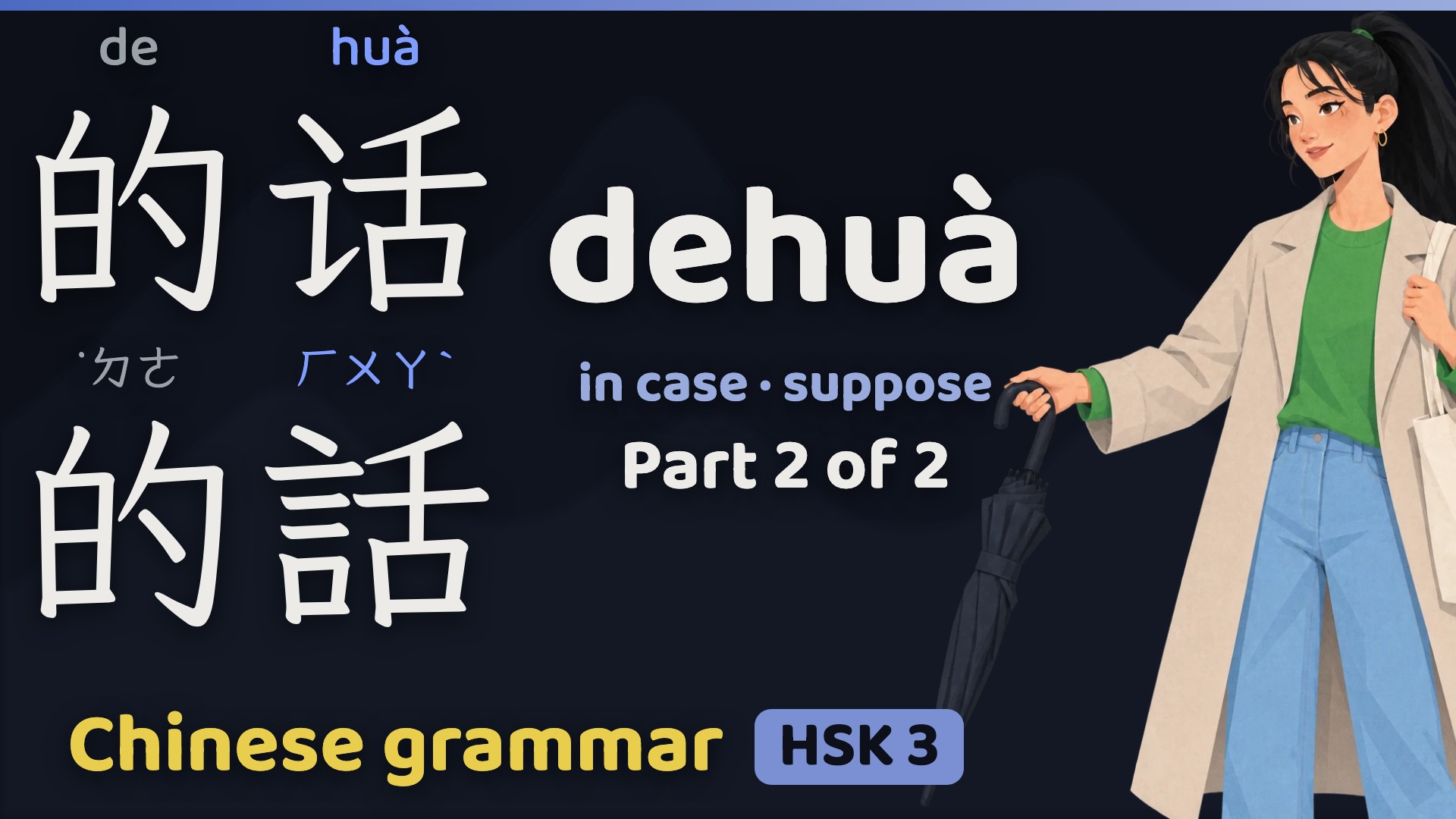
的话 (dehuà) means "if", and several words can go in front of it. This second part covers 万一 for something you hope won't happen, 假如 for imagining, 假设 and 假使 for supposing, and the formal 若是 and 倘若, with example sentences and where each sits from casual to formal.
The grammar guide: Chinese grammar de hua (的话): expressing "if" in Chinese with de hua
Chapters
- 0:00 的话 (dehuà)
- 0:42 万一 for the unlikely
- 3:44 假如 for the imagined
- 6:16 假设 and 假使
- 7:42 若是 and 倘若
- 10:30 Recap
Example sentences
假如生活欺骗了你
Practise 练习
3 grammar exercises and 18 writing drills.
Start without an account.
Start exercise 1 See all exercises
Free: 5 new Exercises a day. Pro: no daily limit. About Pro
Vocabulary list 词单
Exercises 练习
Transcript
-
0:05
What would you do if you won the lottery? Hold that thought. This is part two of our lesson on a word for 'if'. Here it is again.
-
0:14
的话。
-
0:17
In part one, 的话 went at the end of the condition. And we put a casual word or an everyday word at the front.
-
0:26
Today we'll add more words at the front of the condition. We'll hear 'just in case', 'suppose', and some more formal ways to say 'if'. You don't need to memorise the whole list.
-
0:39
The first is 万一. Its first character is the number ten thousand, from the film line in part one, and the second is one.
-
0:50
One in ten thousand. The word means 'if by any chance', for something you don't expect to happen.
-
0:58
Or something you hope won't happen. Here's the first sentence, without that word. 我来晚了的话,请不要等我。
-
1:07
'If I'm late, please don't wait for me.' We haven't said whether we expect to be late.
-
1:13
Now add the word for one in ten thousand. 万一我来晚了的话,请不要等我。
-
1:23
'If by any chance I'm late, please don't wait for me.' Let's go word by word.
-
1:31
万一。
-
1:32
If by any chance.
-
1:34
我。
-
1:35
I.
-
1:36
来。
-
1:37
Come.
-
1:38
晚。
-
1:39
Late.
-
1:40
“了”。
-
1:40
Here, we're imagining that the speaker has arrived late.
-
1:44
的话。
-
1:45
If.
-
1:46
请。
-
1:46
Please.
-
1:47
不要。
-
1:48
Don't.
-
1:49
等。
-
1:50
Wait for.
-
1:51
我。
-
1:53
Me.
-
1:53
Once more. 万一我来晚了的话,请不要等我。
-
1:58
Now being late sounds unlikely. The condition, 'I'm late', sits between two words for 'if'. That's our sandwich again. Can the word for 'if by any chance' work without the ending too?
-
2:12
All the time, on its own, for a worry. This next sentence is what people say at the door. 带把伞吧,万一下雨呢?
-
2:24
'Take an umbrella, just in case it rains.' In sentences like this one, 'just in case' is often the best English for the word. The umbrella's coming anyway. Let's go word by word.
-
2:38
带。
-
2:39
Take, as in take with you.
-
2:42
把。
-
2:43
The classifier for things with a handle.
-
2:45
伞。
-
2:46
Umbrella.
-
2:47
吧。
-
2:48
This makes 'take an umbrella' a suggestion.
-
2:52
万一。
-
2:53
Just in case.
-
2:54
下雨。
-
2:55
Rain.
-
2:56
呢。
-
2:57
This gives the question its 'what if' tone.
-
3:00
Once more. 带把伞吧,万一下雨呢?
-
3:04
This sentence uses 'just in case' without our usual ending for 'if'. The final word adds the 'what if' tone. Quiz time! Which sentence makes being late sound unlikely? Have a think.
-
3:30
It's this sentence. 万一我来晚了的话。 The word for one in ten thousand is for the unlikely.
-
3:37
'If by any chance I'm late...' That's the unlikely 'if'. What's the next word?
-
3:42
假如。 The first character means false, or pretend, and it's written the same in simplified and traditional Chinese. It splits into a left and right side. On the left is the person radical, the radical it's usually filed under. The right side is its sound part.
-
4:00
And the second character?
-
4:04
The second is the one at the front of 如果. On its own it can mean like, or as, and in both words it means if.
-
4:12
So 'pretend', then 'if'. That's a good clue. Is this word only for things that aren't true?
-
4:20
Not only, but often. Here's the first sentence, advice from a friend. 假如我是你的话,我就不去。
-
4:33
'If I were you, I wouldn't go.' I wish you'd said that before I bought the tickets. Let's go word by word.
-
4:42
假如。
-
4:43
If.
-
4:44
我。
-
4:45
I.
-
4:45
是。
-
4:46
Am.
-
4:47
你。
-
4:48
You.
-
4:49
的话。
-
4:50
If.
-
4:51
我。
-
4:52
I.
-
4:52
就。
-
4:53
Then.
-
4:54
不。
-
4:55
Not.
-
4:56
去。
-
4:57
Go.
-
4:57
Once more. 假如我是你的话,我就不去。
-
5:02
The sentence ends with the same Chinese words as 'I'm not going' in part one. We say 'I wouldn't go' here because we're imagining being someone else. Does this word for 'if' turn up in anything famous?
-
5:16
Yes, and there's no need to learn this line. Pushkin, the Russian poet, wrote a poem that's very well known in China. In Chinese, it starts: 假如生活欺骗了你
-
5:31
'If by life you were deceived.' Or, in everyday English, 'If life lets you down.' The poem says happier days will come. Let's go word by word.
-
5:45
假如。
-
5:47
If.
-
5:47
生活。
-
5:49
Life.
-
5:50
欺骗。
-
5:51
Deceive.
-
5:52
“了”。
-
5:53
Here, we're imagining that life has already let you down.
-
5:57
你。
-
5:58
You.
-
5:59
Once more. 假如生活欺骗了你。
-
6:03
The poem puts the word for 'if' at the front and leaves off our usual ending for 'if'. Does the next word also start with the character for 'pretend'?
-
6:15
Yes. 假设 sounds like a maths problem. It means suppose. There's also 假使, which is used in a similar way for supposing.
-
6:27
So, back to my question.
-
6:29
Here's the first sentence, about the lottery. 假设你中了五百万,你会做什么?
-
6:40
'Suppose you won five million. What would you do?' Five million yuan is a familiar lottery jackpot in China. Let's go word by word.
-
6:52
假设。
-
6:53
Suppose.
-
6:55
你。
-
6:55
You.
-
6:56
中。
-
6:57
Win. With this meaning, the character takes the falling fourth tone, not the first tone.
-
7:04
“了”。
-
7:05
Here, we're imagining you've already won.
-
7:08
五百万。
-
7:09
Five million. That's five hundred lots of ten thousand.
-
7:14
你。
-
7:15
You.
-
7:16
会。
-
7:17
Would.
-
7:18
做。
-
7:19
Do.
-
7:19
什么。
-
7:20
What.
-
7:21
Once more. 假设你中了五百万,你会做什么?
-
7:26
We're imagining you've won, then asking what you'd do next. For a bigger budget, there's the Chinese comedy Hello Mr. Billionaire. A man has to spend a billion yuan in a month. Any more words for 'if'?
-
7:41
Last, two that sound formal. You'll meet them more in writing than in everyday chat. The first is 若是. 若是可以重来的话,我不会那样做。
-
7:58
'If I could do it over, I wouldn't do it that way.' That sounds like the end of a long story. Let's go word by word.
-
8:08
若是。
-
8:10
If.
-
8:10
可以。
-
8:11
Can.
-
8:12
重来。
-
8:13
Start again.
-
8:15
的话。
-
8:16
If.
-
8:17
我。
-
8:18
I.
-
8:19
不会。
-
8:20
Wouldn't.
-
8:21
那样。
-
8:22
That way.
-
8:23
做。
-
8:24
Do.
-
8:25
Once more. 若是可以重来的话,我不会那样做。
-
8:30
We're imagining a chance to start again and make a different choice. Now we just need the car from Back to the Future. What's the other formal word for 'if'?
-
8:40
倘若。 The first character has the person radical again, on the left, and the right side is its sound part. It's written the same in simplified and traditional Chinese. This next sentence is very formal. 倘若有人问起,就说我不在。
-
9:02
'If anyone asks, say I'm not here.' A very formal word for a very informal excuse. Let's go word by word.
-
9:13
倘若。
-
9:15
If.
-
9:16
有人。
-
9:17
Someone.
-
9:18
问起。
-
9:19
Asks about someone or something.
-
9:22
就。
-
9:23
Then.
-
9:23
说。
-
9:24
Say.
-
9:25
我。
-
9:26
I.
-
9:27
不在。
-
9:28
Am not here.
-
9:29
Once more. 倘若有人问起,就说我不在。
-
9:34
The word for 'then' introduces what to say if someone asks. 'In case' and 'suppose' change the meaning. These last two words mainly change how formal we sound. So roughly how do the words for 'if' line up, from casual to formal?
-
9:53
要是。
-
9:54
Casual.
-
9:55
如果。
-
9:56
Everyday.
-
9:57
若是。
-
9:59
Formal.
-
10:00
倘若。
-
10:01
Very formal.
-
10:03
Time for one more quiz. Which sentence sounds more formal? Have a think.
-
10:20
It's this sentence. 倘若你有时间的话。 That's the very formal one.
-
10:26
'If you have time...' The formal word is at the front. Let's recap. Our 'one in ten thousand' word is for something unlikely, often something you're worried about.
-
10:39
The pretend one, 假如, is often for imagining.
-
10:43
Then two words for 'suppose', and two more formal ways to say 'if'.
-
10:49
And the word for if still goes at the end, with any of them. So, what would you do with five million?
-
10:55
Make more videos. In a much nicer studio. You can practise every one of these sentences at Chinese Boost dot com.
-
11:04
如果有问题的话,请留言!
-
11:07
'If you have any questions, leave a comment!' Bye!
Sign up for a free Chinese Boost account
Save the words and sentences you find here to your own list, and hear them read aloud. You can export the list to your flashcards whenever you like.
Other articles about 的话
- Video lesson: 的话 (dehuà) for saying “if” in Mandarin Chinese grammar, part 1 of 2 A2
- Chinese grammar de hua (的话): expressing "if" in Chinese with de hua A2