Video lesson: Verb + 出来 (chūlái) for “can't”, “didn't” and more in Mandarin Chinese grammar, part 2 of 2
视频课:动词+“出来”(二)
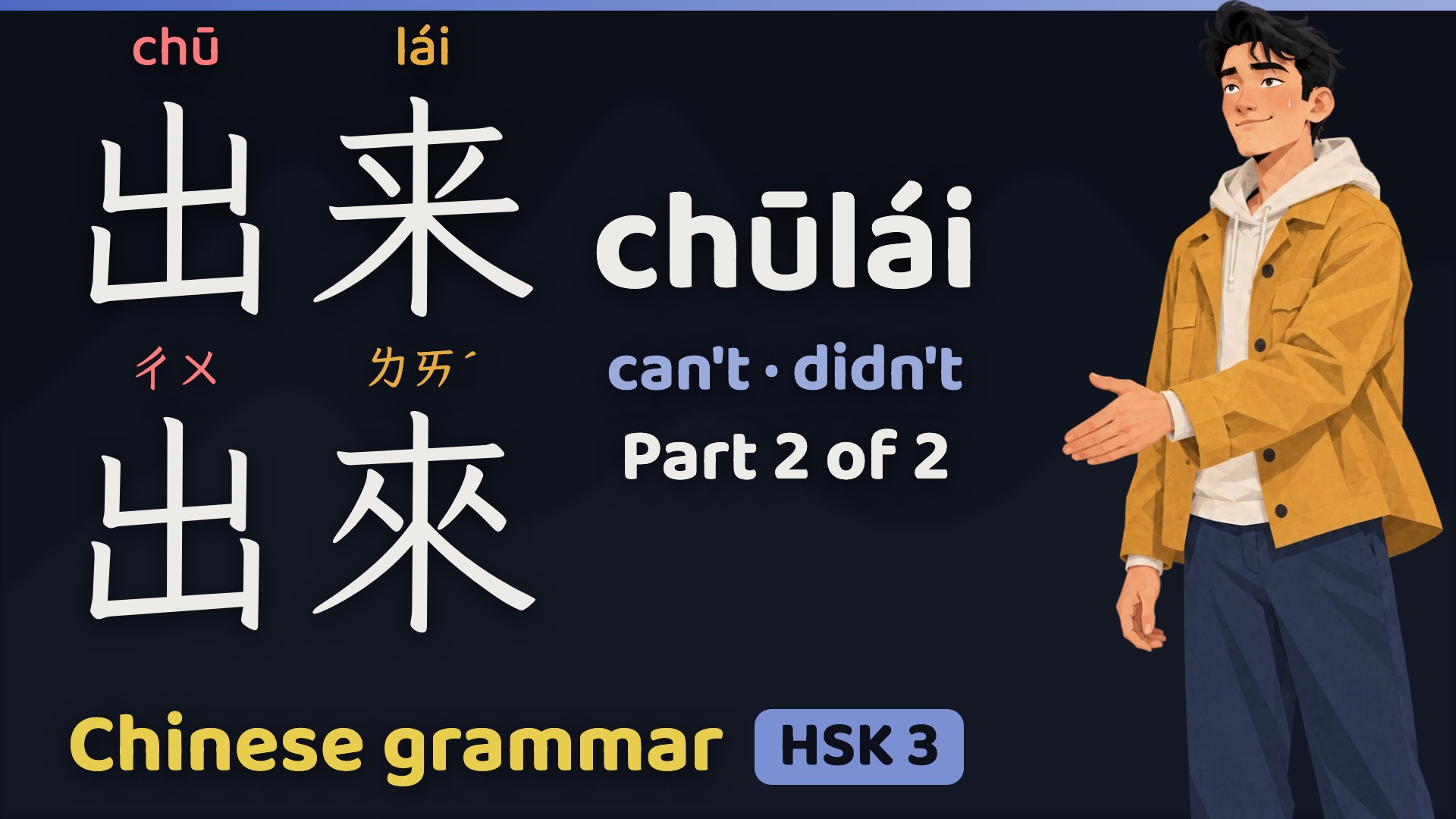
出来 (chūlái) goes straight after a verb. This second part shows how to say you can't or didn't work something out, the difference between 想不出来 and 想不起来, and where the object goes when it sits between 出 and 来, with example sentences broken down word by word.
The grammar guide: Chinese grammar: verb + 出来 (chūlái) construction
Chapters
Example sentences
Practise 练习
4 grammar exercises and 17 hanzi writing exercises.
Start without an account.
Start exercise 1 See all exercises
Free: 5 new Exercises a day. Pro: no daily limit. About Pro
Vocabulary list 词单
- Vocabulary list: Video lesson: Verb + 出来 (chūlái) for “can't”, “didn't” and more in Mandarin Chinese grammar, part 2 of 2 语法:出来、出、来 44 words and 9 example sentences
Exercises 练习
- Exercises: Chinese grammar: verb + 出来 (chūlái) construction 语法:出来、出、来 练习 1 hanzi writing exercise over 6 characters, and 1 grammar exercise over 1 item
Transcript
-
0:05
Ever met someone again and struggled to remember their name? We'll learn how to say that in Chinese. This is part two of our lesson on 'come out'. Here it is again.
-
0:14
出来。 Come out.
-
0:18
In part one, we put 'come out' straight after a verb. It can describe something moving out towards the speaker.
-
0:24
And sometimes a result comes out of the action, like an idea or a taste. Today we'll say we can't do something, or didn't. Then we'll compare two ways to get stuck, and put an object in the middle.
-
0:41
First, how do we say we can't do something? Let's hear it at a pub quiz.
-
0:47
这个问题太难了,我答不出来。
-
0:54
'This question's too hard, I can't answer it.' I was hoping for a question about food.
-
0:59
Let's go word by word.
-
1:02
这个。
-
1:03
This.
-
1:04
问题。
-
1:05
Question.
-
1:06
太。
-
1:07
Too.
-
1:07
难。
-
1:08
Hard.
-
1:09
“了”。
-
1:10
Here, this goes with 'too', for 'too hard'.
-
1:12
我。
-
1:13
I.
-
1:14
答。
-
1:15
Answer.
-
1:15
不。
-
1:16
Not.
-
1:17
出来。
-
1:18
Come out. The answer won't come out.
-
1:20
Once more. 这个问题太难了,我答不出来。
-
1:25
So 'not' goes between 'answer' and 'come out'. What about something that didn't happen?
-
1:31
Imagine a friend got a new haircut, and you walked straight past her. 我一开始没认出来是她。
-
1:43
'At first I didn't recognise her.' Awkward.
-
1:45
Let's go word by word.
-
1:48
我。
-
1:49
I.
-
1:50
一开始。
-
1:51
At first.
-
1:52
没。
-
1:53
Didn't.
-
1:54
认。
-
1:54
Recognise.
-
1:56
出来。
-
1:57
Come out.
-
1:57
是。
-
1:58
Is.
-
1:58
她。
-
1:59
She.
-
2:00
Once more. 我一开始没认出来是她。
-
2:03
So 'didn't' goes before the verb, and 'come out' stays after it. What about someone in disguise?
-
2:10
You don't need to memorise this sentence, but think of Superman. 他戴上眼镜,大家就认不出来他了。
-
2:22
'Once he puts his glasses on, nobody recognises him.' That's a lot of trust in a pair of glasses. Here, 'not' goes between the verb and 'come out' to give us 'can't'.
-
2:32
Here's a phrase you'll want to keep. It's a compliment. 你六十五了?真看不出来!
-
2:43
'You're sixty-five? I'd never have guessed!'
-
2:46
Let's go word by word.
-
2:49
你。
-
2:50
You.
-
2:52
六十五。
-
2:53
Sixty-five.
-
2:54
“了”。
-
2:55
Here, this means you've reached that age.
-
2:57
真。
-
2:58
Really.
-
2:59
看。
-
2:59
Look.
-
3:00
不。
-
3:01
Not.
-
3:02
出来。
-
3:02
Come out. With 'look' and 'not', that means 'can't tell by looking'.
-
3:07
Once more. 你六十五了?真看不出来!
-
3:12
You can't tell their age just by looking. Now, two ways to get stuck.
-
3:18
想不出来 means you can't come up with something. 想不起来 means you can't remember it.
-
3:26
Can't think it up, and can't remember. What's different about the second phrase?
-
3:31
The ending. 起 means to rise. It has ten strokes, and it's the same in simplified and traditional Chinese.
-
3:41
Which radical is it filed under?
-
3:43
Under the run radical, which wraps around the bottom left. The other part gives a hint of the sound.
-
3:50
Think of a memory coming back. First, let's try coming up with an idea.
-
3:55
Your team wants a better plan, and you're stuck. 我想不出来更好的办法。
-
4:04
'I can't think of a better way.' Nothing better comes out of the thinking.
-
4:08
Let's go word by word.
-
4:11
我。
-
4:12
I.
-
4:13
想。
-
4:14
Think.
-
4:15
不。
-
4:15
Not.
-
4:16
出来。
-
4:17
Come out.
-
4:18
更。
-
4:18
More.
-
4:19
好。
-
4:20
Good.
-
4:21
“的”。
-
4:21
This links 'better' to the way.
-
4:23
办法。
-
4:24
Way, or method.
-
4:26
Once more. 我想不出来更好的办法。
-
4:30
So no better idea comes to mind. And when you've met someone before, but can't remember their name?
-
4:37
Then you can't remember. 我想不起来他的名字了。
-
4:43
'I can't remember his name.' I'm hoping someone else says it first.
-
4:47
Let's go word by word.
-
4:50
我。
-
4:51
I.
-
4:51
想。
-
4:52
Think.
-
4:53
不。
-
4:54
Not.
-
4:55
起来。
-
4:56
Rise up. Here, the memory won't come back.
-
4:59
他。
-
5:00
He.
-
5:01
“的”。
-
5:02
This makes 'he' into 'his'.
-
5:04
名字。
-
5:05
Name.
-
5:06
“了”。
-
5:06
Here, this shows a change. I can't remember it now.
-
5:10
Once more. 我想不起来他的名字了。
-
5:13
You knew his name before, but you can't remember it right now. Time for a quiz. Which sentence means 'I can't remember'? Have a think.
-
5:32
It's this sentence. 我想不起来了。 The other sentence means I can't think of anything.
-
5:40
'I can't remember.' Picture a memory rising up, and a new idea coming out. Now for the object, like 'a book' in 'take a book'.
-
5:48
It can also sit between the two characters, with the same meaning. 她从包里拿出来一本书。 她从包里拿出一本书来。
-
5:59
Both mean 'She took a book out of her bag'. In the second sentence, the book sits between the words for 'out' and 'to come'.
-
6:08
Let's go word by word.
-
6:12
她。
-
6:12
She.
-
6:13
从。
-
6:14
From.
-
6:15
包。
-
6:16
Bag.
-
6:17
里。
-
6:18
Inside.
-
6:19
拿。
-
6:20
Take.
-
6:20
出。
-
6:21
Out.
-
6:22
一本。
-
6:23
One, or a. The second character is the classifier for books.
-
6:27
书。
-
6:28
Book.
-
6:29
来。
-
6:29
To come.
-
6:30
Once more. 她从包里拿出一本书来。
-
6:34
The order is 'take', 'out', 'a book', 'to come'. Can an idea go in the middle too?
-
6:40
Yes. Here's an idea, finally. 她终于想出一个好主意来。
-
6:51
'She finally came up with a good idea.' We can stop staring at the whiteboard now.
-
6:56
Let's go word by word.
-
6:59
她。
-
7:00
She.
-
7:01
终于。
-
7:02
Finally.
-
7:02
想。
-
7:03
Think.
-
7:04
出。
-
7:05
Out.
-
7:06
一个。
-
7:07
One, or a.
-
7:08
好。
-
7:09
Good.
-
7:10
主意。
-
7:11
Idea.
-
7:12
来。
-
7:12
To come.
-
7:13
Once more. 她终于想出一个好主意来。
-
7:17
This time, 'a good idea' goes between 'out' and 'to come'. What about the sentence we promised at the end of part one?
-
7:25
Here it is, for when you're too excited to speak. 她激动得说不出话来。
-
7:35
'She was so excited she couldn't speak.' Maybe she won the lottery.
-
7:39
Let's go word by word.
-
7:43
她。
-
7:43
She.
-
7:44
激动。
-
7:45
Excited.
-
7:46
“得”。
-
7:47
This links 'excited' to the result. She couldn't speak.
-
7:51
说。
-
7:51
Speak.
-
7:53
不。
-
7:53
Not.
-
7:54
出。
-
7:55
Out.
-
7:55
话。
-
7:56
Words.
-
7:57
来。
-
7:58
To come.
-
7:59
Once more. 她激动得说不出话来。
-
8:02
She can't get the words out. Let's recap both parts. After a verb, 'come out' can show movement towards us or a result. Put 'not' between the verb and 'come out' for 'can't'. Put 'didn't' before the verb.
-
8:14
想不出来 is for ideas, and 想不起来 is for memories.
-
8:21
And the object can sit between the two characters.
-
8:24
That's the end of our lesson on 出来.
-
8:28
Which sentence will you use first? Tell us in the comments. You can find every sentence from both parts at Chinese Boost dot com. See you next time!
-
8:38
下次见!
Chinese Boost Pro
Save as many words and example sentences as you like. Use Review and start new Exercises without daily limits. Your first subscription includes a 7-day free trial.
Sign up for a free Chinese Boost account
Save the words and sentences you find here to your own list, and hear them read aloud. You can export the list to your flashcards whenever you like.
Other articles about 出来
- Video lesson: Verb + 出来 (chūlái) for “come out” in Mandarin Chinese grammar, part 1 of 2 A2
- Chinese grammar: verb + 出来 (chūlái) construction A2