Video lesson: Verb + 出来 (chūlái) for “come out” in Mandarin Chinese grammar, part 1 of 2
视频课:动词+“出来”(一)
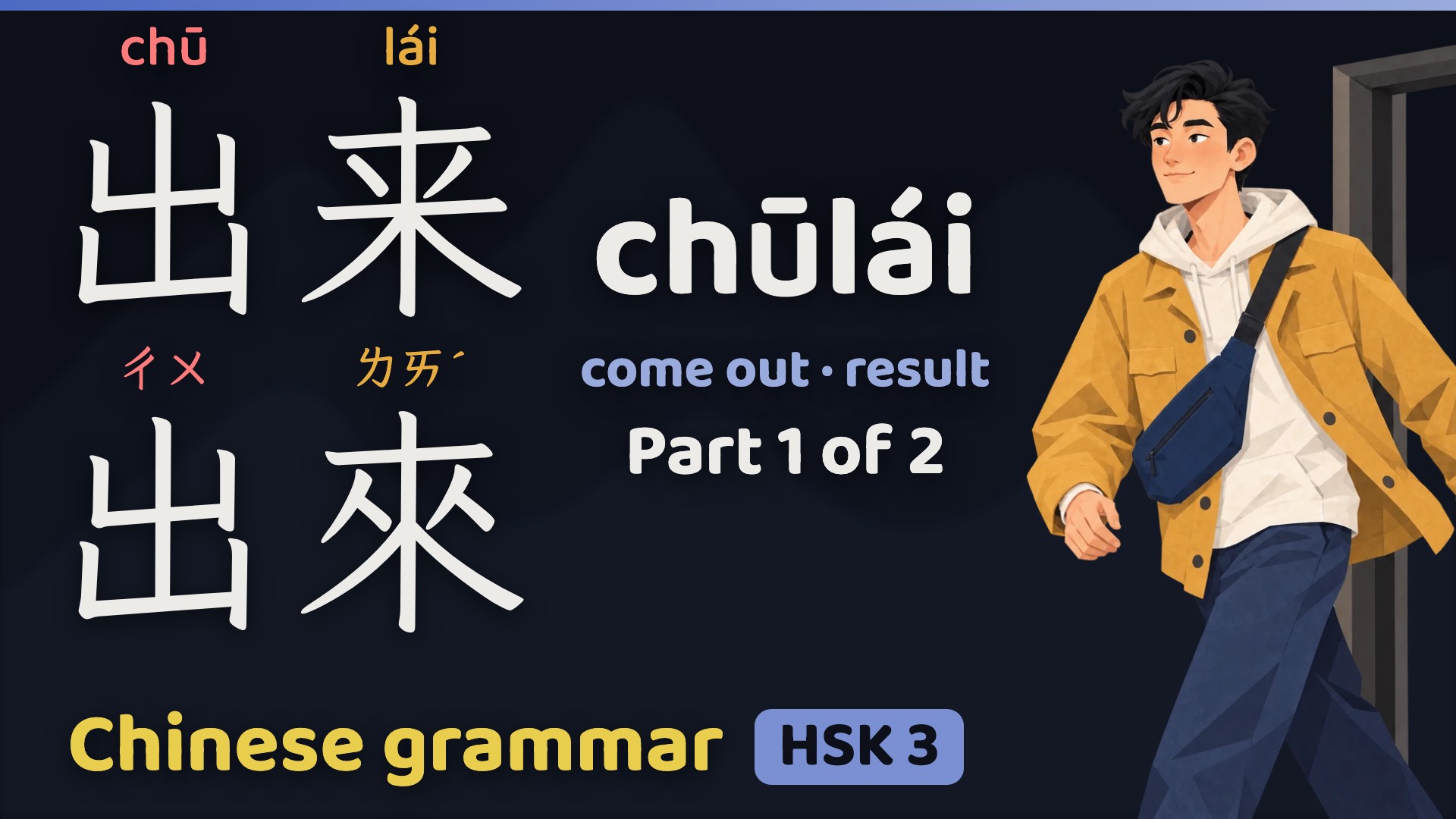
出来 (chūlái) means "come out", and it goes straight after a verb. This first part shows things coming out towards the speaker, then results coming out of an action, such as recognising a voice or coming up with an idea, with example sentences broken down word by word.
The grammar guide: Chinese grammar: verb + 出来 (chūlái) construction
Chapters
Example sentences
Practise 练习
2 grammar exercises and 15 hanzi writing exercises.
Start without an account.
Start exercise 1 See all exercises
Free: 5 new Exercises a day. Pro: no daily limit. About Pro
Vocabulary list 词单
- Vocabulary list: Video lesson: Verb + 出来 (chūlái) for “come out” in Mandarin Chinese grammar, part 1 of 2 语法:出来、出、来 46 words and 9 example sentences
Exercises 练习
Transcript
-
0:05
What do a prison escape and tasting garlic have in common? In Chinese, they can use the same word. Here's today's word.
-
0:12
出来。 It means come out.
-
0:15
This is part one of two. We'll start with things moving out, then see how the same word helps us talk about working something out. You don't need to catch every word. Listen for it after the verb in each example sentence. Let's start with the characters.
-
0:29
The first character is 出. It means out. It has five strokes, and it's the same in simplified and traditional Chinese.
-
0:39
It looks like two mountains stacked on top of each other.
-
0:42
It does! It splits into an above and below structure. The lower part is the open box radical, the radical it's usually filed under. Some explain its oldest form as a foot stepping out of an opening.
-
0:58
A foot stepping out. That's a good picture for 'out'. And the second character?
-
1:05
来。 It means to come. Simplified Chinese writes it in seven strokes. Traditional Chinese writes it a little differently, in eight.
-
1:15
And which radical is it filed under?
-
1:18
Usually the tree radical in simplified, and the person radical in traditional. Its oldest form is often explained as a drawing of wheat, and the word for 'to come' borrowed it for its sound.
-
1:32
So a drawing of wheat ended up meaning 'to come'. Put the two together and we get 'come out'. Where does it go?
-
1:39
Right after the verb. First the verb, then 出来.
-
1:45
And when something moves, does 'come' mean towards us?
-
1:49
Yes. The second character means the movement is towards the speaker, 出来. If it's away from the speaker, we say 出去.
-
2:02
So I'm outside in the garden, and you walk out of the house towards me. That's 'come out'. If I'm still inside and you leave, that's 'go out'.
-
2:10
Exactly. Here's the first sentence, about running. 他跑出来了。
-
2:19
'He ran out.' Out, and towards us. Let's go word by word.
-
2:24
他。
-
2:25
He.
-
2:26
跑。
-
2:26
Run.
-
2:27
出来。
-
2:28
Come out. Towards us.
-
2:31
“了”。
-
2:31
Here, this shows it's already happened.
-
2:34
Once more. 他跑出来了。
-
2:36
Run, then 'come out'. And if he ran out, away from us?
-
2:42
Then 他跑出来了 becomes 他跑出去了。
-
2:46
'He ran out', but away from us. Run, then 'go out'. The verb stays first either way.
-
2:52
This next sentence is about a prisoner. 一个犯人从监狱里逃出来了。
-
3:03
'A prisoner escaped from prison.' Lock the doors.
-
3:06
Let's go word by word.
-
3:09
一个。
-
3:11
One, or a.
-
3:12
犯人。
-
3:13
Prisoner, or criminal.
-
3:15
从。
-
3:16
From.
-
3:17
监狱。
-
3:18
Prison.
-
3:19
里。
-
3:20
Inside.
-
3:21
逃。
-
3:22
Escape.
-
3:23
出来。
-
3:23
Come out.
-
3:24
“了”。
-
3:25
Here, this shows it's already happened.
-
3:27
Once more. 一个犯人从监狱里逃出来了。
-
3:32
So it's 'from', then 'prison', then 'inside'. After that, 'escape' and 'come out'. What's the next sentence?
-
3:39
This next sentence is about a snack. 我从盒子里拿出来一块巧克力。
-
3:49
'I took a piece of chocolate out of the box.' Only one? Let's go word by word.
-
3:55
我。
-
3:56
I.
-
3:57
从。
-
3:58
From.
-
3:59
盒子。
-
4:00
Box.
-
4:01
里。
-
4:02
Inside.
-
4:03
拿。
-
4:04
Take.
-
4:05
出来。
-
4:05
Out.
-
4:06
一块。
-
4:07
A piece.
-
4:08
巧克力。
-
4:10
Chocolate. It sounds a bit like the English word, which in turn came via Spanish from an indigenous Mesoamerican language.
-
4:17
Once more. 我从盒子里拿出来一块巧克力。
-
4:21
Take, then come out. The chocolate comes out of the box and into my hand. Can 'come out' describe a feeling too?
-
4:28
Yes. This next sentence is for when you're nervous. 我那么紧张,感觉心都要跳出来了。
-
4:41
'I'm so nervous, I feel like my heart's going to jump out.' In English we might say our heart's in our mouth. Let's go word by word.
-
4:51
我。
-
4:51
I.
-
4:52
那么。
-
4:53
So.
-
4:54
紧张。
-
4:55
Nervous.
-
4:56
感觉。
-
4:57
Feel.
-
4:58
心。
-
4:59
Heart.
-
4:59
都。
-
5:00
Even. It adds emphasis here.
-
5:02
要。
-
5:03
Going to.
-
5:04
跳。
-
5:05
Jump.
-
5:05
出来。
-
5:06
Out.
-
5:07
“了”。
-
5:08
Here, this goes with 'going to', and means it's about to happen.
-
5:12
Once more. 我那么紧张,感觉心都要跳出来了。
-
5:17
So it's 'jump', then 'come out' again. Does this word turn up in any famous stories?
-
5:22
Yes, but you don't need to memorise this sentence. In Journey to the West, the Monkey King was born from a stone. 孙悟空是从石头里蹦出来的。
-
5:39
'The Monkey King burst out of a stone.' That's quite an entrance. 'Come out' follows the verb for 'burst'. And how does 'come out' work with an idea?
-
5:48
Here, 出来 isn't about moving. Something comes out of the action, like a result or some information.
-
5:58
So you think, and an idea comes out. Can we hear the difference in a sentence?
-
6:02
Here's the first sentence, about a plan. Without our word, it only asks whose idea it is. 这是谁想的主意?
-
6:14
'Whose idea is this?' The verb for 'think' is already in the question.
-
6:17
Now put our word after the verb for think. 这是谁想出来的主意?
-
6:26
'Who came up with this idea?' Adding 'come out' stresses that the thinking led to an idea. Should I be impressed or worried? Let's go word by word.
-
6:37
这。
-
6:38
This.
-
6:39
是。
-
6:39
Is.
-
6:40
谁。
-
6:41
Who.
-
6:42
想。
-
6:43
Think.
-
6:44
出来。
-
6:45
Come out. Here, the idea comes out.
-
6:47
“的”。
-
6:48
This links 'who thought it up' to the idea.
-
6:50
主意。
-
6:52
Idea.
-
6:52
Once more. 这是谁想出来的主意?
-
6:56
So 'come out' goes after 'think'. Here, they mean 'come up with an idea'. What about hearing?
-
7:03
This next sentence is about voices. Here it is with no one listening yet. 是他们的声音。
-
7:12
'It's their voices.' We haven't said how we know that yet.
-
7:16
Now put 'I can hear' in front, with our word after hear. 我能听出来是他们的声音。
-
7:28
'I can tell it's their voices', or, 'I can recognise their voices'. Listening gave me the answer. Let's go word by word.
-
7:36
我。
-
7:37
I.
-
7:38
能。
-
7:39
Can.
-
7:39
听。
-
7:40
Hear.
-
7:41
出来。
-
7:42
Come out. Here, it means I can tell.
-
7:44
是。
-
7:45
Is.
-
7:46
他们。
-
7:47
They.
-
7:47
“的”。
-
7:48
This makes 'they' into 'their'.
-
7:50
声音。
-
7:51
Voice, or sound.
-
7:53
Once more. 我能听出来是他们的声音。
-
7:57
So I can tell who's speaking just by listening. What about taste?
-
8:03
This next sentence is about cooking. 你能吃出来大蒜的味道吗?
-
8:11
'Can you taste the garlic?' If you can't, there isn't enough. Let's go word by word.
-
8:17
你。
-
8:18
You.
-
8:20
能。
-
8:20
Can.
-
8:21
吃。
-
8:22
Eat.
-
8:23
出来。
-
8:24
Come out. Here, it means detecting a taste.
-
8:26
大蒜。
-
8:27
Garlic.
-
8:29
“的”。
-
8:29
This links the garlic to the taste.
-
8:32
味道。
-
8:33
Taste.
-
8:33
吗。
-
8:34
This makes it a yes or no question.
-
8:36
Once more. 你能吃出来大蒜的味道吗?
-
8:40
The verb is 'eat'. Adding 'come out' tells us you can detect the garlic, or taste the garlic, as you eat. Shall we try another sentence?
-
8:48
This next sentence is about a puzzle. 他猜出来这个字的意思了。
-
8:59
'He's guessed what this character means.' One point to him. Let's go word by word.
-
9:05
他。
-
9:06
He.
-
9:07
猜。
-
9:07
Guess.
-
9:08
出来。
-
9:09
Come out. Here, he got the meaning right.
-
9:12
这个。
-
9:13
This.
-
9:14
字。
-
9:15
Character.
-
9:15
“的”。
-
9:16
This links the character to its meaning.
-
9:18
意思。
-
9:19
Meaning.
-
9:20
“了”。
-
9:21
Here, this shows something has changed. Now he knows.
-
9:24
Once more. 他猜出来这个字的意思了。
-
9:28
So he worked out the meaning by guessing. Time for one more quiz. Which sentence means 'I've worked it out'? Have a think.
-
9:47
It's this sentence. 我想出来了。 Without our word, it only means I thought about it.
-
9:55
'I've worked it out.' The other sentence means 'I thought about it'. It doesn't tell us whether I found an answer. That's the end of part one. In part two, we'll say what we can't work out, and try a different word order.
-
10:07
And a sentence for when you're too excited to speak.
-
10:10
Every sentence in this lesson is waiting for you at Chinese Boost dot com.
-
10:14
Follow us so you don't miss part two.
-
10:17
See you then!
Chinese Boost Pro
Save as many words and example sentences as you like. Use Review and start new Exercises without daily limits. Your first subscription includes a 7-day free trial.
Sign up for a free Chinese Boost account
Save the words and sentences you find here to your own list, and hear them read aloud. You can export the list to your flashcards whenever you like.