Video lesson: Where 一点儿 (yìdiǎnr) goes in a sentence in Mandarin Chinese grammar, part 1 of 2
视频课:“一点儿”放在哪儿(一)
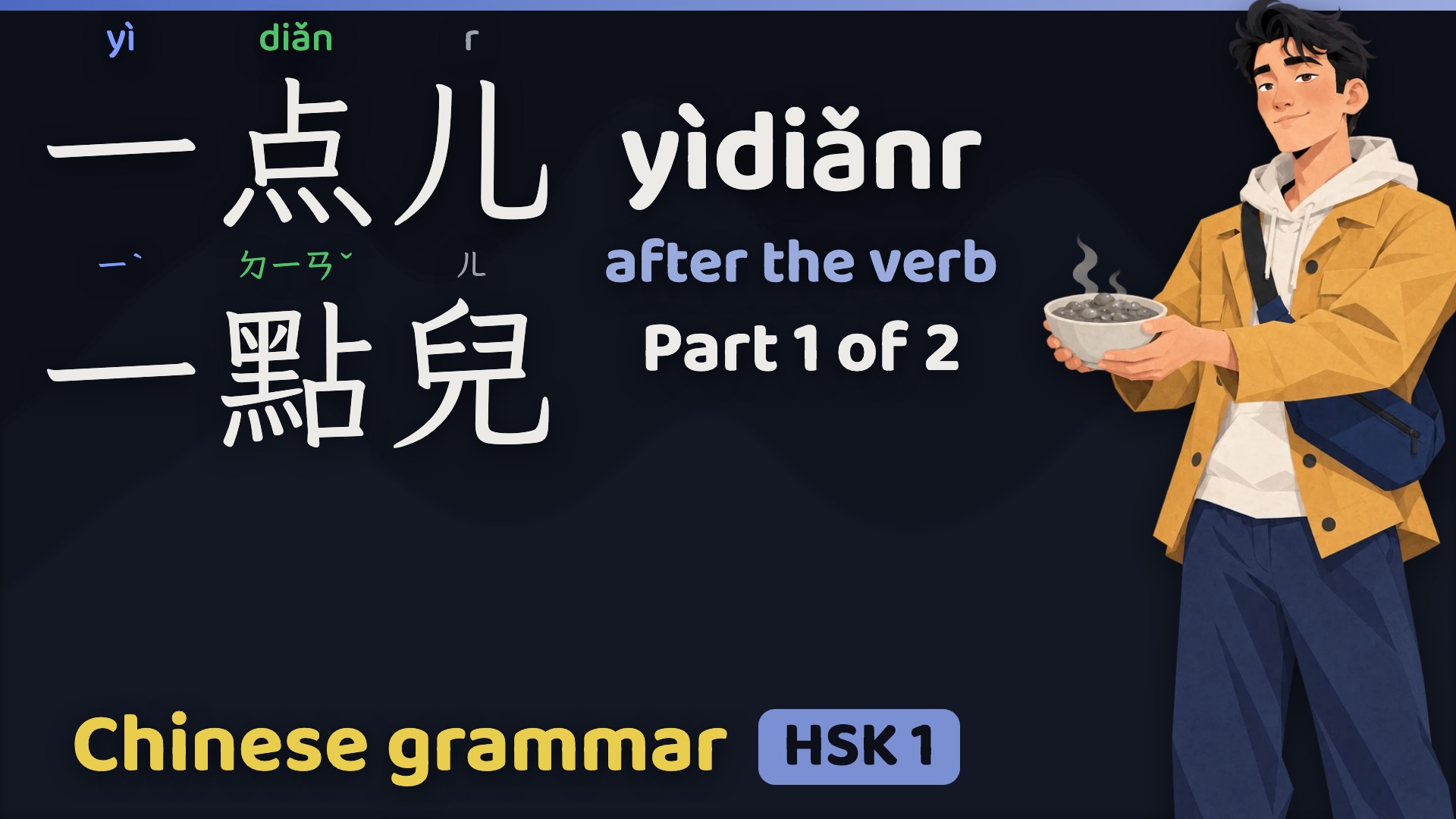
一点儿 (yìdiǎnr) means "a little", "a bit" or "some", and you'll hear it all the time in spoken Chinese. This first part shows where it goes in a sentence, straight after the verb and before the thing, with example sentences built up a word at a time, and how it makes a sentence sound modest or softer.
The grammar guide: Where to place 一点儿 (yī diǎnr) in a sentence
Chapters
- 0:00 一点儿 (yìdiǎnr)
- 1:33 一点儿 after the verb
- 3:47 一点儿 to sound modest
- 5:29 一点儿 to sound softer
- 7:22 Recap
Example sentences
Practise 练习
3 grammar exercises and 10 writing drills.
Start without an account.
Start exercise 1 See all exercises
Free: 5 new Exercises a day. Pro: no daily limit. About Pro
Vocabulary list 词单
- Vocabulary list: Video lesson: Where 一点儿 (yìdiǎnr) goes in a sentence in Mandarin Chinese grammar, part 1 of 2 语法:一点、一、点 20 words and 6 example sentences
Exercises 练习
- Exercises: Where to place 一点儿 (yī diǎnr) in a sentence 语法:一点、一、点 练习 1 drill over 2 characters
Transcript
-
0:05
Hello again! This is part one of two, on a word that means 'a bit'. You'll hear it in shops, restaurants, all over the place really. It's written with three characters. Here they are.
-
0:19
一点儿。 It means a little, a bit, or some. And it's one of the most useful things you can learn to say.
-
0:26
Listen for where 'a bit' goes in each sentence. You don't need to remember every sentence yet. First, let's watch it being written.
-
0:36
The first character is “一”, the number one, with a single stroke. The second is “点”, which means a dot or a bit. It has nine strokes, and the four dots at the bottom are a form of fire, the radical it's usually filed under. In traditional Chinese, it has the character for black on the left, and seventeen strokes.
-
0:58
So the first two characters give us 'one bit'. That's a nice way to picture it. What does the third character do?
-
1:05
The third one, “儿”, is a sound. It puts an R on the end of the syllable before it, the way people speak in Beijing. It's called 儿化。 Listen. 一点。一点儿。
-
1:19
Both mean 'a bit', with or without that R sound. We'll come back to the sound in part two. Where does the word go in a sentence?
-
1:30
Straight after the verb. Here's the first sentence, about being thirsty. Without it, you'd say: 我想喝东西。
-
1:40
'I'd like to drink something.' We haven't said how much.
-
1:43
Now let's put it after the verb for drink. 我想喝点儿东西。
-
1:50
'I'd like to have a drink of something.' Adding 'a bit' makes it sound more relaxed. Let's go word by word.
-
1:58
我。
-
1:59
I.
-
1:59
想。
-
2:00
Would like.
-
2:02
喝。
-
2:03
Drink.
-
2:03
点儿。
-
2:05
A bit, or some.
-
2:06
东西。
-
2:08
Something. Written with the characters for east and west.
-
2:12
All together once more. 我想喝点儿东西。
-
2:16
Wait, there's no number one at the front this time.
-
2:20
That's right. People often drop it when they speak, and both are fine. 喝一点儿。喝点儿。
-
2:26
Both mean 'drink a bit'. So the pattern is the verb, then 'a bit', then the thing.
-
2:34
Exactly. This next sentence is about lunch. 咱们吃点儿饭吧。
-
2:42
'Let's have a bite to eat.' I was hoping you'd say that. Let's go word by word.
-
2:50
咱们。
-
2:51
We. Including you.
-
2:53
吃。
-
2:54
Eat.
-
2:55
点儿。
-
2:56
Some.
-
2:57
饭。
-
2:57
Rice, or a meal.
-
2:59
吧。
-
3:00
This makes the sentence a suggestion, like 'let's' in English.
-
3:05
Once more. 咱们吃点儿饭吧。
-
3:08
Eat, then some, then the food. The same order as with drink. Quick quiz! Which of these is correct for 'I'd like to drink some water'? Have a think.
-
3:32
It's this sentence. 我想喝点儿水。 It goes after the verb, and before the water.
-
3:38
'I'd like to drink some water.' That's 'drink', then 'some', then 'water'. What else can 'a bit' do?
-
3:46
It's also how people talk modestly about what they can do. Here's the first sentence, about music. 我会打一点儿鼓。
-
3:57
'I can play a bit of the drums.' The neighbours have heard quite a bit. Let's go word by word.
-
4:06
我。
-
4:07
I.
-
4:07
会。
-
4:08
Can. As in, know how to.
-
4:11
打。
-
4:12
Hit. Here, play.
-
4:14
一点儿。
-
4:15
A bit.
-
4:16
鼓。
-
4:17
Drums.
-
4:18
Once more. 我会打一点儿鼓。
-
4:22
That's 'play', then 'a bit', then 'drums'. Saying 'a bit' can make you sound modest about your playing.
-
4:31
This next sentence is about an instrument with long strings. 他会弹一点儿古筝。
-
4:39
'He can play a bit of zither.' Let's go word by word.
-
4:45
他。
-
4:46
He.
-
4:47
会。
-
4:48
Can.
-
4:49
弹。
-
4:50
Pluck. Here, play.
-
4:52
一点儿。
-
4:54
A bit.
-
4:55
古筝。
-
4:56
A Chinese zither. The first character means ancient.
-
5:01
Once more. 他会弹一点儿古筝。
-
5:04
We use 'hit' for the drums and 'pluck' for this instrument. 'A bit' goes straight after either verb.
-
5:12
And here, it may not mean a small amount at all. He might play very well! It just makes it sound modest.
-
5:19
Like saying, 'I play a bit,' when you've been playing for twenty years. What does advice sound like without 'a bit'?
-
5:29
It softens advice too. Have you heard of the famous answer from Chinese boyfriends? Whatever's wrong, they say: 多喝热水。
-
5:38
'Drink more hot water.' Headache? Hot water. Bad day? Hot water. It's a running joke on the Chinese internet.
-
5:46
Add the word for a bit after the verb, and it sounds more caring. 多喝点儿热水。
-
5:53
'Drink a bit more hot water.' That sounds less like an order. The kettle's still doing all the work. Let's go word by word.
-
6:03
多。
-
6:04
More.
-
6:05
喝。
-
6:06
Drink.
-
6:06
点儿。
-
6:08
A bit.
-
6:09
热水。
-
6:10
Hot water.
-
6:11
Once more. 多喝点儿热水。
-
6:14
With advice or a request, 'a bit' can make you sound less bossy. Even when the person giving the orders is a robber.
-
6:22
You mean the film A World Without Thieves? A robber holds up a train, and the passengers can't stop laughing at him. So he shouts: 严肃点儿!
-
6:34
'Be a bit more serious!' A very polite robbery. This time, it comes after the word for serious, not a verb. There's more on that in part two. Let's go word by word.
-
6:48
严肃。
-
6:49
Serious.
-
6:50
点儿。
-
6:52
A bit.
-
6:53
Once more. 严肃点儿!
-
6:56
Time for one more quiz. Which sentence sounds less like an order? Have a think.
-
7:13
It's this sentence. 多喝点儿热水。 The word for a bit makes it gentler.
-
7:19
Even if it's still hot water. Let's go back over what we've seen. One: in today's sentences, 'a bit' goes straight after the verb and before the thing.
-
7:31
Two: it can make you sound modest, like playing a bit of the drums.
-
7:36
And three, it can soften advice and requests. That's the end of part one. In part two, we'll see where 'a bit' goes when we say who's getting something, as in 'give someone something'.
-
7:53
And why you'll hear that R sound more in the north.
-
7:56
If you'd like a bit more practice, you'll find all these sentences at Chinese Boost dot com.
-
8:02
多喝点儿热水,下次见!
-
8:04
'Drink a bit more hot water, and see you next time!' Bye!
Sign up for a free Chinese Boost account
Save the words and sentences you find here to your own list, and hear them read aloud. You can export the list to your flashcards whenever you like.
Other articles about 一点
- Video lesson: 一点儿 (yìdiǎnr) with two objects in Mandarin Chinese grammar, part 2 of 2 A1
- How to use 一点儿 (yī diǎnr) in Mandarin Chinese Grammar A1
- Where to place 一点儿 (yī diǎnr) in a sentence A1